


I got your email late last week. Well, Netflix’s email, the chipper corporate announcement about acquiring Warner Bros, addressed to me like we’re old friends catching up. “Hi Sofia,” it opened, before rattling off franchises like a grocery list: Harry Potter, Friends, Casablanca, Game of Thrones. A century of cinema reduced to brand names, tucked between Stranger Things and KPop Demon Hunters as if they’re all the same species of thing.
“What’s changing?” the email asked. “Nothing is changing today.”
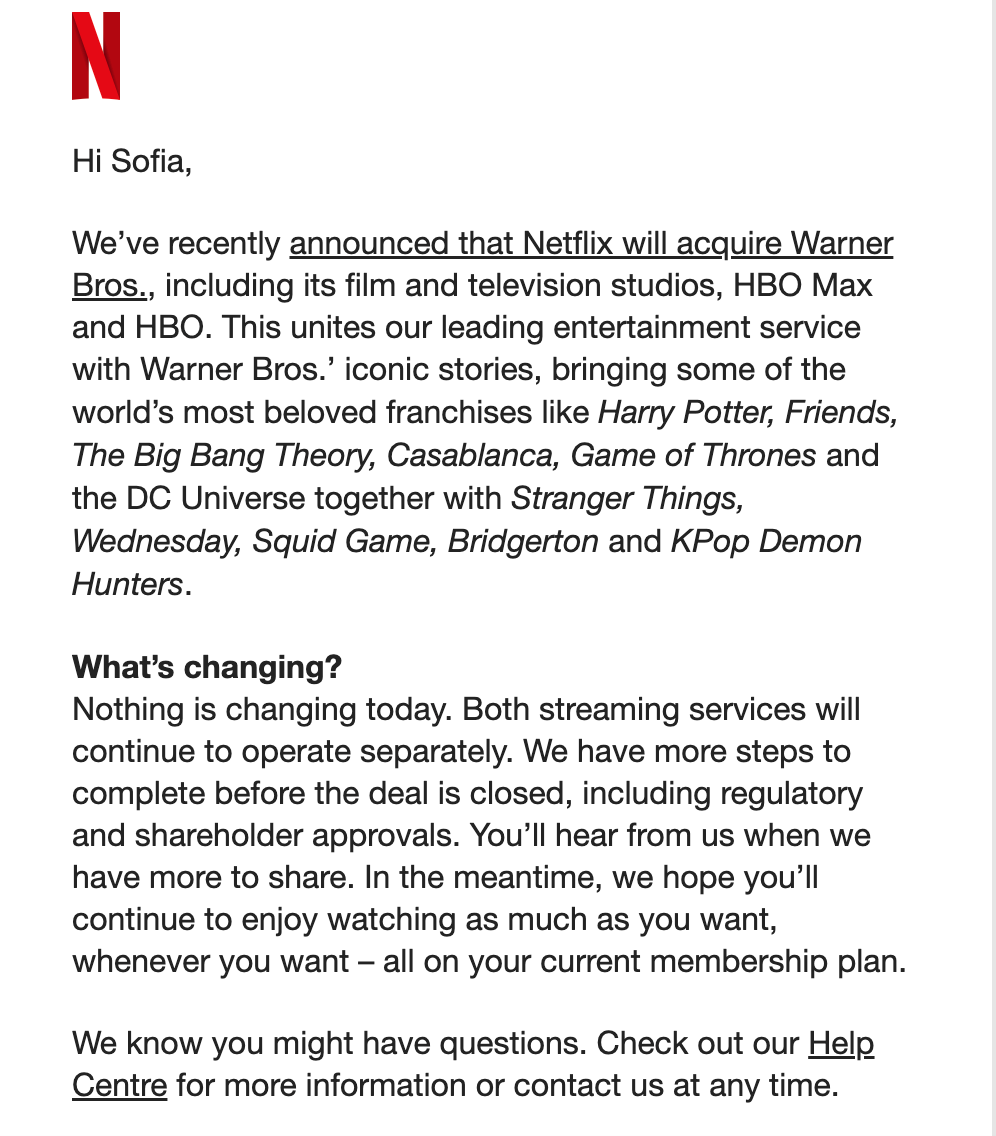
Today. That word’s doing cardio. Because obviously nothing changes today. The ink’s barely dry, regulators haven’t even begun their performance, shareholders need their approval theater. Today is safe. Today is a technicality. Tomorrow, next week, whenever the paperwork clears—that’s when we’ll discover what “nothing” actually meant.
Still, congratulations are warranted. $82.7 billion buys you 101 years of Warner Bros, the studio that gave the world The Wizard of Oz and Casablanca, that houses the DC Universe and basically invented the modern blockbuster. You’ve spent recent days on the press circuit, talking about “supporting theatrical operations”. Reassuring language.
Here’s what’s confusing me, though.
You’ve spent the better part of a decade making your position on theatrical exhibition remarkably clear. “Folks grew up thinking, ‘I want to make movies on a gigantic screen and have strangers watch them [and to have them] play in the theater for two months and people cry and sold-out shows…” An outdated concept, you called that. “The studios and the theaters are duking it out over trying to preserve this 45-day window that is completely out of step with the consumer experience of just loving a movie.” You’ve said this consistently, publicly, with conviction. Theaters are relics. Windows are anti-consumer. The future is people at home on their couches.
Which makes this acquisition perplexing.
You bought Warner Bros. A studio whose identity, whose purpose, is theatrical exhibition. Whose tentpoles require the big screen to justify their existence. Whose prestige relies on premieres and red carpets and opening weekend box office numbers that make headlines.
At the same time, you call yourself a cinephile. You grew up working video store counters, learning film through customer rental patterns. You sit on the Academy Museum board—literally a guardian of cinema history. You bought the Paris Theatre in Manhattan and the Bay Theatre in Los Angeles, those gorgeous historic venues, and told everyone you were “saving” them. You collect cinema like artifacts, display your love of film like credentials.
So what exactly are we supposed to make of this, Ted?
The confusion between Netflix’s business needs and cinema’s artistic needs is about to operate at unprecedented scale. I don’t know what you see when you look in the mirror, Ted. Do you tell yourself you’re saving cinema or are you disrupting it? Does the cognitive dissonance keep you up at night or have you’ve resolved it so completely that buying Warner Bros feels natural rather than contradictory?
But I know this: you’re about to have even more extraordinary power over how films get seen, and I want to understand the philosophy that will guide those decisions. So let’s go back through what you’ve actually said over about the theatrical exhibition in the last few years.
Because I think the gap between those two things is where Warner Bros is going to die.
I. the doublespeak
October, you told investors Netflix had “no interest in owning legacy media networks.” Two months later you’re signing a check for $82.7 billion to buy Warner Bros—the Platonic ideal of a legacy media network. That’s not a pivot, Ted. That’s whiplash. Either you had a Road to Damascus moment somewhere between Q3 earnings and the holidays, or you were lying then and hoping everyone would forget by now. What’s fascinating is you seem to think we won’t notice. Or maybe you’ve said so many contradictory things over the years that you’ve lost track of which version of the story you’re telling this week. Does it feel strange to U-turn that hard, or have you gotten so fluent in corporate doublespeak that your brain just auto-translates “never” into “in a few weeks”?
But whatever. Corporate lies, news cycle management, I get it. What frustrates me is how you announced this thing. You stood there and said Netflix has “always been builders, not buyers.”
While buying. Warner Bros.
I actually laughed when I read that. You’re standing there holding an multi-billion invoice and telling everyone you’re a builder. You can’t just buy the studio—you have to reframe acquisition as creation in real-time, asking everyone to accept that buying equals building, that the words mean whatever you need them to mean right now. Which tells me something about how language works in your head. It’s infinitely flexible, unmoored from fixed meaning. You lie to yourself first, then to us. You’ve convinced yourself acquisition equals innovation, so when you say “builders, not buyers” with a straight face, both things feel true simultaneously.
Your promise that Warner Bros films would “continue to go to theaters” lasted exactly one sentence before you added “windows will evolve to be more consumer-friendly.”
What. Does. That. Mean.
No seriously, answer that. Consumer-friendly means how many days? Forty-five like traditional studios? Thirty? Two weeks? Ten fucking days? What’s “continue” mean—wide releases in 4,000 theaters or limited runs in fifty art houses? And “evolve”—when you’ve spent the past ten years shrinking Netflix’s own windows to basically nothing—it’s a word that sounds biological. Inevitable. Like you’re describing natural selection instead of your business model eating another company’s infrastructure.
Windows don’t evolve, Ted. You shrink them.
You’ve been shrinking them for ten years, then pointing at the dead man and saying “see? Natural causes.” But “shrink” sounds aggressive and “eliminate” sounds honest, so you dress it up in Darwin.
You want to dismantle theatrical cinema but won’t say it because then you’d have to defend it. You’d have to argue that two-week windows are actually good for film as an art form (lol). You want the results without the fingerprints.
This ambiguous language that may protect you right now works beautifully when you’re managing investor expectations and dodging analyst questions. It falls apart when you’re sitting across from James Cameron, you know, the guy who called your strategy “fundamentally rotten to the core”, explaining how his next film is going to work under the Netflix model. I’d pay to watch you tell Cameron that “consumer-friendly windows” and “evolved theatrical strategies” are what’s best for his film. The man, whose films have made $7 billion at the box office, is going to listen to you explain why two weeks in theaters before streaming is so much better for cinema than the traditional model.
That conversation should go well.
Or maybe you’ll try it with Denis Villeneuve, who’s currently making Dune: Messiah for Warner Bros. You’ll sit down, probably in some very nice conference room, and explain that his $200 million epic about desert mysticism and political intrigue gets—what, exactly? The Glass Onion treatment where it played one week in theaters mostly so Netflix could pretend it cared about theatrical? Or something more robust, like, say, two whole weeks before it has to compete with KPop Demon Hunters Season 3 and Love Is Blind: Mars Edition on the Netflix homepage?
And then you’ll have to deal with the theater owners, AMC, Regal, Cinemark, Odeon. You’ll explain that Warner Bros films under Netflix still get “robust theatrical support,” which translated from corporate-speak means they’ll get whatever window Netflix feels like giving them that quarter depending on subscriber growth targets. The owners will ask if they can build marketing campaigns around their films, plan their summer around it, count on it anchoring their Q2 revenue. And you’ll give them...what specifically?
Those conversations don’t run on vague promises. They run on release calendars and booking windows and contractual language that specifies exactly how many screens, which markets, how many days. Filmmakers need to know whether they’re making a theatrical event or Netflix content with a theatrical formality attached. None of that operates on maybe, probably, let’s see how consumer preferences evolve.
So what’s the play? Stall until the ink dries? Bank on everyone forgetting you spent the last decade treating cinemas like Blockbuster Video, a relic we’re all better off without?
II. the philosophy
You’ve answered this question before, actually. Just not while trying to buy the studio. April 2023, earnings call, back when you were free to speak plainly: “Driving folks to a theater is just not our business.”
Woof. There's an entire ideology packed into that sentence, and I don't think you even realize it's there. "Driving folks"—like people are sheep who need prodding toward screens, like the act of going somewhere to watch a movie represents some kind of behavioral failure we need to correct. In your formulation, nobody chooses to go to a theater. They're driven there. By whom? Marketing campaigns? Social pressure? Some vestigial cultural programming left over from before Netflix taught us all better?
It's the language of someone who's decided that his preference is the natural order and everything else is artificial intervention. Staying home is the default human state, and theaters become this bizarre imposition requiring explanation and justification. Why would anyone leave their house when they could watch at home? It's not a question you're asking.
It's an answer you've already accepted as self-evident.
The framing erases an entire mode of experiencing art. Watching a film with a hundred strangers in the dark, feeling the room react together, hearing collective laughter or gasps or silence—that's not "being driven to a theater", Ted. That's seeking out a specific kind of engagement you can't replicate at home. It's choosing communal experience over isolated consumption. But in your grammar, that choice doesn't exist.
This is what happens when you build a business model and then retrofit reality to justify it. Netflix needs people to watch at home. Therefore watching at home must be what people naturally want. Therefore theaters must be an obstacle rather than a destination. The economic imperative creates a psychological truth that creates a moral framework. Convenience isn't just easier. It's more authentic to how humans actually want to experience film.
According to you, Netflix isn't destroying theatrical cinema. Netflix is liberating audiences from theatrical cinema. You're not the villain. You couldn’t be! You're the hero.
Except here's the problem with that story: If theaters are just friction and audiences don't actually value the communal experience and driving people to screens is futile resistance against natural consumer behavior, then Warner Bros' business model is built on a lie a century old. The tentpoles that keep exhibition chains solvent, the wide releases that drive cultural conversation, the theatrical windows that let films build audiences organically—all of it depends on theaters mattering in ways you've spent years insisting they don't.
So either you're about to discover you were wrong, or you're about to prove you were right by making Warner Bros stop doing the things that made Warner Bros what it is.
I'm guessing it'll be the second one.
III. the framing
Here’s another greatest hit from you.
April 2025, TIME100 Summit: “Theatrical exhibition is an outdated concept. Filmmakers who dream of packed houses are clinging to nostalgia, completely out of step with the consumer experience.”
You jumped from “not our business” to “outdated concept” pretty quickly. “Outdated” carries inevitability. Old things yield to new things, that’s just entropy at work. You’ve borrowed the vocabulary of technological obsolescence (Betamax, floppy disks, dial-up) and applied it to an aesthetic category. Slyyyyy trick. It makes your preference sound like natural law, while fighting streaming dominance becomes as futile as fighting the Second Law of Thermodynamics.
It’s amazing how you’ve positioned yourself as both observer and architect of this supposed obsolescence. You’re describing theatrical’s decline as if you’re a naturalist documenting extinction, all while being the meteor.
Very objective.
Very scientific.
The nostalgia thing is clever, I’ll give you that. Once you’ve labeled someone’s position as emotional rather than rational, you don’t have to engage with what they’re actually saying. Nostalgia is what children feel for childhood, what adults feel for their youth. It’s regressive, pre-rational, developmentally stunted. You’ve turned Villeneuve and Nolan into those people who still use rotary phones because they “like the sound.” You’ve turned their professional judgment into sentiment, which means you don’t have to take it seriously. They’re not wrong about what serves cinema; they’re confused about what audiences want.
You try to do what Lakoff calls strategic framing: whoever controls the metaphor controls the debate. You’ve chosen “outdated,” which carries temporal inevitability. That’s just how time works. Fighting it makes you Luddites raging against progress. The frame does all the work.
“What is the consumer trying to tell us?” you asked at that same summit. “That they’d like to watch movies at home, thank you.”
See, you don’t speak for audiences. Consumers and audiences want different things. Consumers want friction minimized. Audiences sometimes want friction maximized. They fly across countries for concerts, wait hours for restaurant reservations, plan vacations around sporting events. That friction is part of what transforms casual viewing into EVENT. It’s a feature, not bug. Their inconvenience signals their investment.
Choice is supposed to mean having options, and for a while there people actually did. They watched at home, watched in theaters, decided based on the movie or the mood or whether it’s raining. Everyone won. Except Netflix systematically made one of those options unviable for your films, treating theatrical like this inconvenient formality before the real release happens on the platform, and once you’ve engineered that outcome you point to it as proof of what consumers wanted all along. Imagine how this plays out for someone who loves movies, who wants to see something in a theater because that’s how it was designed to be experienced, and discovers their only option is scrolling through Netflix at home because you’ve decided their preference is outdated. That person didn’t get consumer advocacy—they got their choice eliminated and then got told they should be grateful for it.
Of course, you can’t say that part out loud. So everyone’s a consumer now, and consumers always optimize, and optimization always means convenience, and convenience always means streaming. The logic is airtight once you accept the premise. Which is why you never justify the premise.
You’ve flattened that complexity into a timeline where newer always means better. And I would agree with you if movies were just information transfer. Here are the images, here are the sounds, congratulations you’ve received the data. But they’re not, are they, Ted? Atmos and actual people breathing oxygen next to you hold different meaning than Casablanca on your phone on the subway. The delivery mechanism is part of the art.
You really do believe you’re the good guy here, I think. Disrupting an elitist industry, standing up for regular people who just want to watch movies in their pajamas, finally telling the truth about what consumers actually want instead of what Hollywood thinks they should want. You’ve said consumer consumer consumer consumer consumer consumer consumer consumer consumer consumer consumer consumer so many times in so many interviews that you can’t hear how it sounds anymore, how it’s become this thing you tell yourself so you don’t have to admit you’ve created monopolistic coercion and calling it consumer feedback.
VI. the truth
Ted, one last thing before I wrap this up. Could you help me understand something about this acquisition? I’ve been doing the math and it makes absolutely no sense—you borrowed $59 billion, your stock tanked the day you announced it, you’re absorbing Warner’s debt, and all to buy a studio whose theatrical business model, as evidenced in this letter, you’ve been publicly trashing for years while Disney and Paramount (who sort of believe in theaters but also maybe not, who knows) stood on the sidelines and watched you overpay for something they couldn’t figure out how to value. So either you’ve lost your mind or you’re buying something nobody else has figured out is worth buying yet.
I’m guessing it’s the second one because you didn’t become co-CEO of Netflix by making $82.7 billion mistakes, which means the question isn’t why you bought Warner Bros but what you’re actually planning to do with a century of intellectual property that has nothing to do with making Superman movies the way Warner Bros has been making Superman movies since 1938.
You said “innovation” six times on Friday’s investor call and “world-building” four times but never once said “generative AI” or “training data,” which is funny because Bob Iger stood up a few weeks ago and announced Disney+ subscribers can soon create and consume user-generated content and everyone understood immediately what that meant: Star Wars is becoming a meme factory, Mickey Mouse is getting fed into AI models, the future of entertainment is algorithmic remixing and Disney’s getting ahead of it by owning the source material.
You watched that and realized Netflix originals alone won’t cut it when OpenAI’s Sora and Runway and Google’s Nano Banana Pro let some seventeen-year-old in Nebraska type “Voldemort but he’s a therapist in Brooklyn” and get a feature-length film back in twenty minutes, personalized and optimized and FREE. That’s it, isn’t it? Your actual competition isn’t Paramount+ or Disney+. It’s the coming content apocalypse where everyone generates exactly what they want to watch and your entire economic model collapses unless you own the canonical versions of the characters people want to remix.
This is why you bought the relic.
Warner Bros gives you Harry Potter, DC Universe, Lord of the Rings, Looney Tunes, The Matrix, Game of Thrones, Friends, The Sopranos—a century-deep library containing virtually every genre and archetype and character type that Western popular culture has produced, which isn’t valuable because these are great films or important cultural objects but because they’re TRAINING DATA.
You need Batman and Superman and Gandalf and every other character that audiences have such deep parasocial relationships with that they’ll want to generate their own versions, and you need to control both the source material and the infrastructure for its infinite reproduction, and this is why you kept dancing around “world-building” instead of saying: we’re letting people generate endless content within these worlds and Netflix will be the platform where it all lives and we’ll take a cut of every algorithmic Batman that gets created.
The bit that’s hilarious is you killed theatrical to save streaming and now you’re spending all of this cash preparing for streaming to be killed by AI. You’re the guy who burned down the castle to win the battle only to discover the real war was with dragons and you just gave away your only defensible position. Theatrical exhibition created scarcity, made films into events, gave cinema cultural weight because you had to leave your house and sit with strangers in the dark and experience something together, and that scarcity had value (economic, aesthetic, the whole thing), but you eliminated it because you were so focused on beating Disney in the streaming wars that you didn’t notice you were destroying the only thing that made any of this culturally relevant.
You’re about to own 25% of the theatrical box office (which you’ll shrink to nothing within three years), HBO and Max (which you’ll fold into Netflix by 2027), and one of the most valuable training datasets in entertainment history (which you’ll use to teach machines how to replace human filmmakers entirely). I’d ask if you’ve thought about what it means to preside over both extinctions, first theatrical, then human creativity itself, but I think you have, and you’ve decided that if cinema’s going to die anyway you might as well be the one who profits from its corpse.
Which is a choice, I guess.
VI. the end
Warner Bros made The Wizard of Oz in 1939. Casablanca in 1942. Rebel Without a Cause in 1955. Bonnie and Clyde in 1967. The Exorcist in 1973. Batman in 1989. The Matrix in 1999. The Dark Knight in 2008. Every single one of those films exists because the cinema industry believed they mattered as something more than quarterly earnings, more than consumer convenience, more than data points feeding algorithms. You’re about to own that legacy, Ted. You’re about to own 101 years of filmmakers who believed movies were worth making the hard way, worth fighting for, worth giving audiences time to discover and fall in love with. And most likely you’re going to turn it into training data for machines that will make sure nobody ever has to fight for anything again because the algorithm will just give them exactly what they want before they even know they want it.
Do you love these movies, Ted?
Did you watch them growing up?
Were any of them the ones that made you want to work in this industry or the ones you bought the Paris Theatre to “save”?
Do you still feel anything when the lights go down and the screen glows and you’re sitting there with other people to react to something together?
If you do, here’s an idea: support actual theatrical runs. We don’t want to see two-week Oscar qualifiers, nor limited releases in five cities so you can say “ummm yes technically, they premiered in theaters”. We want wide releases with 90-day windows where people can plan their weekends around seeing great films on a screen bigger than their refrigerator. Let Warner Bros operate like Warner Bros instead of like Netflix’s content factory with more IP volume. Pay filmmakers what they’re worth instead of what your manufactured Top 10 says they’re worth. Build a model where streaming and cinema actually feed each other instead of one eating the other alive.
You’d make less money in the short term. Your stock wouldn’t love it. But you’d get to tell your grandkids you saved cinema instead of strip-mined it for parts. You’d get filmmakers actually wanting to work with you instead of taking your money while privately hoping Netflix goes the way of Quibi. You’d get to be the guy who figured out how to make both models work instead of the guy who killed one to prop up the other before AI kills them both anyway.
I don’t know if you’ll read this. But I needed to put it somewhere that when this all shakes out and we’re living in the world you’re building, someone will remember there was a moment when it could have gone differently.
All best of luck with the Paramount rival bid,
Sophie

Economic boycotts work! We saw it with Disney when the Jimmy Kimmel thing happened. You should absolutely protest with your wallet. That's the only language they understand.
I’m at a loss for words.
Your essays are so connected with the fabric of human life it’s palpable through the phone. The depth in which you article anger professionally while raging aggressively at what’s going wrong is unique. One day we’ll look back at this era and find your words as a snapshot of the times and historians will say a few stood against the giants, and this piece will find resurgence.
As for Ted, and this merger, if it must happen I vote for paramount to win. Maybe then they’ll be a chance. I see now the future depicted in Wall-E is a certainty and it’ll be made by Netflix.
Welcome back Sophie!