


A girl kneels in a chapel, alone with her doubts. Above her, the Virgin Mary presides, all plaster serenity and impossible perfection. The girl’s name is Marina, and though she doesn’t have the words for it yet, something in that alabaster gaze unsettles her.
It will take her decades to give that question voice. To put a name to the suspicion that the very ideal of womanhood she’s been taught to revere might be the thing that undermines women most. But as Marina Warner, feminist theologian and mythographer extraordinaire, she will spend a lifetime unraveling the threads of that sacred illusion.
In Alone of All Her Sex, her groundbreaking and much condemned study on Catholicism, Warner will peel back the layers of legend and doctrine that have shaped the Virgin Mary into the impossible paragon we know. She’ll show how the flesh-and-blood woman of the Gospels — who speaks a grand total of four times in the entire Bible1 — was gradually buried under layer upon layer of legend and doctrine and artistic reimagination until what remained was a shimmering chimera: the Eternal Feminine, the Queen of Heaven, the Madonna on her pedestal.
Warner will argue, with fierce and unflinching clarity, that this Mary, the impossible Mary, is a trap. A set of contradictions no woman can embody, a standard no mortal can meet. Be a virgin, but bear children. Be humble, but reign as queen. Be entirely without sin, but suffer more than anyone who ever lived, and do it all with a face that suggests you've just finished a particularly restorative yoga class.
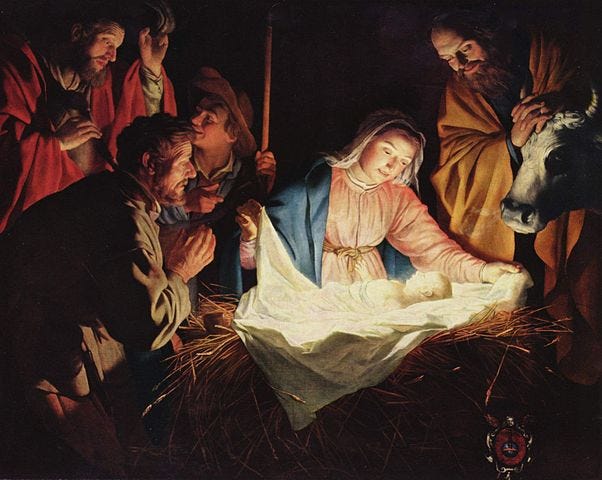
And the implications, Warner will insist, stretch far beyond the church walls. The Marian ideal had seeped into everything — into the mandate to be pure and selfless, into the exhortation to swallow your anger and call it grace, into every advertisement that promises you'll be closer to the divine if you just buy this particular serum, this particular supplement, this particular collagen that ships in packaging so minimal and delicate it could double as a reliquary. You can see the ghost of the Blessed Virgin in the “clean girl” aesthetic. In “trad wife” ideology. In every thirty-two-year-old on your feed who has somehow mastered her marinara and her cold plunge and her career in brand consulting and three children under five and yet still looks, at all times, like she has recently been lightly dusted with something heavenly.
She is Mary's daughter.
This is the truth Warner wants to shout from the rooftops: that the myth of the perfect woman, the impossible woman, is a toxin we’ve been imbibing for centuries.
Which brings us to the juiciest bit of the story. In 1976, Warner will end her book with a prophecy: the cult of Mary, she argued, was bound to fade as women became more emancipated and secular modernity advanced. But myths, as it turns out, are the great adapters. You can banish them from the church and they'll reappear at Sephora. As Warner will ruefully acknowledge in 2013 in a new preface of the book, her original prediction was wrong:
My closing assertion, that the cult of Mary would become, like the worship of Hera or Aphrodite or Artemis, a myth which no longer inspires belief, reads today as a hope at best, and a major historical error at worst.
She admitted, with scholarly grace, that she had underestimated her. The Virgin Mary did not fade. She simply changed clothes. And went on tour.
A house outside Dallas had a Virgin Mary on the mantel, plaster painted blue and white, her hands folded in permanent prayer. A seven-year-old David Lowery passed her every day on his way to the kitchen. He watched breakfast, watched homework, watched his father grade theology papers at the dining table while his mother set out dinner. Sundays meant mass at the cathedral downtown, the smell of incense and old wood, the Host on his tongue like a thin wafer of nothing that his father said was the literal body of Christ. You swallowed it. You walked home. Nobody thought it was strange.
His father taught moral theology at the University of Dallas and brought the work home with him. Aquinas at dinner. Augustine over coffee. Long debates about double effect and just war theory and whether contraception violated natural law, arguments that could stretch through dessert and into the evening while David sat there not following all of it but absorbing the vocabulary, the rhythm, perhaps the assumption that these questions mattered more than anything on television or the radio.
The rule about music came down when he was maybe ten or eleven.
My parents wouldn't let me listen to modern music when I was growing up, so I missed out on Michael Jackson and Madonna.
He didn’t push back because pushing back wasn’t something you did in a house where your father’s job was teaching people what God wanted. So when 1989 came and Madonna released Like a Prayer and the whole world caught fire—when the video premiered on MTV with burning crosses and stigmata bleeding on her hands and a Black saint stepping down from his niche to kiss her while a gospel choir sang and the set burned behind them—David was twelve years old in Texas doing algebra homework and he never saw it.
He heard about it later, of course. He heard that Pepsi had given her five million dollars for a commercial that premiered at the Grammys, aired once on The Cosby Show, and was yanked off the air as Christian groups called for a boycott of Pepsi and all its subsidiaries. And then, a year later, when she took the Blond Ambition tour to Italy, he heard that Pope John Paul II — the most Marian pope of the modern era — had called the show "one of the most satanic shows in the history of humanity”.
But he didn’t see the video. What his parents were protecting him from, exactly, he wouldn’t understand until years later when he finally watched it on a friend’s computer and realized it wasn’t sacrilege. It was someone who exuded bread becoming flesh, wine becoming blood — exactly the way his father had taught him to understand it. Madonna knew what happened at mass. She'd swallowed the same Host that dissolved on Lowery's tongue like paper, weightless, there and gone in seconds. And she put it on MTV.
He left the church eventually and started calling himself an atheist, though he qualified it—an atheist who believes in ghosts. He now makes films about bodies that refuse to stay put. In A Ghost Story a man dies and comes back wearing a bedsheet, unable to leave the house where his wife is mourning him. The Green Knight follows a medieval knight whose visions might be divine or might be fever—the film never tells you which.
His latest, Mother Mary, explores the complex relationship between a fictional pop star and her estranged costume designer. Lowery may have missed Madonna in 1989 but she got in anyway. The thing you're not allowed to hear is always the thing that furnishes your imagination most lavishly.
The Colorado Desert thrummed with anticipation in April. Sabrina Carpenter, the 26-year-old pop sensation, was midway through her Coachella set, the crowd pulsing to the beat of her 2024 hit “Juno,” when she paused. “I have a very, very special guest,” she teased.
The name that left her mouth next sent a ripple of shocked delight through the crowd: Madonna.

And there she was, the 67-year-old queen of pop provocation, rising from beneath the stage as if summoned by some divine force. She emerged in a purple corset over a lacy camisole, long gloves, thigh-high stockings, and tall boots—the exact ensemble, she told the crowd, that she had worn at Coachella twenty years earlier when she first performed Confessions on a Dance Floor in America. "The same boots, the same corset, the jacket I had on earlier, the same Gucci jacket," she said. "It's like a full circle moment."
Pop cultural memory, quite literally, made flesh — and crucially, made by her, on her, for her. The saint had become her own reliquary.
"Strike a pose," she commanded, and the audience obeyed.
She'd learned the ritual early. Little Madonna Ciccone in her Catholic school jumper, kneeling dutifully at mass, a child's mind already flickering between the Virgin Mary and Marilyn Monroe, the martyr and the bombshell. Forty years on, writhing on arena stages in a blaze of religious and erotic symbolism, she had never lost her knack for the so called transubstantiation. When the Vatican condemned Blond Ambition in 1990, she held a press conference at Rome's Ciampino airport and refused to back down. Her show, she said, was "a theatrical presentation of my music, and like theatre, it asks questions, provokes thought, and takes you on an emotional journey." She invited the clergy to come and judge for themselves. They did not RSVP.
But there was something else happening during that set too. As the gospel choir materialized for the obligatory Like a Prayer, the crowd energy felt and looked oddly muted. Phones stayed aloft, yes, but bodies stayed strangely still, writes Wren Graves.
No doubt everyone wanted to film an amazing concert — probably the kind where the crowd went wild and clapped along. Except everyone was above the actual labor of putting on a show, even when Madonna and her gospel choir joined their hands in the direction of the audience.
It was as if forty thousand people were experiencing, in real time, the particular confusion of encountering a living relic — do you sing along, or is that disrespectful? Do you dance, or do you document? Do you worship, or do you just try to get a shaky video for your story and figure out the caption when you're back at the glamping tent? Do you dream her, or does she dream us?
And then, in a blink, she was gone, leaving Carpenter alone again under the lights, blinking as if waking from a lucid dream. “It’s like… what do you do after that?” Carpenter quipped to the crowd.
“I need a drink.”
In Marina Warner's telling, the Virgin Mary is at once queen and concubine, untouchable mother and eroticized maiden, an icon whose very contradictions serve to elevate her above the messy realm of womanhood. In Mother Mary, David Lowery transposes this impossible woman into a 21st century key, dressing her in haute couture and sending her out on stage to be worshipped and consumed anew.
I'm sitting in the dark, watching Anne Hathaway's Mother Mary rise from the depths of the stage, a wire-crowned martyr in sequins and lace. From the moment she struts on screen — haloed and beatified, draped in something between a couture gown and an artifact — I can feel that Lowery has something bigger in mind than a pop star character study.
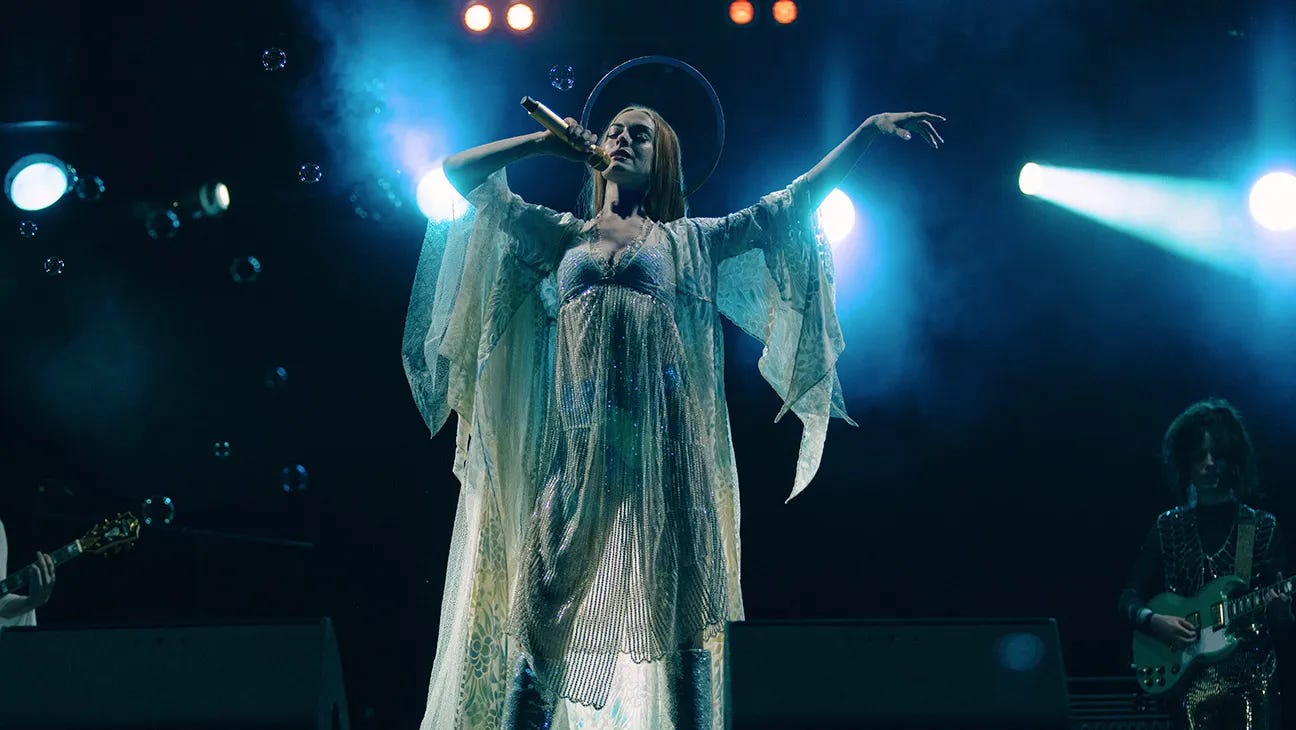
Her trademark is the circular headpiece floating behind her neck like a saint in a fresco. She’s a kind of pop demigod channeling our fantasies of saintliness and sin. The crowd's adulation has this Eucharistic quality to it, this fervor of communion, as if they are consuming her body and her blood and her image and her story with every beat, and I can't look away.
Idols, though, are built to shatter — ask any Catholic kid who has ever watched a nativity figurine slip from their hands on Christmas Eve and felt, for one horrible second, that they'd broken God. Lowery doesn't show us the crisis itself, which I think is a beautiful choice; he lets the aftermath do the talking, and it saturates every frame. Mary flees to the rural workshop of Sam (a stunning Michaela Coel), the reclusive designer who created her early looks and was later excised from her mythology. What unfolds between them is part reunion, part exorcism — a night-long reckoning with the origins of Mary's persona and the costs of Sam's erasure.
These scenes are where Warner's scholarship climbs quietly into the film and sits down and starts unpacking. Watching Mary and Sam circle each other through the ruins of their collaboration — the costumes, the concepts, the shared vision that made Mary's icon possible in the first place — you keep finding yourself back at Warner's description of the Virgin as a "collage of female perfections" assembled by unseen hands. Sam is those hands. She is the artisan behind the image, the seamstress behind the saint, and like every woman who has ever done the invisible labor of making another woman look effortless, she has been thanked for her service by being written out of the story entirely.
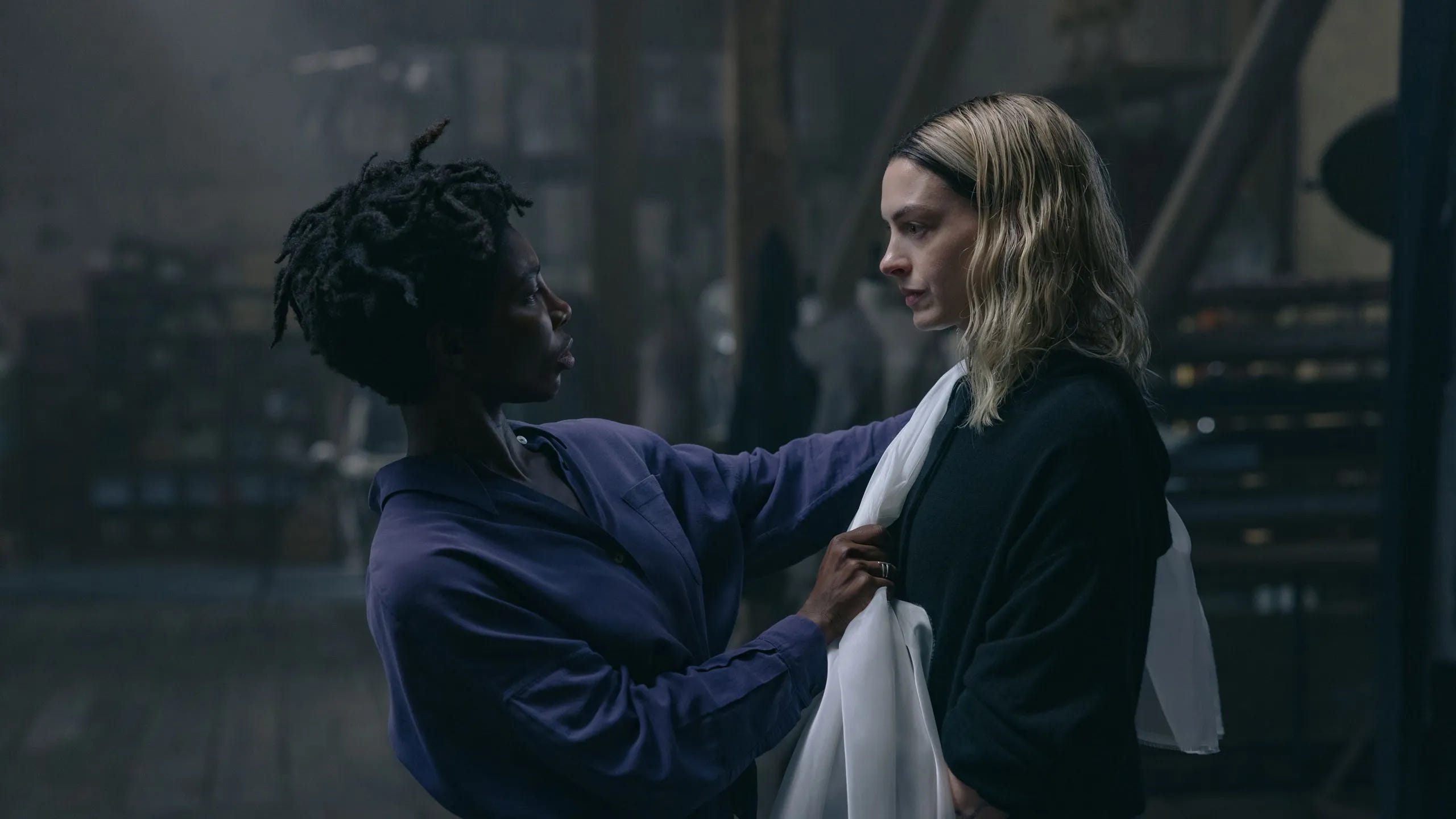
These questions come to a head in the film's most audacious sequence, a one-of-a-kind anti-musical number in which Sam demands that Mary perform her latest choreography in silence, stripped of all sonic and spectatorial artifice. Hathaway's body becomes a pure vessel of pop ritual, a site of ecstatic self-abnegation. It's extraordinary to watch, and it's also a very precise little essay about how we consume our pop goddesses — we love them as image, as gesture, as surface, we peel away the human underneath layer by layer until what's left is the smooth, luminous icon and nothing else.
A face on a billboard selling something it doesn't believe in.
A woman the whole world recognizes on stage and nobody knows.
As the night deepens, Sam pours herself into what will be her final creation for Mary — a gown that Lowery has described, in interviews, as the symbiotic fusion of artwork and artist. "The dress is the song," he’s said, in the sense that the garment and the body and the music and the myth have become so thoroughly entangled that trying to separate them would be like trying to unfold a paper crane back into a flat sheet.
I now find myself circling the question the film keeps circling. Is Sam creating Mary, or is she consuming her? Is she Pygmalion or Galatea? Is she worshipping her or weaponizing her?
Lowery, ever the sly subversionist, keeps blurring the lines the two, which I think is the only realistic thing you can do when your subject is an archetype that has survived two thousand years by being flexible enough to absorb every juxtaposition. What does it mean to be an object of worship and a target of destruction, a vessel for the culture's fantasies and a scapegoat for its fears? How do you find your way back to yourself when your very self has been fragmented into a thousand shimmering pieces, each one reflecting a different impossible ideal?
Nowhere is that tension more apparent than in the film’s bravura final sequence. In a moment of ecstatic self-annihilation, Mary takes the stage for her comeback, risen, glittering, and for a moment the illusion is total. She is the phoenix, she is the goddess, she is everything we ever wanted her to be. And then she strips it all off — the halo, the costume, the scaffolding of her image — to the visible distress of the team whose job is to keep her wrapped. She sings her new song to a crowd that is applauding, when you really think about it, the shape of its own longing.
The woman herself has dissolved. She is nowhere and everywhere, absorbed into her own iconicity. The impossible woman is always, already, an absence. She is a projection we generate together, a hallucination dressed in couture, and we are all of us inside it.
My mother had my first sister when she was twenty-two, in a small flat in Kypseli with a balcony that looked onto other balconies, laundry hanging between buildings like flags nobody had agreed on the meaning of. She was young enough that her own mother kept showing up unannounced to check the baby wasn't being held at the wrong angle. My second sister arrived two years later. By then my mother had learned to time the visits, to have the flat already spotless before her mother walked in so there'd be less surface area for criticism. Then the marriage ended and she was alone with two girls under five in a city that had very specific, very vocal opinions about women raising children without husbands.
She met my father a few years later. Married him. Had me, then my brother. Worked through all of it — admin jobs where you answer someone else's phone and keep someone else's diary and make someone else look competent while your own life runs on Nescafé and the silent arithmetic you do at the supermarket to see whether you can afford the good olive oil this week or whether it's the own-brand one again (the one that tastes like it was pressed reluctantly). I have one memory of her sitting down during the day and it's only because my grandmother physically lowered her into a chair after she came home from minor surgery and immediately tried to start folding laundry. She was still holding a pillowcase. She looked confused by the sitting, as if her body had been interrupted mid-sentence.
What I remember most is her standing in front of the mirror in the hallway, pulling at her stomach. She’d do it in the morning before work, at night before bed, any time she passed it. I was maybe seven, standing there watching her, thinking: what is she looking for?
She’d apologize to guests for the state of the house when the house was spotless. She’d serve dinner and apologize it wasn’t fancier. She’d come home after a full day, cook, clean, help with homework, fold laundry, get us bathed and into bed, and then sit on the edge of her own bed and tell my dad she felt like she wasn’t doing enough. Enough of what, I couldn’t tell you. We were fine. The house was fine. We ate. We had clean clothes. We felt loved. But the gap between what she was doing and what she thought she was supposed to be doing was where she lived.
And here’s the thing I didn’t understand until I started pulling at this entire story: the gap is the design.
My mum was doing what women have been doing for thousands of years — measuring herself against a standard that was never meant to be met, because a standard you can meet is a standard that can't sell you anything anymore.
The Virgin Mary couldn't be the Virgin Mary; she was an idea that men assembled over centuries and credited to a girl who barely speaks in the source material. Madonna is not Madonna alone — Patrick Leonard co-wrote the songs, Stuart Price produced the albums, Jean Paul Gaultier made the cone bra, a hundred collaborators built the spectacle and then stepped out of the spotlight while she absorbed it. In Lowery's film, the dress goes onstage and Mary removes the halo and Sam, who sewed every sequin of that dress, stays behind in the workshop, invisible.
And the women you watch living it — the ones who seem to have “figured it out” — they're not doing it alone. They have nannies and cleaners and meal prep deliveries and personal assistants and someone who presses the linen and someone who holds the ring light at the right angle so the kitchen looks twice its actual size. They all have a Sam. And the Sam, always, stays out of the frame. That is the gap.
If you're still reading this hoping I'm about to tell you how to fix it, I can't, and I think anyone who says they can is probably trying to sell you a very tastefully packaged something. But if we were sitting together right now, and I'd poured us both a glass of red, I'd want to ask you some questions.
What if the gap is the correct response to an impossible demand? What if you let your wrinkles accumulate like evidence? What if you let your stomach carry the soft record of having held children inside it, or of simply having lived for however many years in a body that eats and rests and takes up exactly the space it needs? What if your mother wasn't failing, and you're not failing, and the seven-year-old watching you from the hallway isn't learning that she's doomed to fall short — she's learning that falling short is what women do, and if nobody interrupts that lesson, she'll hand it down like a heirloom?
Now I’m the one standing in front of the mirror making that sound my mother used to make, somewhere between a sigh and an apology, and when there’s a kid watching, they’ll be learning something from it too. I know, somewhere in the part of me that isn’t afraid of the mirror, that I can choose what happens next.
So can you.

If you enjoyed this essay and value this sort of writing, please consider upgrading to a paid subscription! Or else I might have to try harder to make money — yuck. Imagine me, a frail, sensitive, artistic type, sitting in front of a computer screen all day trying to figure out how to monetize Facebook ads. Torture!
To Gabriel at the Annunciation: “How shall this be, seeing I know not a man?” (Luke 1:34)
To Gabriel: “Behold the handmaid of the Lord; be it unto me according to thy word.” (Luke 1:38)
The Magnificat at the Visitation (Luke 1:46–55): “My soul doth magnify the Lord… he hath put down the mighty from their seats, and exalted them of low degree; he hath filled the hungry with good things; and the rich he hath sent empty away.” (Note: ancient manuscripts disagree about whether Mary or Elizabeth speaks the Magnificat; Adolf von Harnack argued in 1900 for Elizabeth.)
To the twelve-year-old Jesus in the Temple: “Son, why hast thou thus dealt with us?” (Luke 2:48).
At Cana, to Jesus: “They have no wine.” And to the servants: “Whatsoever he saith unto you, do it.” (John 2:3, 2:5).
AHHHH. You did it againnnn. Not me over here squee-ing and fangirling all over this piece... 😬 But shiiit. This one really nailed all the moving parts for me.
I haven't seen the film, but as a raging feminist and someone who grew up choking down the body of Christ while simultaneously worshipping Madonna way more devoutly, this essay was brilliantly woven together. The infallible pop girlie who absorbs the worship and credit of an entire team has been something I have been thinking about for a long time, and it’s strange how even more dystopian and cult-like it has become during these last decades of economic and cultural depression (cue morning-after Met Gala discourse). I loved this essay, and while I haven’t been reading/following your writing for long, this legitimized my fangirl status.