


Picture this man: Handsome as an expensive watch and unhappy as one, wound up tight. His job is to steal the dreams, to father the bombs (in leaner years, the magic). His wife is dead. If she isn't, give it an act. She keeps visiting him in blue light, wearing the dress she had when the clocks were better, and each time the plot pauses expectantly to let him suffer at the largest possible aspect ratio.
He is obsessed. He is guilty about the obsession. It is the source of the crime that defines his decades, that rotates them; guilt is the permanent address. Memory is the climate he finds himself in, and time behaves badly around him, running backward and looping back and folding itself into neat boxes that he builds and then becomes imprisoned within. Women orbit him, glowing, distantly, exerting tidal forces on the parts of his conscience that only emerge at night. Over three hours, he will speak a few words about his feelings, and each is an exercise in exposition about himself.
You know him. You have bought tickets to his grief, ever since the Clinton administration, in varying ratios of scale and scope.
Can you name him?
If you said Leonard Shelby, you would be right. If you said Cobb, you would be right, too. Bruce Wayne, yes, the sad magicians are all in there, right down to Oppenheimer, and congratulations on the recency bias. The portrait is fair for all of them, it stretches to the proportions of nearly three decades of movie making in a single man, and I mean this as a compliment: no other filmmaker in Hollywood has invested three decades and a large part of his budget in building the same beautiful sad lighthouse, over and over, refining his obsession, his own unhappy features, buying him oceans so that he may be lonely in them. Other directors have themes. Nolan has a tenant. I mean this as a compliment! I have paid to see him do it every single time.
He'd be the first one to tell you so himself. Promoting The Odyssey, he told the New York Times this film is "the ur-text. It's in everything I've done before." He said something similar to he LA Times, noting, "I've been telling this story in all my films for years."
He cast Matt Damon in the role, in part, because Damon is also Jason Bourne. He even told a journalist this. I get it. Damon has been playing him in a franchise where he spends his time trying to figure out who he really is, and he plays that hollowed-out wanting really well. If your Odysseus is a soldier who lost himself in a war, you call Damon and you call it a day (he was very good by the way).
Nolan opened one of the oldest poems in the Western canon and found the man he'd been filming since Memento already inside it, waiting. I booked opening night in a dusty Odeon, the only place I’d managed to grab a pair of tickets. Seated.
samantha morton supremacy
So let me start with the things I liked. The score is so good in the film. Göransson did something I did not think was possible in a studio movie at this budget, which is that he made the music sound like it came from the world onscreen. How cool! You know the feeling of watching a period film and the strings swell and you’re suddenly aware you’re watching a movie, because no one in ancient Greece had access to a hundred-piece Romantic orchestra and your brain clocks the anachronism even if you don’t consciously register it? Göransson eliminated that entirely. He built the score out of bronze gongs and struck metal and a reconstructed ancient pipe called an aulos, and then layered James Blake’s voice over the top of it, and the result is something that sounds wet and old and percussive, like someone dug it out of the ground. During the Cyclops sequence the low frequencies went through my ribs. I have heard this poem chopped into anecdotes between courses since I was small enough to sit on a phone book at the table, and I have never once heard the Odyssey sound like this. It sounded like the inside of a cave. It sounded like the inside of a ship. Good job, Ludwig.
Troy burned (that statue head chop shot 😮💨) and the heat was in the room. Samantha Morton’s Circe grabbed soldiers by the face and moulded their features into pig snouts with her bare hands like a potter working clay, and I HAD to turn away. We hit real good turbulence with this one. These were the most impressive minutes of the film and they were islands themselves.
Stranded inside three hours of ocean with no current connecting them.
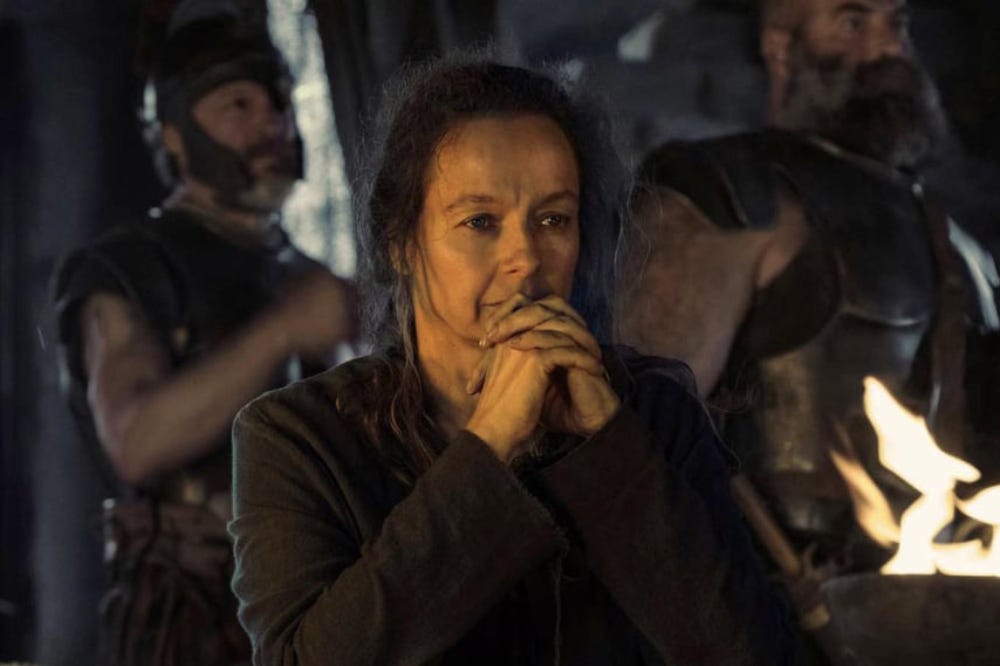
Polyphemus showed up and Polyphemus was gone. The Sirens showed up and Nolan let us hear them sing and having Damon tell us about it was nice, and then the Sirens were gone before the decision to make them so could pay off (not nice). Scylla. Charybdis. The Laestrygonians. Many reviewers and people online already mentioned that the first act’s editing almost feels like a long trailer, and this was also my sensation while watching the film. The experience was similar to having seen some highlight reels from a bigger film that exists somewhere else. A film where you can feel like you have spent enough time on one of these islands to know what the air smells like.
Nolan’s film was shot in seven countries, but it doesn’t add up to a geography. I couldn’t draw you the coastline of a single island. I couldn’t describe you what the light looked like at Circe’s house in the morning. I couldn’t even tell you that I have the slightest idea about the feel of life in that world, the human touch that makes you think that people live there eat and sweat and get bored and have sex and fight over the shopping. The rooms are there to get through, and so are the islands.
The room around me was having a different night. A man a few seats over made small unconscious sounds after the action sequences. I heard involuntary noises of people’s bodies confirming that they got what they paid for. When Odysseus strung the great bow near the end, Göransson scored it with a note plucked on an actual lyre and the audience broke into a huge *gasp*. They gasped at the beggar disguise. They gasped at the massacre of the suitors. I gasped too.
Which is why I am writing what follows.
the format conundrum
Aristotle told us ages ago that the "essential" of the Odyssey is laughably short. You have a man who has been away for a long time, his home is being eaten alive by squatters and in the end, and then he comes back and kills them. Everything else is episodes. What Aristotle means by that may not be immediately clear. Homer’s episodes are episodes in a particular sense of the word. They are didactic. The genius of Homer was to recognize that episodes are the heart of the story. Odysseus goes into the Cyclops cave because he can't stop himself. His curiosity physically overrides everything else. It costs six men and a decade-long curse from a god who holds grudges. He stays with Circe a full year, a FULL year, and his crew have to come beg him to leave. Homer is unforgiving in making us guess whether it was the longing for Ithaca or Circe’s comfy-cozy cottage that kept him there. He is tied to the mast not to hear the Siren song riddled by the poison, but to experience, to suffer, to live.
This is a man who will always choose to have the experience and metabolise the consequences later. He refuses to choose. He’s gluttonous. (This is also what makes him both a spectacular hero and an absolute nightmare of a husband.)
Each episode unmasks or teaches him something, making him wiser and better. In The Odyssey, the encounters begin to build and the edit pulls the rug. We lose the transformation. We gain trailer spectacle. Sure, Nolan can do compelling trailer spectacle. But the only way you can tell the story the way Nolan wants it told (= from start to finish) is not by filming it for the biggest screen ever. It’s by committing to a two-part film or even a trilogy. There’s a reason the Dune franchise, often called Odyssey in space, has immersed us in its world over time.
Other directors have found ways to tackle this. Franco Rossi filmed the Odyssey in 1968 as an eight-part TV series, which has widely gone down as the most faithful adaptation of the poem for the screen. The reason for this is probably the simplest: an episodic poem turns into an episodic film. The Coens did O Brother, Where Art Thou? having claimed they'd never read Homer at all (this is maybe true), felt no obligation to illustrate the poem and transplanted its skeleton into Depression-era Mississippi with bluegrass and George Clooney's hair. The result has more of the Odyssey's trickster energy in it than other adaptations that have tried harder. Two years ago, Uberto Pasolini drew attention to his film adaptation of the Odyssey. He discarded the monsters, the nymphs and the gods, in other words, the first half of the poem, and committed to the homecoming as a chamber piece on a fraction of Nolan's budget. In The Return, we focused on a marriage under twenty years of pressure. The film is small, occasionally slow, but I believed in that marriage. I believed Binoche had been sleeping in that bed alone for two decades from the way she held her shoulders, from the flatness in her voice when she told Fiennes she wasn't sure she wanted him back, from the grit I could feel under their sandals whenever the camera followed them outside.
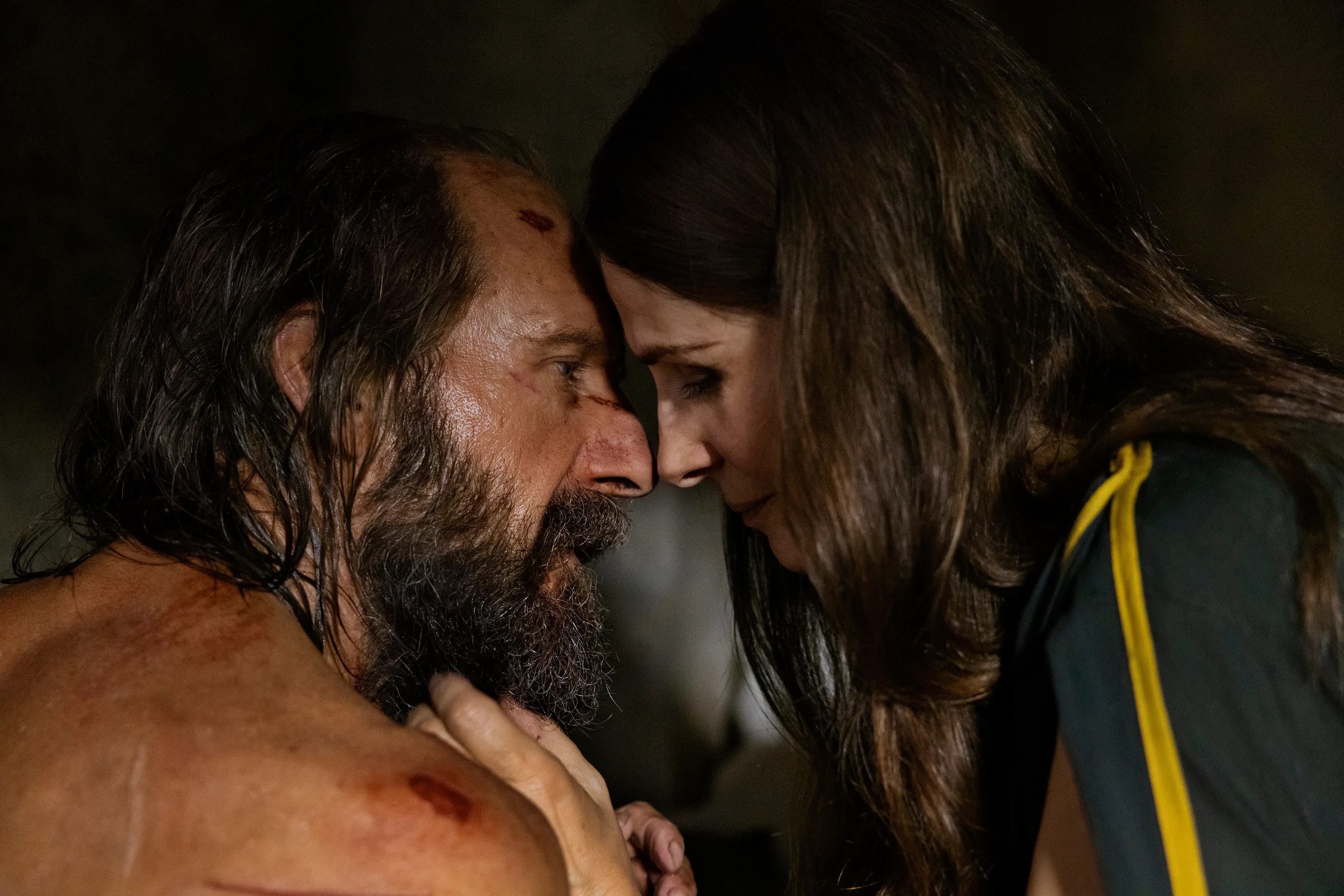
is our family trio ok?
In Nolan’s The Odyssey, I know for a fact that the light falling across Penelope’s weaving takes centre stage. Nolan loves that shot, the one where the camera is on one angle of the loom while Anne Hathaway is on another and the glow of the sun fractures through the threads, painting fractured shadows on the wall. I sat there taking the glorious composition while thinking about how Penelope's whole deal is that she has been secretly unravelling this weave for three years to keep the suitors at bay, promising she'll pick a new husband when the shroud is finished only to unravel it at night and hide the progress. This is a con so good it held for three years until a maid finally ratted her out. And the film cares more about what the thread does to the light than about what the woman behind it is doing to an entire palace full of armed men who think she's an idiot. Hathaway, our lord and savior, gets one real monologue, a speech about holding Ithaca together alone and uncredited while her son tries to take over. As Maxwell Rabb wrote about in Harper's Bazaar, it came across: "like nothing, we quickly move on."
I felt that.
Odysseus speaks to his own wife, in a form of a beggar, and this scene should be electrifying. Electrifying in the sense of Homer’s wording, since the man is lying to Penelope, feigning loyalty to her husband and perhaps knowing that she sees through him, but knowing also that he is putting on a performance for an audience of people who want him dead. Damon's Odysseus sounds like a man who has been to one therapy session and got the language down without doing the work. "It's not always an easy thing, a homecoming. What if the Odysseus you knew lost his way? What if he saw things?" Daniel Mendelsohn, Editor-at-Large of The New York Review of Books, pointed out that this is not what Homer sounds like at all, but that it soundsvery much like every other Nolan protagonist. He is not wrong. You could paste those lines into Interstellar without changing a word and nobody would notice. This is fine. We're fine.
Tom Holland plays Telemachus in a register so accidentally twenty-first-century that it teleported me out of the Bronze Age and into the queue at my local Pret in Chiswick. I don't blame Holland for this. I don't think anyone could have played those lines and kept their sandals on ancient ground, and I say this as a very Greek person who frankly wanted to cry about it, because Telemachus's own arc in Homer (his trip to Pylos and Sparta looking for his father), is a coming-of-age nostos in its own right. A boy who becomes a man by going looking for someone, failing to find him, and coming home changed by the search alone. Holland's Telemachus is looking for his dad (yes I said DAD, sue me!) as if looking for someone who went out for milk and never came back. On a human level, sure, this is passable acting. On a Homeric level it is a puddle in a car park where an ocean should be.
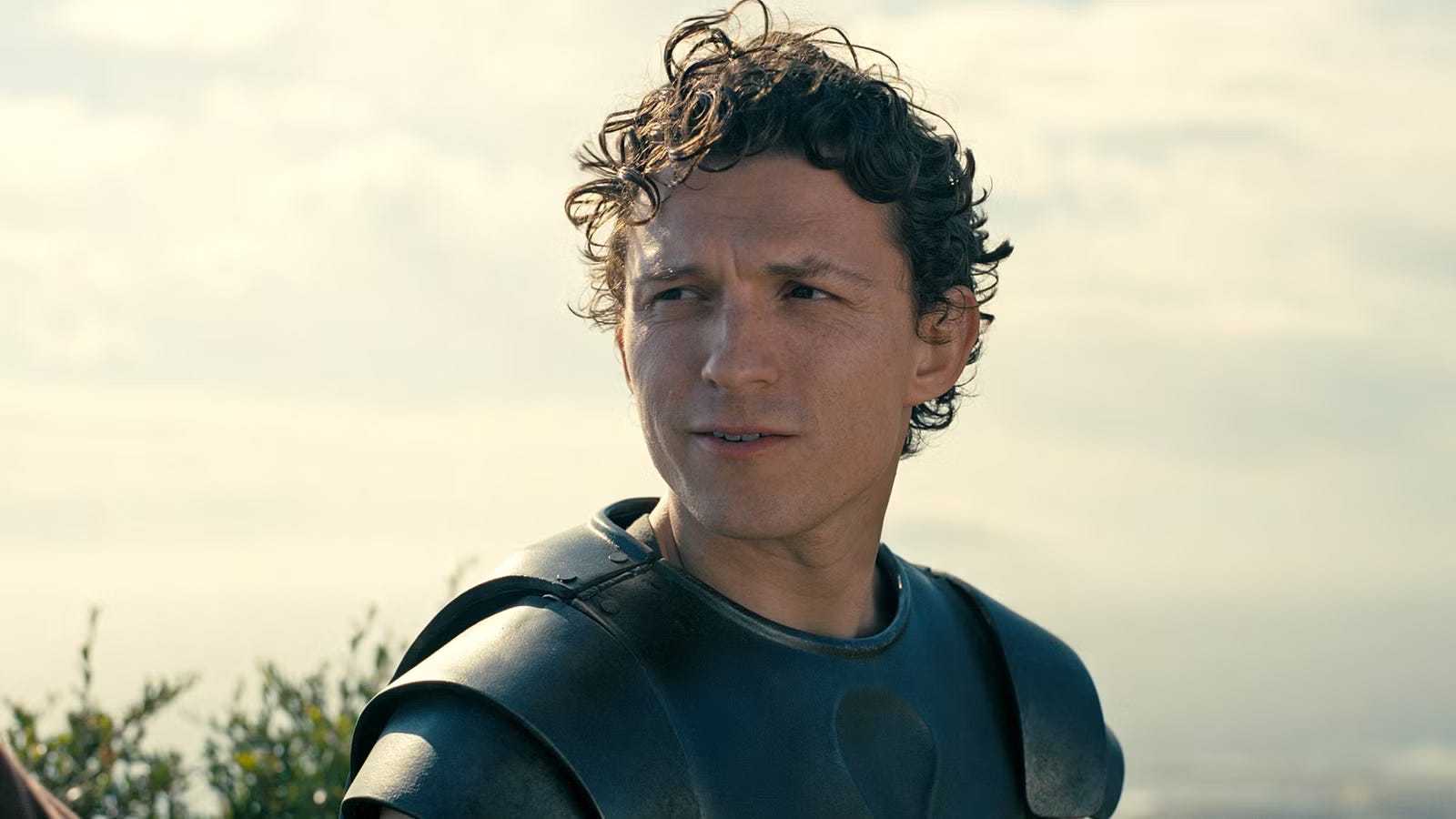
the side men of the odyssey deserved better
I know you want to talk about the women. I want to talk about the women. We will get there, you and I, at length, and I will not be kind about it. But first I want to take a detour through another group that got the same treatment in this film: the side men.
Homer's Menelaus is a crier. He is wealthy, over-generous in a way that borders on embarrassing. He refills your glass before you've finished drinking, sends you home loaded with gifts you never asked for, and weeps openly about people you've never met while you sit there pushing food around your plate. Homer catalogues the palace with loving specificity: bronze, gold, amber, silver, ivory. When Telemachus walks in and can't stop gawping at it all, Menelaus gently changes the subject. Your friend's rich dad catching you staring at the car and pretending he didn't notice. He feeds the boy, tells war stories, cries about Odysseus for so long it gets uncomfortable. Every gesture here is governed by xenia, the sacred hospitality law that Zeus enforces personally. The scene exists for a reason you don't clock until much later: Homer is showing you what it looks like when someone treats a guest as though the guest might be a god wearing a borrowed body. He is building a standard, and the standard matters because by the time you watch the suitors helping themselves to another cup of wine they didn't pay for, you feel their offence as something close to heresy.
In the context of the film, Menelaus boasts about the Trojan Horse from the inside to a teen who has come to him in search of his father. Bernthal is doing a committed, wild performance of a post-war thug in a domestic spiral, and I'd 100% watch that character in a different film, but in this film it doesn’t work. He is trying to convince us that generosity reigns supreme in the home, outside of which there is nothing but other homes with their own brand of generosity. The standard is removed, and therefore, the subsequent gifts of the suitors are no longer perceived as betrayal but rather as an intrusion into a personal home. I get it, these are rude guests in the man’s house, and rude guests deserve an eviction, maybe a lawsuit. Certainly not a room full of arrows.
Homer's suitors know the gods are watching and they have decided the gods have better things to do. That is what makes them terrifying. These are men who received the memo, read the memo, and decided the memo was addressed to someone less important. You have sat across from this confidence on Zoom. You have reported to it. You have dated it, if you were unlucky, or been raised by it, if you were unluckier. It is the arrogance of a person who has gotten away with everything for so long that getting-away-with-it has hardened into an identity and a worldview.
Pattinson’s Antinous is nothing to fear about. He has a good time, of course, feral and slapstick, channeling whatever Pattinson has in him to pick up signals from an exclusively brighter movie than only he can see. I rated that. But he is also a cartoon, entirely legible from his first scene, with no sense that he knows any of this will cost him. He kicks old Argos and drags him to a manure pile, John Wick style. The dog has been kicked, the audience is furious, the target is acquired. You want him dead in thirty seconds because A DOG IS HURT FOR FUCK'S SAKE. Homer takes twenty-four books to get us to the point where we want the suitors dead, and what that says about vengeance is that it’s not quite the same thing as anger. Anger is combustible, and burns swiftly. Homer builds something sturdier, and more enduring than that.
Patel’s Eurylochus sometimes furrows his brow and, as far as I know, is the only crewman who talks. The rest of Odysseus's men drift through the film as atmospheric extras you can't distinguish from the rigging. Do they have opinions about being turned into pigs? Did Nolan cut their tongues? Homer's Eurylochus refuses to walk into Circe's house when something smells wrong, and every man who goes in without him comes out a pig. His cowardice and his wisdom fire from the same nerve. He challenges Odysseus about decisions that get men killed, to his face, and the poem sides with him more than once. He is the one character allowed to say what the audience is thinking such as “maybe following this man into another cave is a bad idea?”. Psychiatrist Jonathan Shay, who treated Vietnam veterans and later wrote Odysseus in America, reads the Odyssey as a study in command failure and treats Eurylochus's challenges as the poem's accountability mechanism. He is the voice that forces Odysseus to hear what his recklessness costs the people sailing behind him. Patel’s dissent vanishes mid-scene. The crewmen row behind him in silence, not even asking why.
the women (i can’t keep this short, i’m sorry)
Anyway! The women!
Homer’s women take vengeance on gods, turn men into pigs, tear up shroud cloths at a torch lit funeral feast for three years running so that they might gain time, sit in olive trees outwitting the wittiest of men and every important turn of the Odyssey is either planned or executed or greatly assisted by a woman. Several of the most important events are entirely designed by women; they are the very sinews.
Nolan's women wait. They advise. They suffer. They look beautiful and slightly dangerous. They deliver one monologue each, usually mid-film, usually interrupted, and then the camera moves on, because the camera has places to be.
Because of this, I’m not interested in running another lap of the Nolan/women discourse (even though you guys know I had expressed what I was hoping to see from Nolan’s Odyssey when it came to this issue in my piece here). What I am interested in is something Emily Wilson said about the film that has been stuck with me since I read it.
Wilson, who I also wrote about in my initial piece last year, has produced one of the most popular translations of the Odyssey in recent years. You probably know the opening line ("tell me about a complicated man”) a six-word grenade that detonated a decade of discourse about who gets to decide what the oldest surviving epic in Western literature sounds like in English. Nolan cited that line as inspiration. To my surprise, he never picked up the phone to consult her. Wilson found out secondhand that her translation had been credited, and before the film came out she said publicly, on the record, that there is absolutely nothing wrong with adapting Homer however you want.
Change whatever you want.
The poem is robust.
It can take it.
After she saw it, she found Penelope "so thinned out" it endangered "any possibility of believing in this marriage."
What Wilson identified in Penelope is running through all women in the film. Every woman in The Odyssey who holds power, divine power, intellectual power, sexual power, strategic power, has had the power source disconnected and the frame left standing. Calypso looks like Charlize Theron in a Castaway B-film. She occupies Calypso's island. She does not do what Calypso does, and what Calypso does in Homer, the thing that makes her crackle on the page, is scream at the gods. She screams at Hermes about the double standard on Olympus, about how male gods bed mortal women constantly, recreationally, and the cosmos shrugs, but the moment a goddess takes a mortal lover the full machinery of divine punishment descends on her, and she names names, she gives examples, and Homer lets the argument sit in the poem unanswered. Theron's Calypso is a mortal woman running a trauma clinic for tortured men. Mendelsohn called this "Yoda-like," which I think is generous to Yoda. Her biggest line is a question about whether remembering is therapeutically advisable (pardon?). Nolan took a goddess and turned her into a woman who manages a man's feelings.
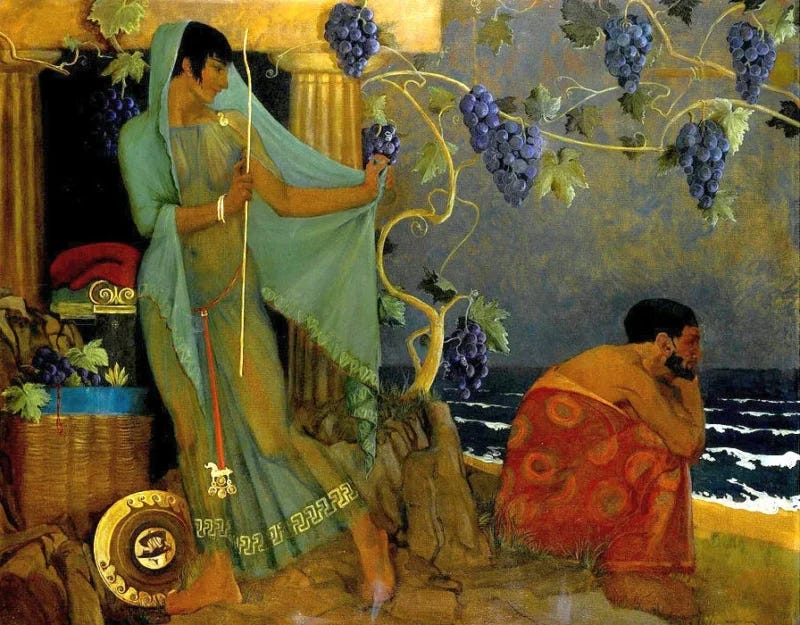
And this connects to the amnesia device that structures the whole film. In Homer, Odysseus on Calypso's island weeps every single day for home. He sits on the headland staring at the sea with tears running down his face. The poem makes sure you understand the offer on the table: immortality, eternal youth, an eternity of sex with a goddess. He said no! He chose Penelope, the ordinary woman he had left behind over the cosmic, ageless alternative. Nolan's Odysseus cannot make that choice because he has been drugged into forgetting his wife exists. A man who does not remember Penelope cannot choose Penelope, and a story in which he cannot choose her is a different story. The different story is a less complicated one.
Morton's Circe I already told you is the best performance in the film but Morton's Circe is a woman running at half her Homeric capacity. Homer's Circe threatens, transforms, sleeps with Odysseus, hosts him for a year, then sits him down and tells him how to survive every single thing that is about to try to kill him. She teaches him about the Sirens. She explains Scylla and Charybdis and the Cattle of Helios. Her mentorship is the hinge the entire second half of the wanderings turns on. We didn’t see any of this.
And then there is Athena. Should we talk about the olive tree story? Homer's Athena sits under an olive tree on Ithaca with Odysseus and plots a massacre with him. She has just caught him lying to her face (he doesn't know she's Athena by the way, she's disguised as a shepherd so he invents a Cretan identity for himself on the spot) and when she drops the disguise she laughs at him. She laughs and sits down and says, essentially: we are the same, my boy. I am the goddess of cunning. You are the mortal of cunning. Let's partner up. My grandma used to describe this scene as two foxes meeting in a field, two animals who hunt the same way recognising each other and deciding to hunt together, and it is one of the great relationships in the poem! Jenny Strauss Clay, a classicist whose book The Wrath of Athena: Gods and Men in the Odyssey argues that the sentimental guardian-angel reading of this relationship is thin. Athena's warmth toward Odysseus coexists with genuine divine anger about Greek sacrileges at Troy, and the tension between the warmth and the withholding is what gives the bond its electricity. Zendaya's Athena tells Odysseus to look at the clouds and have faith. Amy Nicholson wrote in the Los Angeles Times that she "isn't that helpful, mostly staring at Odysseus in mute dismay." In Nolan’s Odyssey, there is no olive tree. There is no scheming. The foxes have been separated and one of them has been sedated.
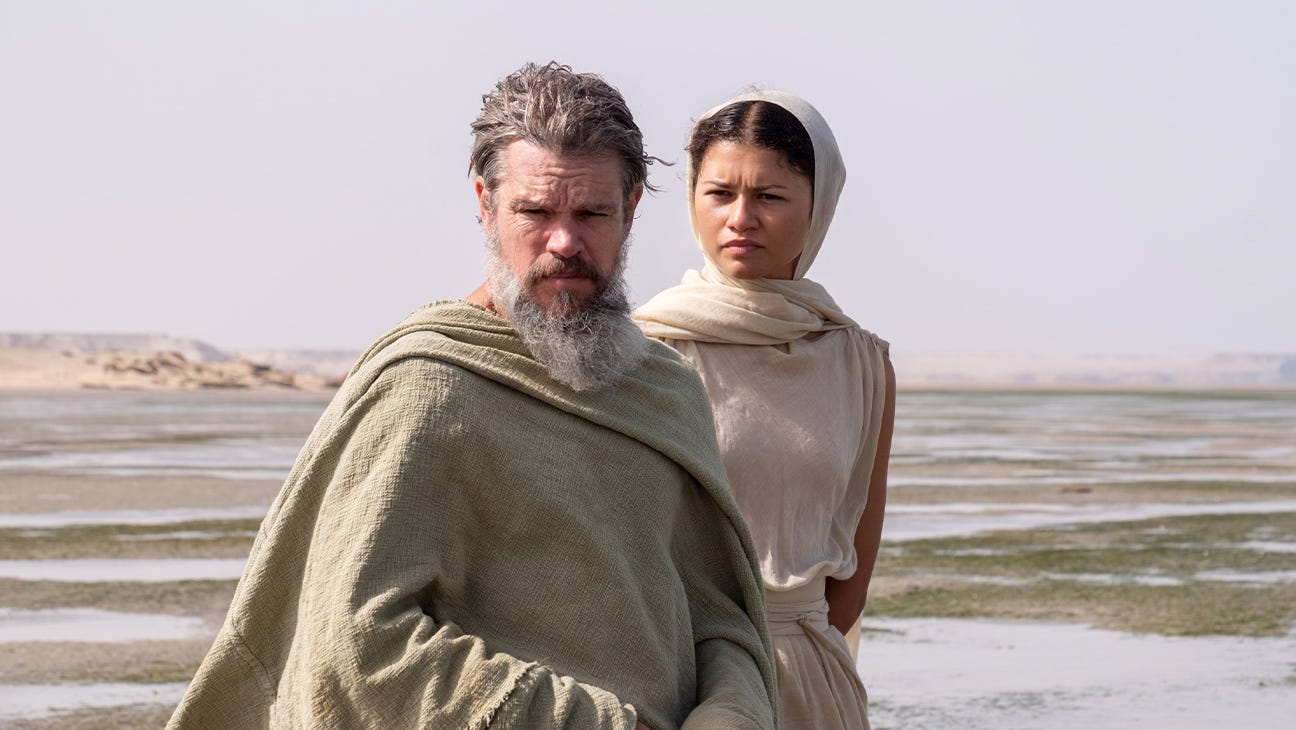
I like my adaptations inventive, not accurate
I wonder whether some of you are composing a very reasonable counterpoint right now. Something about artistic licence or about how an essay of comparing a blockbuster to a three-thousand-year-old poem looks a lot like fidelity criticism. Or maybe something about historical accuracy is not the purpose of adaptations. And it’s about time we address this. I would be thinking the exact same thing in your position. So let me stay inside that thought with you for a second before I complicate it.
Imagine someone had told you, walking into the cinema, that this was an original screenplay. A story about a soldier who took ten years to find his way home, the wife who held the household together while she waited, and the son who grew up in the shadow of a father he barely remembers. Would the homecoming have moved you in its own merit? Would you have felt the man reconstituting himself as he walked back into his life, cell by cell, recognition by recognition, or would you have felt, as I did, a body arriving at coordinates? I keep asking myself this, and the answer keeps arriving in the same place. The argument I’m trying to make has nothing to do with whether the film is historically accurate or faithful to the original text. If anything, I love wildly inventive, subversive and exploratory movie adaptations (shoutout @ Tragedy of Macbeth). My argument has nothing to do with Homer and everything to do with what homecoming actually requires as a piece of storytelling: A meditation on what it takes to return back to the self, rather than sailing back to a physical location, fighting titans and monsters.
Homer constructs homecoming the way coral constructs a reef: organism by organism, accretion by accretion. Odysseus comes home disguised as a beggar, and the people who loved him have to find him inside the stranger, one by one, slowly. His dog finds him first. Argos is the poor dog who has longed for his friend on a dung heap, arthritic, forgotten, too weak to stand for anyone, and when Odysseus walks through the gate dressed in rags something in the old dog’s body remembers what his mind has probably long surrendered. He lifts his ears, wags his tail once, and dies, and Odysseus wipes one tear and keeps walking and swallows everything. All the grief lives in the performance of composure. Did you feel that pause in the film?
His old nurse, Eurycleia, finds him next. Accidentally, on her knees. She’s washing the stranger’s feet as she has washed a thousand strangers’ feet, and her fingers discover a scar on his thigh. A wound she'd known since he was barely more than a boy. Her fingers remember before her mind catches up, and his hand closes around her throat before she can cry out. Did you feel her awe?
And then Penelope, who has been governing this island and unravelling her own weaving, lays a trap so exquisite: their marriage bed is carved around a living olive tree, built by his own hands, rooted in the earth, immovable. She tells him, sweetly, to have it moved outside the bedroom, and ages of cunning and composure collapse in a single eruption of outrage. She has him. She outsmarts the smartest man in Greek literature with a question about INTERIOR DECORATING. (I love her. I love her so much.)
Aristotle's insight here as much as mine: the recognitions ARE the interiority. The poem does not give us the inner voices, the soliloquies and monologues, and the free indirect discourse. Nothing gives you direct access to what Odysseus is thinking or feeling, and yet by the end of these encounters you understand his interior transformation completely. Did you feel it happening while watching Odysseus come home? This turning of love into something else, that now takes on a corporeal, material form in the bodies and minds and hands of those who have loved him and thought they knew him? It has been cellared in their hearts, growing dark and potent, and these recognition scenes are meant to uncork it.
What pours out is the man. The dog knows his scent, the nurse knows his scar, the wife knows the secret architecture of their intimacy, and each recognition puts a piece of him back. Homecoming in Homer is something done to him by the people who remember him. It is seen throughout four books, with an almost sluggish pacing, and this is what it is all about. You can’t come home alone, you come home through the people that kept you whole while you were away.
Even if you take Homer out of it, a film about a long return journey would have to make the homecoming seem like a process, a drag even. It would have to make the people around the protagonist the agents of his return, and the door to his homeland had better not open quick enough for him to retain that sense of self that got him into this mess in the first place. I left the theatre feeling like I had missed that slow opening of the door. I walked out alongside audiences who felt completely nourished, and I understand that and I respect it. For people discovering the bow contest and Cyclops for the first time, the surprise and the delight are real, and I would be a smaller person and a worse critic if I tried to take either of those away. Spectacle is a gift.
All I was asking for was a different gift.
A character come back to himself under the weight of coming home, and I did not feel that happen. The room for it was there, but Nolan filled it with the wrong thing.
i’m not sure the usual nolan cocktail works guys
Nolan filled it with the substance he has always used: guilt. Leonard in Memento tattoos grief into his own skin to carry it past the reach of his dissolving memory. Cobb's dead wife in Inception colonises his dreamscape until she becomes the building material of his subconscious. Oppenheimer watches the world blister. In Nolan's best work, guilt and mission fuse into one volatile compound (Cobb's guilt IS the inception, Oppenheimer's guilt IS the bomb) and the collision between wound and purpose is what the films are about. It is a gorgeous engine, and I have loved watching him build it my whole life.
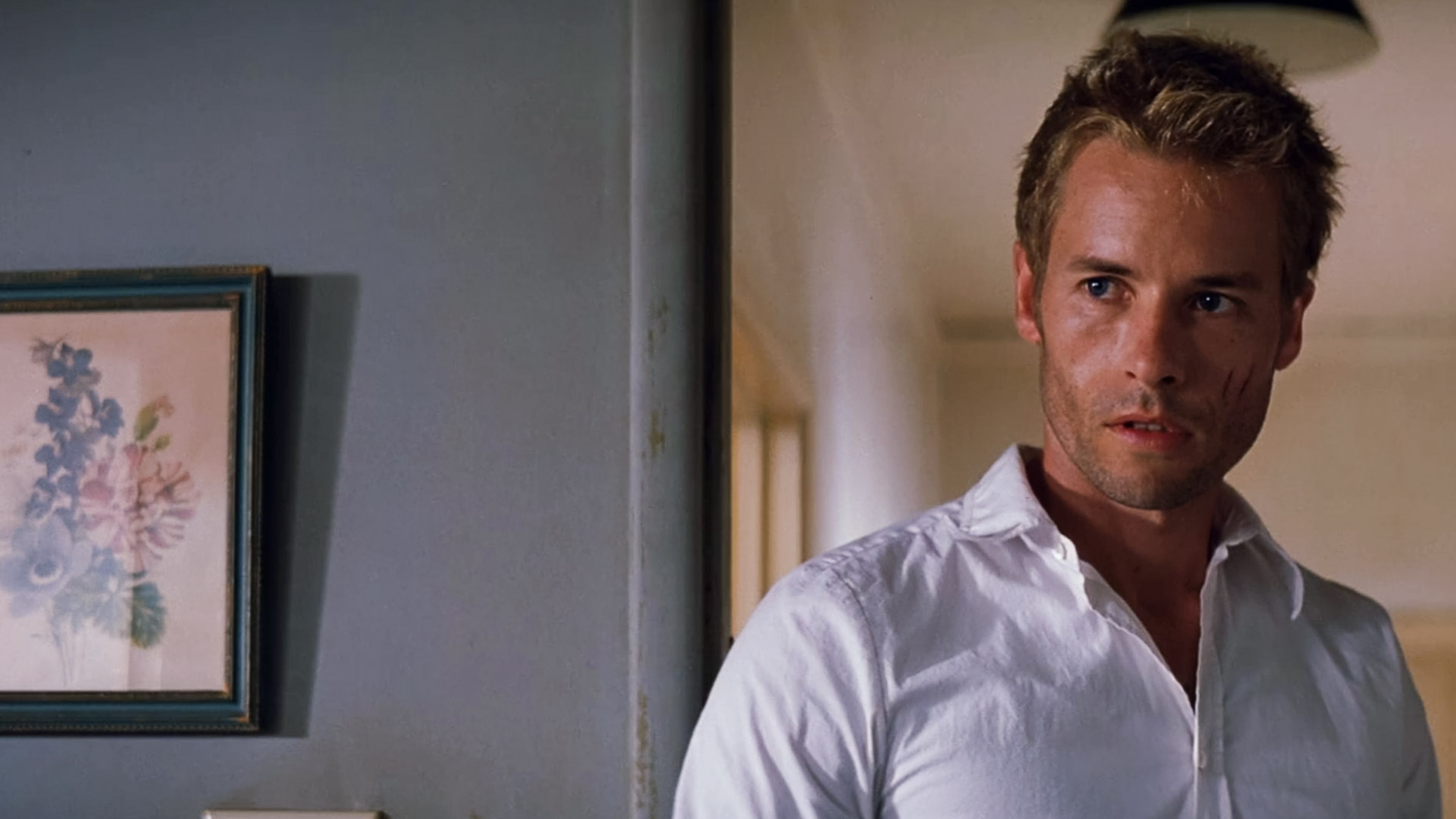
But Homer's engine runs on something else entirely: hubris, recklessness and the narcotic, ruinous thrill of being the cleverest person alive. Odysseus, safe aboard his ship after blinding the Cyclops, stands at the stern and SCREAMS his own name across the water. Is it brave? Absolutely. Is it suicidal? Also absolutely. Does it gift Poseidon a target to track him by for the next decade? Oh yes. And he does it anyway, because he cannot help himself. THAT, that magnificent and devastating vanity, is what homecoming requires him to shed, metabolise, and outgrow.
The thing that makes Odysseus extraordinary and the thing that makes him lost are the same thing, bound together, waging war upon itself. All the poem's heat comes from that. Guilt sits next to this struggle like a stranger sharing your armrest on a long-haul flight. Nolan's Odysseus feels remorse about his dead men and also wants to get home, and these two impulses coexist so placidly you almost wonder why anyone thought there was a story here. For the first time in Nolan's filmography (though I have thoughts on Oppenheimer, call me later lol), the engine idles.
Guilt was available to Nolan because it is available to all of us. We are swimming in it. It is how interiority works in Western culture right now. We know this man, the traumatised veteran working backwards through fractured memory. We have met him a hundred times and we LIKE him. Transformation is a harder ask. It requires a story in which someone becomes something actually new, and the growth demanded of the protagonist necessarily involves a moulting of self, leaving the old skin behind and asking the audience to believe that the creature beneath was worth the shedding. Odysseus needs to molt; he needs to shed the dazzling, ruinous skin of the man who shouted his name at the Cyclops and grow into something more porous, more able to be found by the people who loved him before the war. That moulting is why the Odyssey has endured for nearly 2,800 years, and it is the one thing that Nolan, for all his gifts and his devotion to the material, does not find a room for.
your bedtime story
When I was little, my mother told me the story about Procrustes who had an iron bed. He invited passers-by to relax on his bed, but stretched those who were too short and cut off those who were too tall to make them fit the bed exactly. The bed remained the same, yet the traveller had to adapt to it.
Nolan first experienced the Odyssey as a boy in London in a stage production, from which he took away a single image: the Trojan Horse tipping side-long into the sand. He would later compare it to the Statue of Liberty half-buried on the beach in Planet of the Apes. Both images do the same thing. They turn a civilisation’s pride into rubble and the rubble into something beautiful. He carried the image with him, and was hired to direct Troy in 2004 before the studio handed it back to Petersen. He kept the image, his own private iron bed.
He took it, laid it out and made a perfect fit of it. It is not that Nolan did this cynically. He loves the poem. He loves spectacle. He loves scale. He loves immersive sound. He loves beautiful shots of skin and muscle. He loves Odysseus the way Odysseus loves himself. He loves him like a boy. Nolan saw Odysseus as Procrustes’ traveller, stretching him on the iron bed of his machine of guilt and memory. The stretch is his, the ambition is his, and some of the images are truly beautiful. Some of them even work. But that is all the machine did. That, and interpret. It reduced the very thing that made Odysseus strange. The very thing that made him Greek. He shoehorned himself into Odysseus the way he always does with this travellers, and this time it did not work. I don’t mind this. Childhood loves are allowed to become adult misreadings.
The things in this film that cracked my heart open were Homer’s. The things that left me aching were Nolan’s. His door into Odysseia was a monument tipping into the sand of a stage when he was a boy. Mine was a word my grandmother said to describe my grandfather when he’d been away too long. Those two doors led to the same room in the end, but at this scale, his version becomes the poem for most people because this is what mass culture does. It overwrites. It becomes the default memory.
I guess this is what it means to love a story more than any one telling of it. To hold it so close for so long that seeing it reflected back in a distorted mirror feels like losing a piece of yourself. I don't know how to reconcile the joy this film gave so many people with the grief it gave me. I don't know how to hold my own childhood reverence alongside Nolan's and call it a draw. But I know that Odysseia will outlive us both. It will absorb this retelling and the next one and the one after that. It has been doing this since the 8th century BC. Odysseus always comes home in the end, even if he has to cut off pieces of himself to fit through the door.

Hi! You can help keep long-ass essays like this one coming for the price of a fancy coffee once a month. TFS is mostly free to read, but your paid membership helps the work remain sustainable and allows me to keep dragging everyone into my weird cinema tangents every week. Thank you so much for reading x
My favorite episode of Joyce’s ‘Ulysses’ is Circe, which led me to Madeline Miller’s ‘Circe,’ which led me to be disappointed with Nolan’s treatment of Circe in the movie. You put a finer point on that shortcoming.
I love reading your take on this because it materializes elements of the film I perceived (especially the negative ones) but couldn't quite put into words. You've given me a lot to think about.
Perhaps there's a silver lining in that there's a whole new round of people becoming interested in the original poem, particularly Wilson's translation (if book sales are anything to go by).
As always, thank you for sharing this, Sophie!