


Hello friends, old and new!
Welcome you to the first issue of ✨ Nolan Club ✨
In a shocking twist, I managed to convince you to let me write about the themes of Odyssey over the next few weeks leading up to the release of Christopher Nolan’s The Odyssey. Each issue is centered around a theme through the lens of films, songs, podcasts, essays and so much more. I’m soooo grateful to all my patrons who submitted their own picks to help co-curate them with me.
The first issue, homecoming / nostos, is about as foundational as it gets. One of the enduring questions across all of Nolan’s films is whether you can ever really go back — whether you can return home in any meaningful way, whether time can be undone, or whether lost love can be rekindled. It’s a fitting threshold to step through first, as well as something of a personal touchstone for me.
Hope you enjoy this issue as much as I enjoyed writing it.
film
E.T. the extra-terrestrial (steven spielberg, 1982)
My first memory of seeing E.T. The Extra-Terrestrial was during one of my family’s summer camping trips. The campgrounds we would stay at would sometimes screen movies at night, and though the details are hazy, I remember my parents setting up our large tent while I sat at the picnic table on my small camping chair, watching a curious extraterrestrial learn about Earth and enjoy Reese's Pieces with a small boy. I was enamored, and to this day, the movie holds a special place in my heart.
Watching it now as an adult, it’s clear to me that the magic of E.T.—and the reason it lands as a homecoming film—comes from how it stages return as desire and rupture at the same time. Elliot and E.T. creating a telepathic connection that allows them to communicate without words. E.T.’s gentle touch as he heals Elliot’s cut finger. E.T. watching TV at home, getting drunk on beer, and syncing Elliott into that chaos from miles away. E.T. hiding among Elliott’s stuffed animals and trying to move through the house without being seen. E.T. pointing at the moon as he reminds Elliot of his home. Elliot giggling as E.T. touches his face and breathes heavily in awe of the human experience. The glimmer of wonder in his eyes as he learns about Earth for the first time. E.T. imitating the sounds of the children’s movie, mimicking them to learn how to speak.
E.T. wants to go home. Elliott wants him to stay. The whole movie lives inside that contradiction. But where that framework focuses primarily on the parallels between the two heroes, I’m equally interested in the darker side of Odysseus’ adventures in the underworld. In The Odyssey, Odysseus longingly communes with the souls of the dead. As he sacrifices animals to the gods, he watches their spirits drink the blood and remembers the lives they led on Earth. It’s a moment of clarity, breaking of the cycle of numbness that allows Odysseus to move on from his past and finally return home.
In a similar way, E.T. provides Elliot with the opportunity to commune with his own lost childhood. E.T. arrives on Earth as a kind of specter or ghost, a reminder of Elliot’s younger years before the pain of divorce and the loneliness of adolescence set in. He helps Elliot remember the sweetness of life, the importance of love and compassion, and most importantly, how to feel again. E.T. helps Elliot commune with the boy he once was, the boy he thought he’d lost forever. And like Odysseus, Elliot is haunted by the knowledge that he must one day leave behind the memories of his past.
So often, I think about the way Elliott cradles E.T. in his arms as he dies. He struggles to hold him up, to keep him from drifting away, and eventually gives into the weight of his body, gently cradling the dying alien in his lap. He rocks him back and forth as they share a final embrace, whispers tenderly into E.T.’s ear, “I love you.” E.T. reaches for Elliott’s face and touches his glowing finger to his forehead. “I’ll be right here,” he says. All this time, E.T. has been taking care of Elliott, keeping him safe, and now it’s Elliott’s turn to return the favor, to hold him close and guide him through the unknown, to love him as he goes.
film
interstellar (christopher nolan, 2014)
When D.L. Holmes suggested Interstellar as a nostos choice, my immediate instinct was protest: isn’t this a film about leaving home? But once I started thinking about it, I realized how perfect it really is. To me, interstellar feels like a film about another world, about a beautiful but alien cosmos. To many of you, it’s more personal than that.
When Cooper returns from the water planet, the sound of the ship's engines still roaring in the background, he races to his daughter Murphy's video messages. They've just lost one of their team members to a tidal wave. They've subjected themselves to the gravity of a planet that slows down time at a near infinite rate. Their beloved team member Doyle is gone forever, swept away by the wave at the entrance of the ship, just seconds too slow to get inside. Twenty-three years have passed on Earth. But Cooper wants to hear from Murphy, because she's still out there. She's in pain. She needs him.
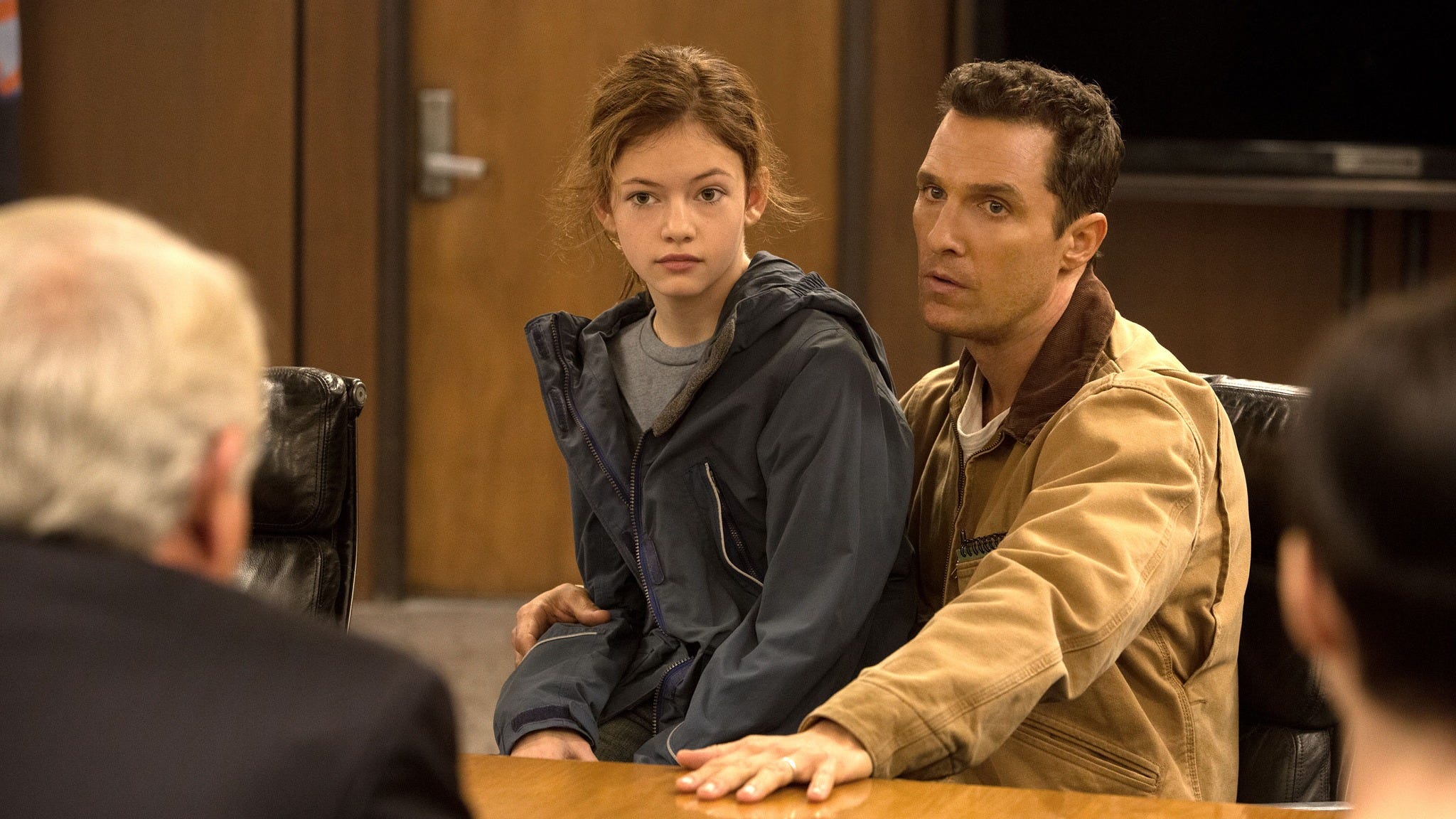
He watches through the ship's screens as twenty-three years of messages scroll past — his son, his grandson, his father's death. Then Murphy: "Hey Dad. You son of a bitch. Never made one of these when you were still responding because I was so mad at you for leaving. And when you went quiet, it seemed like I should live with that decision, and I have. But today's my birthday. And it's a special one, because you once told me that by the time you came back we might be the same age. And today I'm the same age you were when you left." She has become him.
Cooper balances the guilt of surviving the planet’s deadly tidal wave and the loss of that team member with the knowledge that he has to leave for the next planet, where time will move at a much faster rate. But what will happen to her if he doesn’t make her feel seen, understood, appreciated? The answer is that she will continue to be hurt and angry, and he can’t bear to let that happen. So he does the thing love does. He makes it about him.
Humans, as the nature of this film proclaims, are inherently selfish beings. We constantly make it about us, even when we’re not supposed to. That’s the nature of love. But this also serves as one of the film’s central paradoxes: The only way to save humanity is to abandon it. Love and survival are inherently contradictory forces; they’re the only things that will keep a human being going, but they’ll also destroy our species in the end.
Christopher Nolan’s Interstellar is a film about love, and no other emotion has such a capacity for selfishness as love. It drives Cooper to choose his moment with Murphy over the lives of the rest of the crew. It drives Murphy to take over NASA and the fate of humanity, insisting on solving the equation Professor Brand confessed on his deathbed had always been a lie, that Plan A was impossible, that he'd never believed they could save everyone. It drives her to refuse the solution to the gravitational problem when her estranged father’s love is at stake. It drives Cooper to return to her, even at the cost of his own life. And this is why I think, out of all of Nolan’s movies, in addition to being the most emotional, Interstellar is also the most Homeric.
Homer’s Iliad and Odyssey are adventure stories in the most classical sense: the hero is thrust into a journey beyond the comforts of home and family, where he must battle gods, monsters, and other men. But at their cores, they’re love stories about obsession and longing: Achilles and Patroclus' bonds of friendship and love are so powerful that they defy the will of the gods, and Odysseus’ endless journey home to Ithaca to be with Penelope is so legendary that it gives the ancient archetype of the “Homeric man” its name. Homer’s men are obsessed. They rage. They aren’t afraid to love too much, even if it means destroying themselves and the world around them, which as Interstellar reminds us, is what love often does.
Odysseus doesn’t even have the decency to die when he’s given the chance to go home: he keeps going on his stupid journey. And what is Cooper’s journey but an Odyssean refusal to go home?
podcast episode
the queen of dying (radiolab, 2021)
I was in the middle of a long, drawn-out break-up when I first heard Radiolab’s The Queen of Dying. Rachael Cusick’s voice eased in through my headphones, cradling a world of tenderness and grief.
Rachael, a writer and radio producer, grew up with a mother who died of cancer when she was six. “And then they just weren’t supposed to talk about the empty chair at the dinner table anymore,” she explains. Rachael says she spent her whole childhood “fighting off these feelings and failing, and fighting and failing,” thinking there must be something wrong with her. When she eventually discovered the five stages of grief, they felt like the first time anyone had underlined the word grief as a thing to go through. But then the stages didn’t work. They became, as she puts it, “supermodel tight jean versions of quote-unquote ‘normal’ grieving that I couldn’t fit into.” And she thought, who the hell sold me this?
So she goes looking. And what she finds is Elisabeth Kübler-Ross, a Swiss psychiatrist who in the 1960s basically invented the modern language of dying. Kübler-Ross spent her early career as a country doctor in Switzerland before becoming a psychiatrist at the University of Chicago. In this enormous hospital full of dying patients, she couldn’t find a single one — the staff hid them in the furthest corners of the ward because no one wanted to be reminded they existed. Kübler-Ross walked the halls every day until she found an old man who stretched out his arms and said “please sit down now.” She promised she’d be back the next day with her students. When she arrived the next day, he was in an oxygen tent and could barely breathe. He looked at her with “that same kind of pitiful look” and said, “thank you for trying anyway.” He died half an hour later. She had never actually listened to him.
That became her life’s work. She started seminars where dying patients would sit behind a glass and talk about dying, with hundreds of doctors and students watching. Her book On Death and Dying came out in 1969 and made her a sensation. People wept in the aisles at her talks.
Kübler-Ross’s story gets significantly stranger after this point so I won’t give anything else away. But the reason I thought of this episode for this issue is that it tells us a story which doesn’t fully resolve. In Homer’s Odyssey, nostos is fraught with danger and not always achievable. In “The Queen of Dying,” we have this same sense of a doctor, a researcher, and a woman who believes that she can return things to their original state or fix them, only to have her own nostos become complicated and twisted.
Rachael captures this so beautifully in her reporting on Dr. Kübler-Ross. It’s an incredible tribute to Kübler-Ross’s work while also providing thoughtful and nuanced critique of her life and legacy. It’s an incredible episode. You’re going to love it.
film
inception (christopher nolan, 2010)
Christopher Nolan’s Inception begins with a disorienting dream sequence that climaxes with an emotional gut-punch and concludes with a lingering question: Is Dom Cobb finally home? While the titular inception (planting an idea into a target’s subconscious) is important to the plot, it is Cobb’s inability to go home — and what it takes to finally get there — that is the emotional spine of the film. And this is what makes it the number one #1 nostos Nolan film in my book.
In the case of Cobb, our homes are buried beneath the pain of grief and the guilt of letting go. They are hidden in time; they are the spaces we carry with us. But they are also the projections of our unconscious, the spaces we are forced to confront when we can no longer hide from ourselves. To return home means to risk losing everything, to risk being lost. At the edge of the dream, Cobb explains: "Our dreams feel real while we're in them. It's only when we wake up we realize things were strange."
To wake is to return, to leave the dream state and what we desire, and return to the real world, the place of violence and betrayal and remorse. To wake is to confront. It is to be expelled from a limbo that is far more comforting than the waking world could ever be. I’ve long been fascinated by this idea that home can inherently be a place of danger, that to go home is to risk being hurt. And Inception is a film that surprisingly, and perhaps paradoxically, understands this idea too.
Home is both a fantasy and a kind of purgatory in Inception. Cobb and Mal built their ideal life together in the dream state and now they can’t escape it. "We can still be together, right here," Mal tells him in limbo. "In the world we built together." In the dream state, she is alive. In the dream state, she is real. In the dream state, they are still together. But to be together is to be trapped, and to be trapped is an illusion, however comforting it may be. It is paradise built on the memory of a life that never existed. It’s a fear and a fantasy that Cobb can’t let go of. It is the thing that threatens to consume him whole. He carries it in the totem he uses to ground himself; the spinning top is the only thing he needs to know if he's in the dream or the real world — and the top beginning to wobble, for the first time, is the final image that breaks him and brings him back to life.
And in the end, he finally makes it home. The top wobbles; the illusion breaks. Mal is gone. He is finally free. But freedom is no fantasy. It feels real. And it keeps him alive. Reality isn’t a place that heals you, it’s a place that hurts you. It’s a place where you carry the weight of guilt and continue to long for what you can never have. There is no going back. There is only moving forward, to the promise of a future you can’t envision. In the final moments of Inception, Cobb returns home to his children after years of running away from a life that he never wanted. You can see the joy on his face as he spins the top and walks away from it, but notice when he does find his way back home, he doesn't wait for the top to stop. He walks away from it toward them, toward the place he's always been running to, the place that has always kept him alive: his nostos.
essay
wow, no thank you (samantha irby, 2020)
I love Samantha Irby. I love the way she writes about her body, about her marriage, about friendship, about pop culture, about being a midwesterner. I love the way she writes about not knowing how to be a grown-up, how to fix a house, how to raise kids, how to write a book. I love the feeling of her work — funny and alive and still emotionally meaningful, like you’re sitting on the couch talking with your funniest friend, or looking at their group chat texts. I love that she is hilarious, but also that she uses her humor to write about the sad and difficult and confusing things: grief, chronic illness, the anxiety of adulthood. I love her writing about living in a fish-out-of-water situation so much that I wanted to write about one of her books for this issue.
I narrowed it down to Wow, No Thank You, an essay collection that’s basically all about homecoming (albeit in a chaotic, unexpected way). Central to the book, homecoming is a hazy new beginning that requires new forms of competence. She creates a home in Kalamazoo, Michigan with her wife, living with stepchildren for the first time. This is a dramatic shift — Irby is a Chicago comedian and writer who has written for Shrill, Work in Progress, and And Just Like That..., but most of the essays in the collection are rooted in her domestic life. Leaving Chicago feels like moving out of the city where she discovered who she was, and into a place that doesn’t have as much of a script for who she can be. Irby’s essays are funny, self-deprecating, and full of physical and mental health vulnerability, with a deep investment in flawed and imperfect community.
Most importantly, Wow, No Thank You is about the I-can’t-believe-it-ness of new beginnings. In a style full of Irby’s signature jokes, she describes panic-comedy at home: “my house is repeatedly saying, ‘What the fuck is that smell? It’s me; I’m the smell. I’m the idiot who left the food in the food processor to rot for three days because I thought it would be ‘simple’ with a capital S to make hummus and I forgot about it because the meatball daughters were arguing about some dumb shit… all day.” The new house requires “competence” as systems begin failing that she never had to manage in an apartment, but she understands that this form of adulthood isn’t about being correct or right: “I am not a homeowner with a to-do list that is a reasonable length and a house that is in good working order; I am a homeowner with a simple solution that requires extreme competence on my part.” Much like Odysseus overwhelmed by the flotsam of his ship in The Odyssey’s first lines, Irby needs to quickly become competent. The journey back home requires competency at rapid speed.
film
the wizard of oz (victor fleming, 1939)
There is a theory in psychoanalysis — from Donald Winnicott, if you want to be formal about it — about the difference between the home you grew up in and the home you’ve constructed inside yourself from the raw material of having grown up in it. The internal home. The one you carry. The argument being that healthy development requires you to leave the first one and inhabit the second, to internalise enough of it that the physical structure becomes optional — that you can be away, at sea, in a war, in Oz, and still have the thing that home actually provides, which is not shelter but continuity of self. The knowledge of who you are when nobody is watching.
Dorothy has this, which is why clicking her heels in the last five minutes works immediately. There is no warm-up, second attempt, or moment of doubt where the shoes sputter and she looks around and thinks, well, this is awkward. She just does it, and she’s home. The readiness to go home is the same readiness as knowing who you are without the yellow road and the companions and the green city to organise yourself against — and Glinda, who is essentially a transitional object in a tiara, withholds the exit until Dorothy has done enough miles to locate that knowledge in herself rather than in the destination. Dorothy’s entire journey, retrospectively, was an optional scenic detour around a solution that was already on her feet. And that’s what homecoming often is: the suspicion that the way back was always available or that some significant portion of what we call “trying to get home” is actually just learning to believe that we can.
This is, I suppose, the difference between nostos as logistics and nostos as readiness — and The Wizard of Oz is the only film I can think of that stages the gap between them so completely and then has the nerve to make it feel like a happy ending. Oz is in Technicolor. Kansas, when Dorothy wakes up, is sepia. She left a grey world, spent ninety minutes in a saturated one, and returned to the grey world and called it everything she’d ever wanted.
And that’s the cruellest thing about homecoming: It promises reunion and delivers archaeology. You don’t go back to your life. You go back to the site of your life, and you sift through what’s still there, and you try to reconstruct from the evidence something that matches the version you’ve been carrying around in your head, which has, in your absence, calcified into myth. The home you left was a place. The home you’re returning to is an argument you’ve been having with yourself for years, and the place has the audacity to just be a place, unchanged, indifferent, smelling the same.
song
owe you everything (puppet, 2022)
When I put out a call for my paid patrons to co-curate Nolan Club with me, C. C. Simmons suggested the song Owe You Everything.
She wrote in her message: “The song is dedicated to an artist named Pierce Fulton, whose work Puppet (real name Brendan Baldwin) looked up to when he was starting out in the EDM scene, and even got the chance to collaborate with Pierce before he died by suicide in 2021. If you read/listen to the lyrics, Brendan is telling Pierce about the role he played in helping Brendan become completely himself and succeed the way he has as an artist, to the point where he's finally found love for the whole journey that led him here, including the parts he never cherished before.”
I hadn’t heard this song before, but Charlotte hears it as a record of homecoming:
“A hero returning home after a long and dangerous journey. Listening to Owe You Everything, I can't help but wonder if the danger needn't be limited to mortal peril. Maybe it can also take the form of all that seeks to swallow our human potential, make us doubt ourselves, or whatever else made Brendan hate what he made half of the time/prevented him from becoming the truest version of himself. But once you get there — once your light becomes too bright for any shadows to obscure it — you can stand in those spaces you once feared and feel nothing but gratitude, because there's no home (within yourself or otherwise) without the coming. And sometimes, the X factor is a Pierce or an Athena that always knew you could do it.”
The first notes of the song feel like the sound of the walls of a place you love swelling in on you — a tight hug that compresses the isolation of a hotel room into the warmth of a childhood bedroom. In writing about nostos, I was particularly interested in the original mythological context surrounding the word; Homer defined nostos as a return home, but often a return home where everything has changed. In Owe You Everything, Brendan captures the spirit of this re-imagining: looking back at a past self with the wisdom of the person you’ve become, while still feeling the weight of all the ways you’ve always carried yourself.
He is signalling to us that it’s okay to hold the memory of someone’s influence as a source of joy and discovery, even as that person has died. But he is also capturing the strange intimacy of influence: how it exists both inside you and outside, as the voice that shapes your choices and the hand that tugs at the strings of your becoming. In the song, influence becomes another word for someone else’s notes, someone else’s choices, someone else’s sounds. How do you exist without the glimmers of others’ light? And, at the same time, how do you find your own light among all of that reflection? Brendan Baldwin is asking these questions, searching for the answers within the sound of his friend’s essence.
The song moves through ambition, impostor-feeling, creative shame, and appreciation. It lands on self-recognition and a hard-won relationship to origin/home. It returns, like nostos always does, to being unfinished.

Big thank you to Jemmaline, D.L. Holmes , Alexander Lobov, and C. C. Simmons, who sent the dispatches for this first issue!
If you want to co-curate the rest of the Nolan Club with me, this is your sign to upgrade your TFS membership 🫶🏻
this is so phenomenal — i read right before, and again after, seeing The Wizard of Oz — there are even similarities in the obstacles Odysseus and Dorothy face (the sleepy poppies/lotus as an example). excited for more of this series!