

I’m back, baby! After two whole weeks away. I went to Greece, which was lovely — especially when I wasn’t being tempted to meet an untimely end by a bunch of gorgeous young mosquitos. Don’t worry, dear reader, I made the choice to live, and I’ve now returned a little sunburnt but focused on the important things: Christopher Nolan’s The Odyssey, which is now just *weeks* away.
Naturally, we’re counting them down with our second issue of Nolan Club: hubris.
The etymology of the word hubris (ὕβρις) traces back to the Ancient Greeks, and it’s thought to describe an offense against the gods, a kind of extreme arrogance, but it also means something more like “wanting it all”. And isn’t that what Christopher is up to? Wanting it all, even if it’ll be the end of him.
Enjoy!
film
the prestige (christopher nolan)
I think about control a lot, probably too much. The belief that if you just plan carefully enough, account for every variable, commit totally enough, you can override the basic randomness of being alive. I do this with work—if I just schedule it right, outline it perfectly, I won’t hit a wall. I do this with relationships—if I just communicate clearly enough, nobody gets hurt. And I do this with grief, which is where it gets dangerous. After someone leaves your life, you replay every decision that led to it, convinced that if you’d just done something different, chosen better, been smarter, you could have controlled the outcome. The Prestige is about what happens when that belief becomes total. When you decide you can engineer your way out of randomness, and you commit to that delusion so completely that by the time you realize you were wrong, there’s nothing left to go back to.
The hubris is thinking suffering transforms if you choose it. That pain you inflict on yourself intentionally is somehow different from pain that just happens to you. Angier builds a machine that kills him every night because his wife drowned randomly, accidentally, and he can’t live with the meaninglessness of that. So he makes his deaths meaningful—chosen, repeatable, part of the greatest trick ever performed. He thinks he’s taking control of his tragedy by authoring new ones, but really he’s just killing himself over and over because he can’t accept that sometimes terrible things happen and there’s no reason and no villain and no way to make it make sense. Borden does the same thing by erasing himself. His identity becomes the trick, and he thinks that’s a choice he’s making, a sacrifice he’s controlling, but really he’s just disappearing and calling it discipline.
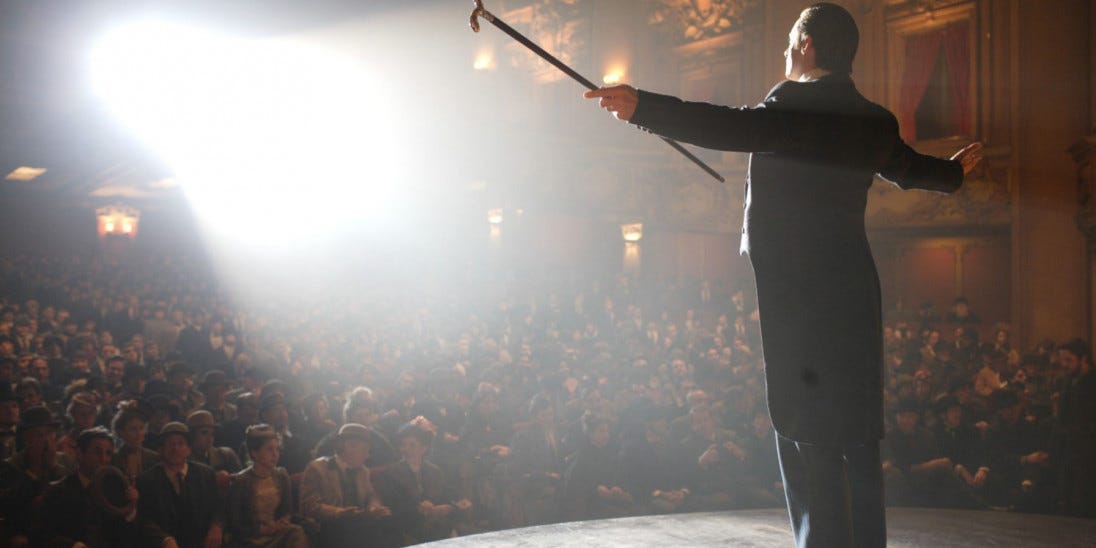
What both of them share is the conviction that they can partition themselves cleanly. Be the performer onstage and the person at home, and the two won’t bleed into each other. Borden thinks he can live as half a person and his wife won’t notice the days when the other brother is playing husband. Angier thinks he can drown himself nightly and the version that survives will still be him, unchanged, whole. They’re both wrong. You can’t spend your humanity in controlled increments and expect the rest to stay intact. The performance bleeds into the life until there’s no life left, just the performance, and by then you’ve forgotten you ever had a choice about it.
I’ve made smaller versions of this mistake. Decided I could work eighteen-hour days and my relationships would be fine because I’d decided they would be. Decided I could ignore my body’s signals because I had a deadline and the deadline mattered more. And then I’m shocked when my body gives out. My hubris is in thinking I get to decide the cost, or that I can sacrifice exactly this much and no more.
I cannot.
You cannot.
Borden's wife hangs herself. By the end, Angier doesn't know which version of himself survived. The suffering takes more than they agreed to give, and they’re both so committed to the belief that they’re in control of the experiment that they don’t notice they’ve become the variable being tested.
The Prestige keeps asking what you’re willing to sacrifice for greatness, which is the wrong question. The right question is: why do you think you get to decide? Why do you think your suffering is a controlled burn instead of just a fire? Borden dies believing that the trick was worth it. Angier dies believing it too. But the trick is just a trick. The audience goes home and forgets. The only people who remember what it cost are the ones who paid, and by then it’s too late to ask for a refund.
tv show
the rehearsal (nathan fielder)
From the very first episode of The Rehearsal, I couldn’t believe what I was seeing, a kind of manically performed absurdism that I thought only existed in the pages of Nabokov, or in the works of Harmony Korine. The show follows Nathan as he helps his subjects rehearse for big life conversations, using trained actors and elaborate sets to recreate their real lives in minute detail. He builds replica venues, casts actors as their loved ones, rehearses the rehearsal, and even builds an entire simulated parenthood setup with a woman who wants to practice motherhood and rotating child actors. And the show keeps expanding, and he keeps believing that one more controlled variable will finally make this safe. But the project soon spirals out of Nathan’s control, and it becomes apparent that he’s not just everyman, he’s also the villain.
Anyone talking about The Rehearsal as a show about anxiety, or cringe comedy, or Nathan Fielder’s specific relationship with social reality misses the real magic. The show is about showing off. About cracking a joke so elaborate and intricate that it becomes self-obsessed. About inviting your friends over to show them the coolest trick you’ve learned on the guitar, even if it’s just a couple of loops and some pedals that make it sound like a whole orchestra. About becoming so enamored of your own show-off abilities that they completely consume you, and then you lose the room. Nathan Fielder becomes his own enemy, loses sight of himself within his own show-off spectacle, and then becomes an even better show-off for it. For him, the more elaborate the rehearsal, the closer he could get to being God in somebody else’s life. The mistake other people made was trusting him to pull it off.
Hubris, in all senses of the word, becomes him. Hubris blinds you from the humility that must be held in the presence of something that cannot be rehearsed.
In a time where being like God is more easily achievable than ever, thanks to our increasingly elaborate technologies, it is imperative that we learn this lesson as a society.
film
showgirls (paul verhoeven)
I must have watched Showgirls for the first time when I was sixteen, and I remember thinking two things: that Elizabeth Berkley seemed like she was having some kind of medical emergency in every scene, and that I couldn’t tell if the movie was supposed to be funny. I’ve watched it maybe five times since then, and I still can’t answer that second question. Which is, I think, worth discussing.
Nomi Malone arrives in Las Vegas with a suitcase and a switchblade, and she leaves the same way. In between, she claws her way from lap dancing at the Cheetah to headlining Goddess at the Stardust, and the film never once suggests this is a tragedy. She gets exactly what she wants. She fucks the right people, makes the right moves, pushes Cristal Connors down the stairs when Cristal becomes inconvenient. The math works. That’s what makes Showgirls so unsettling to watch—not that Nomi fails, but that she succeeds completely, and success looks exactly as hollow as failure would have.
Elizabeth Berkley’s performance operates at a frequency that most actors would recognize as career suicide. Every line reading sounds like she’s being electrocuted. When she screams "I'm a dancer!" at her boss, she means it with her entire body. Gina Gershon is playing camp—she knows exactly what movie she’s in. But Berkley is doing method work, finding emotional truth in lines like “Maybe YOU are a whore, Cristal, but I'm not”. She’s trying so hard to prove she’s a Serious Actress that the performance becomes its own spectacle, completely unmoored from the film around it.
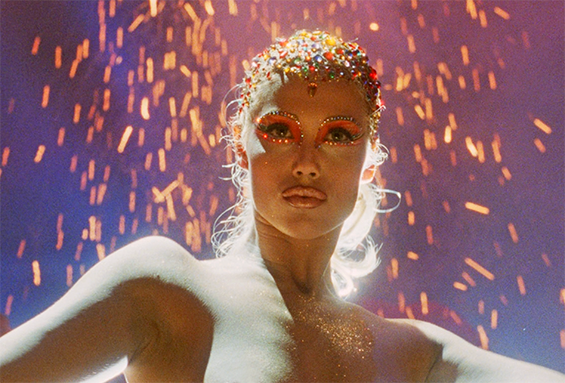
There’s a moment about halfway through where Nomi explains her philosophy to her roommate Molly: she’s going to be a star, and she says it like it’s already happened. She’s done the calculation. Desire plus ruthlessness equals inevitability. And here’s the thing—she’s right. The formula works as she predicted. She gets the billboard, the standing ovations, everything she wanted. The hubris isn’t in believing the math would work as usual. The hubris is in believing that winning would feel like winning.
Verhoeven told her to "exaggerate everything, every move”, and Berkley, fresh off playing Jessie Spano on Saturday morning television, thought she was being given the opportunity of a lifetime. She gave everything. Too much, probably. So much that the performance became unforgettable for all the wrong reasons. But watching it now, there’s something almost moving about how hard she’s trying. She’s performing for an audience that doesn’t exist—one that will recognize her brilliance, validate her commitment, understand what she’s attempting. Both Nomi and Berkley are convinced someone out there is watching who will finally see them for who they really are.
The film became a cult classic decades later, which doesn’t vindicate Verhoeven so much as complicate the question of what we’re even talking about when we talk about hubris in art. Was he right all along? Or did we just find new ways to appreciate his output? Probably both. Showgirls is about a woman who believes she deserves stardom enough to destroy anyone in her path, made by a director who believed his artistic vision could elevate material about lap dancing and revenge into something profound, starring an actress who believed her commitment could transform a ridiculous script into a showcase for her range.
Nomi hitchhikes out of Vegas in the final scene, heading toward Los Angeles with the same manic energy she had when she arrived. She’s learned nothing. She’s still convinced the next city will finally give her what she’s looking for. Verhoeven frames it as triumphant. And you could argue that’s just what hubris looks like when it’s playing itself completely straight. When you’re so convinced of your own vision that failure and success become impossible to distinguish from each other, because either way, you’re still right there in the center of your own story, still believing.
text
oedipus rex (sophocles)
The thing about hubris that Sophocles understood is that it feels like competence. Oedipus doesn’t think he’s arrogant when he decides to outsmart the oracle. He thinks he’s being responsible. The prophecy says he’ll kill his father and marry his mother, so he leaves Corinth to protect his parents. That’s a rational choice made by someone who takes prophecies seriously and acts accordingly. Sure! However, he also thinks that if you just stay alert and make smart decisions you can negotiate your way around the worst outcomes. Oedipus treats fate like a problem to solve instead of a condition to live with.
Sophocles wrote this in Athens during the city’s most unbearable period, when they’d just invented democracy and philosophy and were deeply pleased with themselves about it. The Athenians had beaten the Persians through tactical superiority. They’d built the Parthenon. They’d created a system of government based on rational discourse and collective decision-making. They thought they’d figured out how to be human better than anyone else in history, and they were probably right, but they were also setting themselves up for the kind of fall that only happens when you’re standing on top of the world convinced you’ve earned permanent residency there. Sophocles gave them Oedipus—smart, rational, committed to truth, everything they valued—and then let them watch him investigate his way into discovering he’d been living inside his worst nightmare for decades and just hadn’t noticed.
The hubris at the center of Oedipus Rex is the belief that awareness is protection. That if you can see the danger, name it, understand its contours, you can control how it touches you. Oedipus knows about the prophecy. He’s hyper-aware of it. He’s organized his entire life around avoiding it. And the avoidance is what makes it happen, because fate doesn’t care about your contingency planning. You can’t risk-assess your way out of being human. You can’t strategy-memo your way around grief or loss or the basic fact that you don’t actually know yourself as well as you think you do. Oedipus was so certain he knew who his parents were, where he came from, what he was capable of, that when Tiresias told him the truth he couldn’t even hear it. The information was right there. He dismissed it as conspiracy because it contradicted what he already knew about himself. (Also: what he knew about himself was wrong, and by the time he figured that out his whole life had already happened.)
The reason Oedipus Rex still resonates with us today is because we’re all doing smaller versions of this constantly. We think self-awareness is a shield. We think if we can just identify our flaws, understand our patterns, see our blind spots, we can correct for them. We go to therapy and learn our attachment styles and read books about cognitive biases, and we think this knowledge will protect us from repeating our mistakes. But knowing you have a pattern doesn’t mean you stop enacting it. Understanding why you do something doesn’t mean you stop doing it. Oedipus knew the prophecy backwards and forwards. He studied it, planned around it, stayed vigilant. And he still killed his father at a crossroads and married his mother and ruled Thebes for years before anyone figured it out. The knowledge didn’t save him. It just meant he got to understand, in excruciating detail, exactly how he failed to save himself.
feature story
who is the bad art friend? (robert kolker)
At some point in your life, you become the protagonist of your own story. It’s a rite of passage, an assumption of selfhood, the dawning realization that you are the main character. But what happens when you become the protagonist of someone else’s story — a story you didn’t choose to be a part of, one that, by all accounts, isn’t about you at all? You might get angry. You might laugh. You might think it’s a bit strange but ultimately do nothing. You might call your lawyer.
Who is the bad art friend? is mandatory reading if you live on the internet — but in case you haven’t read it, here’s the basic rundown: Dawn Dorland is the woman who, having donated a kidney to a stranger, made sure everyone knew about it — both in her private life and in her writing group, where soliciting praise was a favourite pastime. Sonya Larson is the woman who, after having received all the praise anyone could possibly want for her writing, decided that she could incorporate the language of Dorland’s donor letter into her fiction… and that it was fine because it was fiction. What started as a minor dispute (Larson's story ran in American Short Fiction; Dorland only read it in 2018 when it went online, two years after she'd first heard Larson was writing about a kidney donation) quickly escalated into lawsuits.
There’s much more to the story, but what fascinated me most was the way Kolker pinpoints the exact moment where moral action becomes turned into status, then into entitlement to recognition, and then into entitlement to narrative ownership. Kolker is careful to recognize the very human flaws of both parties (he resists the urge to cast Dawn as a cartoonish villain, I think, because she’s a real person and not, say, a Nolan character), but he also holds space for the way this trade-off has become a kind of cultural currency.
At the same time, I am repulsed by Dorland’s cringeworthy passive-aggressive posts, and I’m willing to bet many people would refuse to witness them. What I am deeply unsettled by is the assumption that doing something good earns you something back. The hubris we’re witnessing here is acting on the premise that being good is not good enough. You must be maybe good, but most importantly you must be recognized for being good, or at least have someone witness your forced goodness. Otherwise, it is not enough for the world to see, and it is not enough for the world to give witness — or credit — to the act itself.
I do want to end on another strain of hubris though: the certainty that we understand art better than the people who actually made the art or lived the thing. I was struck by how everyone in this story is dead sure their reading is the right one. Sonya is sure she knows what’s fair to take. The Chunky Monkeys are sure they know exactly how ridiculous Dawn is. Dawn is sure she knows what her gift was supposed to mean to everyone. And the reader is sure they know who’s right. That’s the part that should make you squirm, because we do it constantly. We think we know better than the artist, better than our friend, better than the stranger on the internet. Do we?
Hubris.

If you want to co-curate the rest of the Nolan Club with me, this is your sign to upgrade your TFS membership 🫶🏻