

We’ve arrived at the third theme of Nolan Club — and the most complex, honestly. Fate is the most difficult theme for me to reckon with in my own life, both on a personal level and within the larger context of the world we live in, and that has made it difficult to grapple with on the page. My instinct is to push this sort of thing away, to avoid disruption and discomfort, but I’m learning that it’s often through those places that we find the most potential for change and growth.
Fate (μοῖρα) is “the allotted portion,” yes, but it’s also:
what is due, fitting, or rightly ordered
the share, line, or lot assigned to us
the portion of life we keep meeting
When I first started writing this issue, I had a good laugh at the universe’s expense. Fate is a rude theme for anyone who likes to believe they are in control of their life, relationships, inbox, leep schedule even government. As I perused the evidence of fate’s work—the UK preparing its 6th prime minister in five years, the sheer elation of Jude Bellingham crashing onto the grass after the final whistle in the England vs Mexico game, a ridiculously important deadline I had convinced myself I would miss but miraculously I’m going to make—I realized that anyone’s sense of control is a joke, one I continue to tell for the sake of my own amusement.
If you’ve been following along, thank you for coming back. If this is your first issue…Welcome to fate, and thank you for joining the club ✨
film
tenet (christopher nolan)
What if, I wonder, Tenet is a modern moira story? Not moira like destiny, or fate with a lowercase f, but moira as the Greeks understood it: Moira, the path you’re already following when the gods stop to intervene. The slow moving train refusing to change tracks even as the characters on it attempt to disembark, to get to their destination sooner, to change the run of events.
In the case of Tenet, that’s a matter of life and death.
Neil walks toward the death he understands is his. He hasn’t “experienced” it in the simple human sense, because Tenet refuses us simple human senses, but the event has already happened inside the loop. From the Protagonist’s perspective, Neil’s sacrifice is already part of the world. At the same time, The Protagonist discovers that he is not recruited by fate — he becomes one of its authors. The organisation that saves him is something he creates. His moira is writing. He has to follow the line of it, to find ways to bend it, to create more space within it, to walk it forward, backward, and back into himself until authorship and obedience start looking like the same thing.
When I think of Christopher Nolan’s films more broadly, I think of the sort of rupture that makes the entire universe feel different. Something has happened that affects everyone, and you either have to reckon with it or continue on and risk being left behind. But in Tenet, a joyous embrace of the ridiculousness of its own concept, Nolan makes a film that, on an emotional level, mirrors the feeling of growing up under algorithmic fate more closely than any of his others. The Protagonist doesn’t have free will, but rather an intricate set of scripts and loops designed to create the illusion of choice. However much he might think otherwise, he is not a free agent operating outside the rules of time and physics, but a cog in a machine that has already planned far more than he understands. Even the Protagonist’s name — the Protagonist — is a script he has to follow, attached to him like fate. There are rules, and he has no choice but to follow them.
In Tenet, free will keeps running into a world that seems already arranged. The Protagonist thinks he’s improvising, but he isn’t. Some of the people guiding him are there because a future version of him helped build the path. Neil returns to help him because he has already done it; he has already been on the Stalsk-12 mission and died in the process. And of course the Protagonist will go on to found the organisation that saves him. So much of this has already been built around him by the Protagonist’s older future self, who orchestrates the counter-operation with incredible foresight, like a video game about time travel where all the cheat codes are written by a single person.
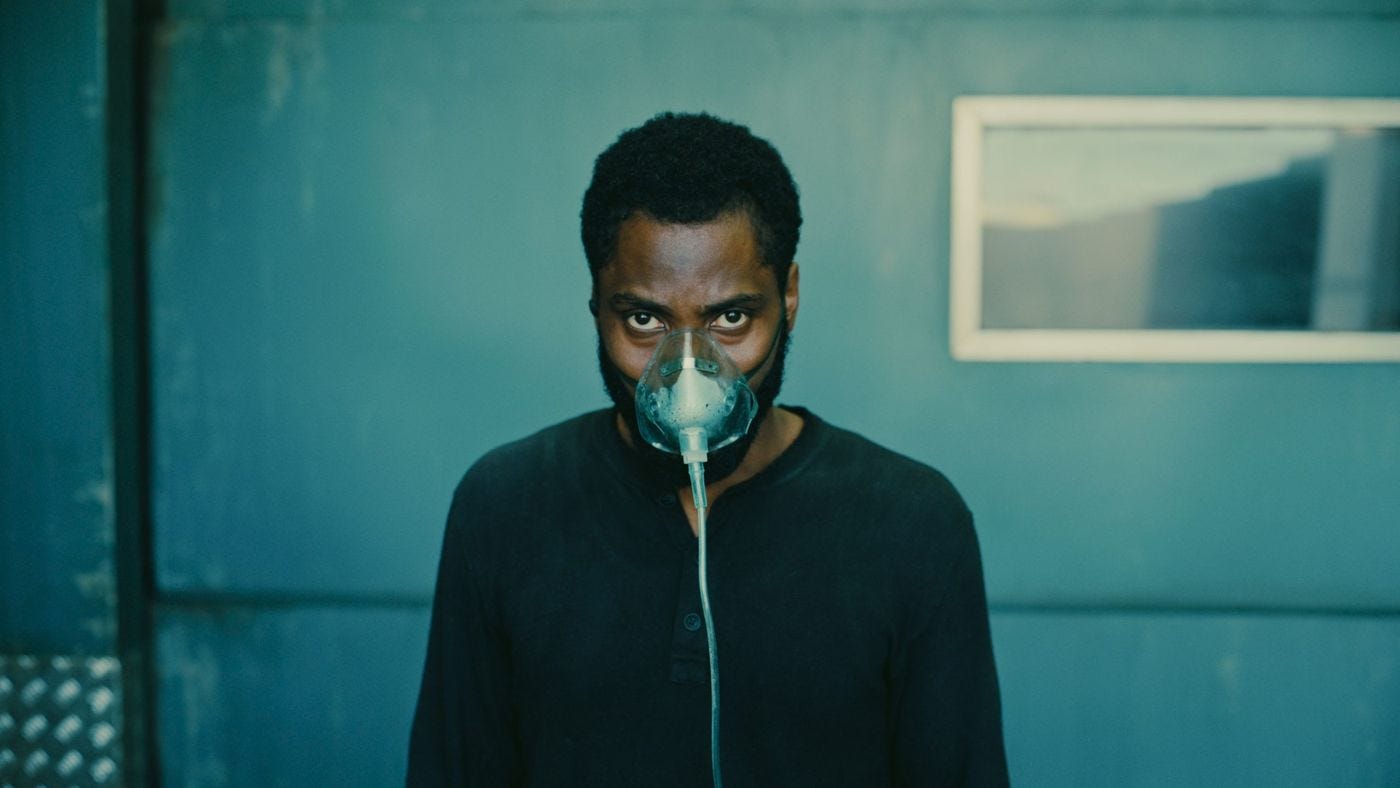
Much like a social media algorithm, Tenet’s built loops restrict the Protagonist’s actions and create the illusion of control. You believe you are choosing your own actions, but in reality they have already been decided for you. The future Protagonist is an architect with hindsight, and like all architects, he can only see the consequences of his designs once they’ve already been put in place.
Neil says in one of the final scenes, “What’s happened’s happened. Which is an expression of faith in the mechanics of the world. It’s not an excuse to do nothing”. It’s a faith that Tenet’s characters must put in the mechanics of their universe in order to get through the strange loops, but it’s also a philosophy that many people live by and attempt to use as justification for their actions.
What’s happened’s happened. Sometimes, for Neil, this feels like the only way to live.
novel
the secret history (donna tartt)
Everyone knows The Secret History is about murder, but the reason it’s still relevant is that it understands the humiliating glamour of wanting your life to become more serious, more ornate, more fatal. The fantasy is not just “what if I studied Greek with hot rich weirdos.” The fantasy is: what if my life had form? What if the ugliness I came from could be revised into ritual, language, beauty, danger? What if I could step into a story so powerful it would finally tell me who I am?
That’s the moira.
A boy from unglamorous Plano, California — Richard Papen is an easy subject for disdain. But his rapturous voice is one of the many reasons I’m still captivated by The Secret History nearly a decade after my first read. Tartt knows that to make a reader love a character — or at least never want to leave their side — is to show them something exquisite. This is a story about death and moral rot, but in Richard’s voice it reads as a love story. Richard learns the hard way that beauty will not save you, but Tartt has him (and us) on the hook at first, stringing us along with rich descriptions of the rare and precious delights of privileged life. Richard pursues these things desperately, hoping that they will make him beautiful, and perhaps change him into someone capable of being loved.
Out of jealousy and longing, the reader suspects that Richard is almost too willing to abandon his moral compass in service of grasping the beauty that threatens to slip through his fingers. His moral decay and aesthetic elevation are intertwined; Tartt doesn’t let Richard’s attraction to beauty sit innocently beside the evil; she makes the two feed each other. The more enchanted he becomes by these people, the easier it is for him to look away from what they are doing.
This is the dark side of beauty — seductive, and Richard and the reader learn the hard way, dangerous. But is Richard really the only one seduced? Every character in the novel, from the tragic Bunny to the feral Camilla, invites our sympathy. Isn’t it more truthful to say that we want to live in their beautiful world, even though we know it’s a trap — and that this, in essence, is the fantasy of being young and hot, even when you are not?
Moira, as I originally understood it, was a kind of story, and you chose your story, not the other way around. But perhaps this interpretation of fate is a little too hopeful. Richard chooses his story, and then it begins to choose him. This is the true darkness of the beauty that Richard pursues: not lightning from the gods, but self-sentencing by aesthetic. The beautiful dorm, the chosen friends, the Greek, the cashmere coats, the fantasy that proximity to clever people will transform you — and then the bill comes due.
This is the story of my twenties, by the way! Mesmerised by beauty, so desperate to be swept away by a dark and talented boy that I would sacrifice my dignity and safety for the privilege. When you are young, attractive things feel like magic — they promise to take you far away from your ordinary life, and sometimes they do. More often, they don’t. They leave you in the cold remnants of a familiar reality, holding someone else’s story.
I love this book so much.
film
the witch (robert eggers)
Fate is the story other people keep telling about you until the world rearranges itself to make them right.
Take Robert Eggers’ The Witch, a restrained little horror film about the birth of American evil. A story about Puritanical repression and misogyny, yes, but also about belief — belief in God, in Satan, in the evil that lurks around every corner, in the particular evil of the girl standing right there in your kitchen. It’s the family’s misplaced faith in the darkness of the world that leads to their downfall. They live as if the world is a test, and the woods answer in the form of a real witch in the woods. That is part of the terror in Thomasin’s story, sure. The greater tragedy is that her family has no imaginative category for her except sin, temptation, disobedience, and blame — and I think most women who grew up in a household with an opinion about us know exactly what that claustrophobia feels like.
And so regardless of how the story is told, it’s Thomasin1 who survives the onslaught. She is the most capable person in this family by a distance, the one keeping things together while her father fails to make the farm yield and her mother folds inward with grief. And yet, through the eyes of that same family — most violently her mother’s — the only future available to Thomasin is the witch. I’ve written before about the primal fear of female adolescence at play in the film, but though Eggers leans into it, it isn’t the only reading available to him, or to us. I believe in the witch because I believe in people. There is nothing they will not do when they have decided your fate.
Katherine is relentless in her condemnation of her daughter. William is more sympathetic, mostly meaning he is more useless — seeing more than Katherine does and still not saving Thomasin, as men in possession of a conscience and no spine have always done. Flora’s udder gives blood instead of milk. The crops fail. Caleb comes back from the woods changed and delirious and then doesn’t come back at all. Each new disaster narrows the circle, and Thomasin is standing in the middle of it, getting smaller.
I chose The Witch for this issue because it understands fate as a family system long before it becomes a supernatural event. Thomasin is not born free and then cursed. She is born into a household that needs a vessel for dread, hunger, failed faith, sexual panic, maternal grief, paternal weakness, and sibling weirdness. Congratulations, babe, you’re the eldest daughter. You’ve just met moira.
But Thomasin’s moira does not just wait for her — it runs to her.
When Samuel disappears and the family says a wolf took him, Thomasin becomes the place their grief and suspicion go. Katherine says God has cursed this family, because of course even the accusation has to pass through theology before it lands on the girl standing in the room. God may be the subject of the sentence, but Thomasin becomes the object of the family’s fear. Katherine has been waiting her whole life to point the finger at the woman who stole her son, and the fact that the woman is her daughter is not a complication — it’s practically a relief. The world, once it decides what you are, has a way of making sure your own family doesn’t get in the way.
They were chosen.
They deserve her.
On the Sabbath, when Thomasin joins the witches’ circle and laughs high above the trees, she does not feel free, exactly — freedom isn’t quite the word for what happens when every other door has been locked from the outside. She is not made a witch by her family but turned into one by them, slowly, over years of accumulated accusation. “Wouldst thou like to taste butter? A pretty dress? Wouldst thou like to live deliciously?” Black Phillip asks. She says yes. The bar for temptation is butter. A dress. The Devil is offering her the things her own home made impossible.
That is the sick joke of accusation becoming destiny: the fascistic control of a Puritan family and the hedonistic excesses of a witches’ sabbath are both prisons. When a girl is treated as dangerous for long enough, danger is the only door left open.
book/tv show
the handmaid’s tale (margaret atwood)
I know you’re already smirking because the book literally contains Moira and you’re like, wow Sophie, so clever, so original. Well done, you made the joke before I could. Now, let me take it away from you just a little bit: as funny as that little coincidence is, The Handmaid’s Tale’s actual moira problem is much more grim, much more practical, and much more terrifying. Gilead doesn’t need mythic Fates when it has names, uniforms, rooms, routes, rituals, wives, commanders, aunts, and enough language to make captivity sound like purpose.
I remember when the TV adaptation of The Handmaid’s Tale first premiered in April of 2017, launching a whole new wave of Atwood’s novel into the zeitgeist. The show was eventually put on my list of media to avoid for many reasons, but in the early days, I remember speaking to a colleague about it. “Is it good?” I asked her, assuming she would be able to read my face and body language like a book. I was not ready to give it a shot, but neither did I want to sound like I was dismissing a major work of fiction. “It’s horrible,” she said, deadpan. “It’s so horrible.”
And in case my face hadn’t already anticipated this, she continued: “And I mean that in the best way. You should watch it.”
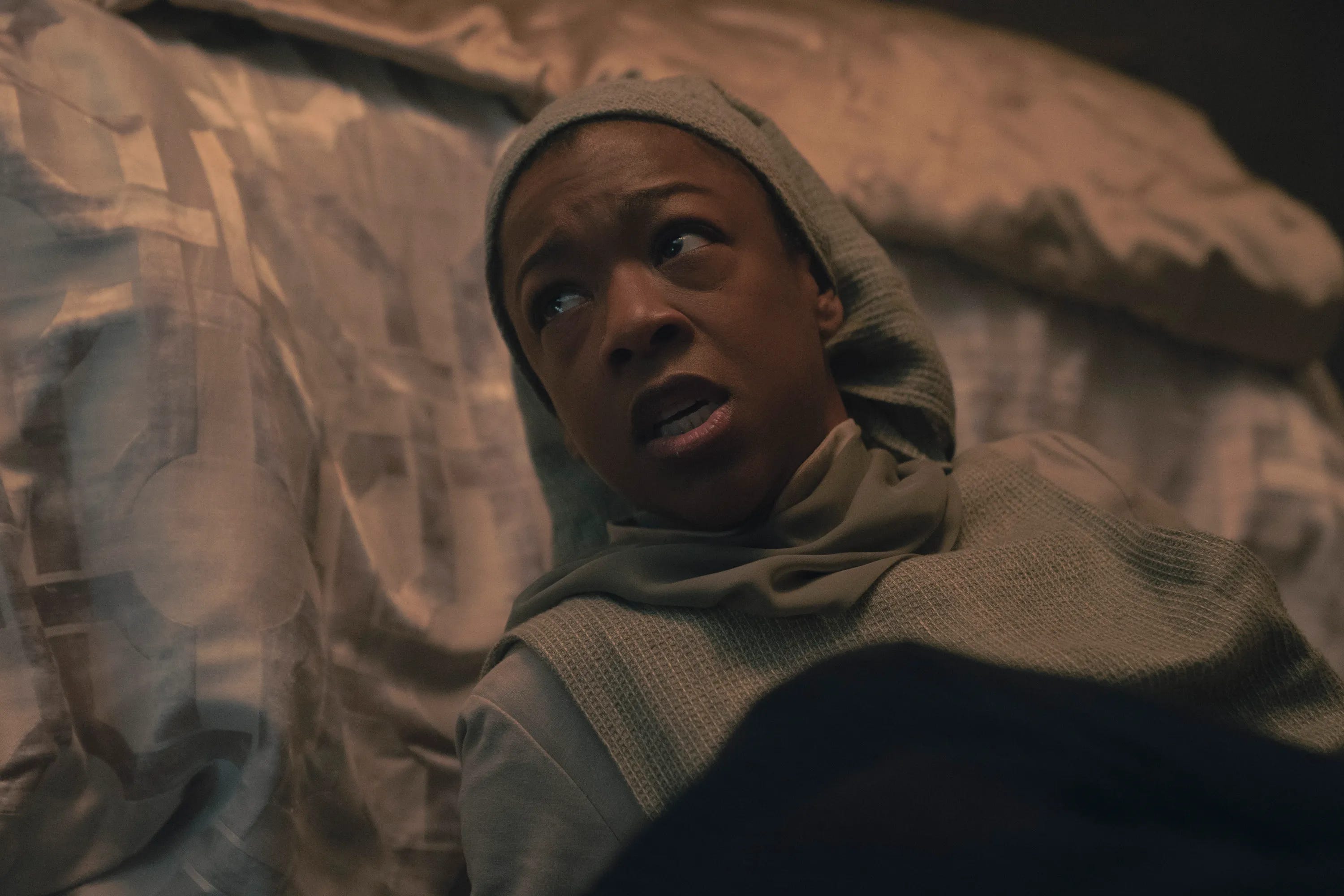
In Gilead, Offred’s survival runs on her instinct to live. The cost of that survival is that compliance can look like consent from the outside. Although she did not choose to become a Handmaid, she has been stripped of choice so thoroughly that now every choice available to her has been engineered by someone else. Technically, she can choose where to look, what to remember, how much of herself to keep hidden, how to walk through a room without giving Gilead the satisfaction of seeing all of her fear. Small things, but critically important when the alternative is total surrender. From the outside, Offred appears to have accepted her new life. She wears the red cloak and participates in the Ceremony. She holds hands and prays and is pushed toward Nick by Serena Joy before that relationship becomes one of the few places where her own desire and Gilead’s apparatus become horribly tangled. The eyes of Gilead see consent in her compliance.
But Atwood’s novel argues that survival never looks like rebellion from the inside. Within Offred’s mind, her choices are acts of defiance against Gilead. Even if they are not real acts of rebellion — and even if they are part of the Gilead system designed to give her a false sense of autonomy — they matter to her. She clings to them like a baby holding their favorite toy before bed; it doesn’t matter that it isn’t real attachment, just that it makes her feel safe enough to sleep.
The best passages in The Handmaid’s Tale are often the most grotesque, and they all illustrate what the female body as assignment — and as fate — looks like. Gilead doesn’t just oppress women; it converts women into roles and then pretends that the role is natural, ancient, holy, inevitable. The horror is that the regime has a whole vocabulary for why her captivity is her purpose. You can’t escape Gilead, because you were made for Gilead, and Offred’s Handmaid name — literally “of Fred” — is designed to sound like identity while functioning as ownership.
These descriptions in The Handmaid’s Tale have a life of their own. They’ve been adapted into memes and muted images, and they travel under the easy banner of “feminism” and lodge themselves in your brain. But Offred’s body is both fascist imagery and the body of a woman who deserves to be free. You can’t escape Gilead, because you were made for Gilead. You can’t escape moira, because moira is what has been assigned to you. Given enough time, Gilead wants the handmaid to wear her name like any other.
film
a woman under the influence (john cassavetes)
If you haven’t seen A Woman Under the Influence, Gena Rowlands plays Mabel and Peter Falk plays Nick, her husband and a construction foreman. Mabel whirls through scenes like a hurricane with a high-pitched cackle that will shred your nerves and make you laugh at once. She talks too loud and too fast, misinterprets jokes, intrudes on the conversations of Nick’s crew when they come back to the house after a shift — tries to fit herself into their world as best she can but can’t quite read the room. At home, she serves spaghetti to Nick’s crew for breakfast. She loves hard and she wants every person around her to be happy. When Nick leaves for work, she chases him out of the house and begs him not to go. She wears high heels around the house and puts on lipstick after he leaves anyway, because even though he will be gone for hours she still wants him to know that his wife is beautiful. Everything about Mabel is “too much.”
This “too much”ness is unsustainable — unsustainable for Nick, who must play the dutiful husband in public while coming home each night to a woman whose energy makes him feel small and unsure; unsustainable for their three children, who cannot always rely on their mother keeping it together; unsustainable most of all for Mabel, who pushes against the boundaries set by everyone around her but doesn’t quite have enough strength or support behind her to break them completely, so instead just rubs herself raw against them every day until they settle into a rhythm of violence.
When we first meet Mabel we might think she is eccentric or free-spirited, but we very quickly come to discover that there isn’t much freedom left in it anymore. She tries too hard at everything because everything has become an act meant to soothe those around her into believing that she is not actually breaking as badly as they all insist. She is inherently trapped.
But Mabel’s trap is not only cruelty. Sometimes the trap is everyone agreeing too quickly on the story of you. Mabel’s fate is sealed, in part, by everyone around her expecting her to give her heart to her family, and not to herself. When Mabel is sent away for psychiatric treatment, she returns quieter, changed, empty. Nick wants Mabel to be okay, but Mabel at her most okay is the woman who cleans the house on time, doesn’t go out and become impossible to explain, and never gets into an argument with her husband. What Nick, and everyone else in Mabel’s life, wants from her isn’t very different from what the family wants: to be small, to be quiet, to go through life without making too much noise.
Early in the film, Mabel says, “Tell me what you want me to — how you want me to be. I can be that. I can be anything.” The film makes it clear that normal means a woman who accepts her fate, believes she belongs to her husband and children, and resists nothing. It means a woman who will agree with the story everyone else has already decided on.
Fate, in this context, is the life other people keep allotting to you: wife, mother, hostess, patient, problem, beloved disaster. Fate is being watched too closely by the people who love you. Fate is sleeping in a bed that makes you anxious every night because your family doesn’t want the healthy version of you exactly and anyway it would ruin your husband’s story if anyone did actually think his wife was nuts.
But Mabel’s story reminds me that fate can also be a cage, a space where you can’t make any noise and where your body is not even yours. “Just be yourself” is a nice thing to say. What if everyone else has already agreed on who you are?

If you want to co-curate the rest of the Nolan Club with me, this is your sign to upgrade your TFS membership 🫶🏻
Eggers has said Taylor-Joy’s was the first Thomasin tape he saw, and even after watching many more, she remained the one. It was her feature-film debut, which gives the whole thing its own tiny fate-joke: the girl no one had really seen yet arrives already looking like the only possible Thomasin.
Just wanted to throw my two cents in, Gena Rowlands is a great actor. I distinctly remember watching A Woman Under the Influence and having to consciously relax my body, I was just wound so tight by some of those scenes. It is so painful to watch her anguish. Also let’s not forget that Peter Falks supposed normal guy gets his children drunk. Who’s really the unstable person in this relationship?
Great read as always! Need to rewatch The Witch and Tenet again, as well as A Woman Under The Influence. That one was such a devastating movie. Thank the fates (pun!) that John Cassevetes made it at that time cause I doubt he have gotten it made today.