


Hello, friends. If this is your first issue of my newsletter, you might be wondering: What’s this? Could it be? That Final Scene is actually writing about a final scene? That’s right, folks. You are getting a deep dive into a movie’s ending…and specifically, A24’s The Drama.
I’m glad to be honoring my roots, because Sophie’s Law states that the best part of any movie is always the final scene. If you haven’t seen the movie yet, I’m giving you a big ol’ spoiler warning to exit stage left. Or if you like reading spoilers, hey, I’m not going to stop you. Enjoy!
At the end of The Drama, Emma and Charlie end up in their special diner. Charlie arrives first. He is bloodied from the reception, where the whole edifice of the previous ten days finally gave way in spectacular fashion. He orders a cheeseburger and a Diet Coke. Emma walks in still wearing her dress. She orders at the counter. She then sits down across from him. And instead of continuing the conversation — the one that started at a regrettable food and wine tasting — she introduces herself.
Hi, I'm Emma. He plays along.
Hi, I'm Charlie.
They hold hands. The film ends.
It is, on its face, a lovely ending. Earlier in the week, Emma had tried this same game with Charlie when he was spiralling — meet me fresh, she said, pretend we're strangers, pretend you're just finding out who I am. He couldn't do it then. The walls were closing in. The fact that he can do it now, despite everything that happened, is Kristoffer Borgli's argument about love: that it can choose, at the last possible moment, to begin again. We're being seduced by the velocity of the gesture — look how fast they can move past this! One can simply delete one's philosophically incoherent traumas and emerge as a pristine version of oneself just by updating the nomenclature, like changing your Netflix password after a breakup.
But as I watched them play-act at being strangers, I couldn't help but feel that something in the room had already curdled. There is a fundamental difference between forgiving a person’s plans and forgetting what you’ve conjured up: the terrifying geometry of their face while they were making them. Borgli wants us to believe in the reset, but the invisible architecture of that booth has already reorganized itself permanently around what Emma disclosed.
Which leads to the one thing the film’s graceful ending made me question: what exactly are we being asked to forget so that this romance can stay upright?
This question leads us directly into the path of Erving Goffman. In his 1963 book, Stigma: Notes on the Management of Spoiled Identity, Goffman dissects the way we move through the world when we carry a trait that society deems deeply damning. For Goffman, social life is a constant effort to maintain a working consensus—a shared agreement between people that everyone is exactly who they appear to be. You're a bookstore clerk, I'm a customer, we both pretend these identities are stable and complete and nobody mentions the fact that I’m three months behind rent or that you once shoplifted a Cadbury Creme Egg because you were having a bad day.
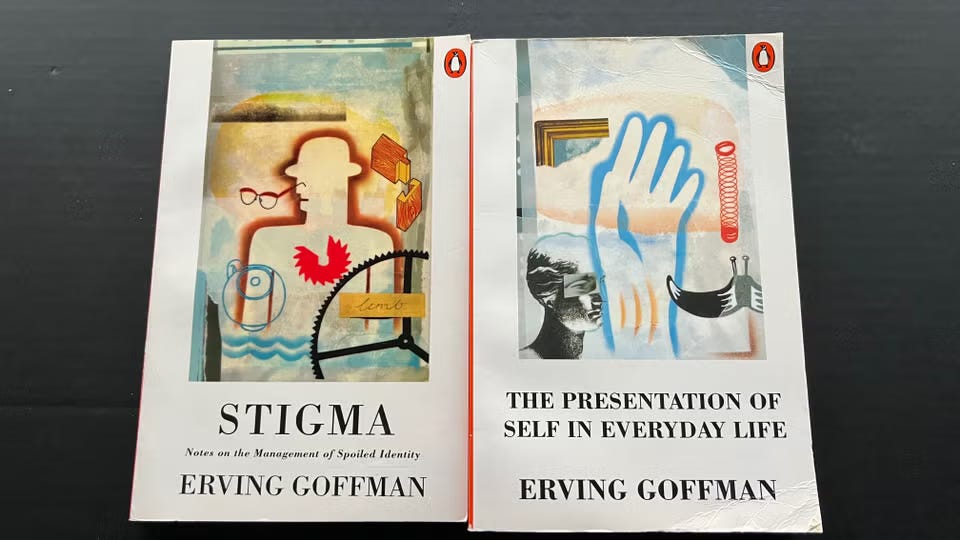
Stigma is what happens when the mask slips and reveals something we have decided is deeply damning — what Goffman called a spoiled identity. It's the gap between who you're pretending to be and who you actually are, except the "actually" part is usually just the thing that confirms every prejudice the room was already holding about you anyway. He split the world into two camps:
First, there are the discredited—the people whose flaws are visible the moment they cross the threshold. They are the known entities, carry-ons of deviance whose physical presence dictates the terms of the room before a single word is even spoken. Judgment is the tax they pay for existing.
Then, there are the discreditable. These are the people with secrets tucked into their pockets, surviving through the quiet, obsessive, and ultimately exhausting art of passing. This is a high-stakes, 24/7 management of undisclosed information where you are keeping the room ignorant of a truth you haven't authorized. The moment Emma speaks in that food and wine tasting, the transition is final. She moves from one camp to the other. The consensus dissolves. The literary editor Charlie loved is replaced by a record of treacherous, evil intent.
To make this even more complex, Goffman differentiates between the types of stains we carry.
Abominations of the body — disabilities, disfigurements, the ways flesh can fail to cooperate with social expectations.
Blemishes of individual character — the addiction, the breakdown, the criminal record, the plan involving a rifle and a school bus.
These are things you can sometimes hide if you're “disciplined” enough and “lucky” enough if people aren’t looking.
But then he introduces tribal stigma: race, religion, national origin, and the things transmitted through bloodlines that mark you before you've even done anything wrong. Most people are managing one or the other, but Emma is caught in a complex collision across all of them. She is a hard of hearing mixed race Black woman managing an identity that is specifically, dangerously “discreditable”. Her body is already being read by a room that has its own prehistoric ideas about tribal stigma, and she is trying to layer a managed identity over a secret that, if revealed, would confirm every structural prejudice the world already holds against her.

I know the shape of this mechanism even if my version was embarrassingly low-stakes by comparison. When I moved to London at 24 I was dragging a decade of clinical depression behind me like a wet overcoat I couldn’t take off no matter how many times I tried to leave it in the Uber. I hated who I was — Sofia, the Greek girl who couldn’t get out of bed most days, who’d spent years lying on a bedroom floor in Athens staring at the ceiling or watching back-to-back movies and wondering if this was just what life was going to be forever, a series of days strung together by the thin thread of not quite wanting to die but also not particularly wanting to be awake — and so I did what anyone would do when confronted with an identity they find intolerable: I deleted her. I was born Sofia. I got off the plane at Heathrow as Sophie. I decided I wanted a new name, a new country, and in extension, a new self.
It worked for a while. “Sophie” was a cohesive unit of vague London-adjacent sophistication — someone who went to gallery openings and knew how to pronounce “Shoreditch” without sounding like a tourist and had a good story about the time she saw Jack O’Connell at a pub. Nobody asked where Sofia went because nobody knew she’d existed. I was passing. I’d successfully managed the discrediting information of my past and built a new consensus in its place, and for a few years the whole performance held up beautifully. I was the girl who’d always been Sophie, who’d always been fun, who’d always known how to show up to drinks without spending 45 minutes in the bathroom first trying to remember how to make her face do the thing that signals “I am having a good time and you should continue talking to me.”
The problem with Goffman's working consensus is that it's always a temporary truce held together by everyone agreeing not to ask too many follow-up questions. Years later, when I finally felt secure enough, I started telling people the truth. Oh yeah, I used to be Sofia, I changed it when I moved here, a bit of a rebrand, you know how it is hahaha. My family still calls me that. I thought my current standing would act as a shield. It did not. I’ve watched it happen in real-time—the way some people who have known me for years suddenly look at me with a new, narrowed focus. Their eyes recalculated my value. The room darkened because I’d introduced a version of myself that they weren't prepared to manage.
Even at this scale, where the secret is much lighter, the social space contracts. It proves that the "reset" is often a myth. The room doesn't forgive the disclosure. Once the identity is spoiled, it simply builds a new, smaller box for you to live in.
So when Borgli frames that diner ending as a romantic grace note, as two people choosing to meet each other fresh and leave the past behind, I'm sitting there thinking: who exactly is doing the work of forgetting here? Because it's sure as hell not Charlie.
Thomas Nagel wrote an essay in 1979 called "Moral Luck" that I should note everyone should be forced to read before they're allowed to judge anyone for anything. Nagel's whole argument is that the self we take credit for — the good person, the moral actor, the one who makes the right choices — is mostly just a pile of accidents we didn't authorize. He called this constitutive luck: the raw materials you're assembled from before you've even had a chance to fuck it up yourself. Where you're born. Who your parents are. What language you speak. Whether the house you grow up in has books or guns or both. Whether you're wired for serotonin production or whether your brain decided early on that happiness is a bourgeois affectation and you should probably just get used to being miserable.
Emma Harwood at 15 was built from materials she never requested. A Louisiana zip code with approximately zero mental health resources and a political culture that treats school shootings as an inevitable feature of American life. A white Southern school where being Black and angry meant you were already being watched, already being categorized, already being written off as a problem waiting to happen. And a rifle sitting in the house like a toaster. Borgli documents all of this with what I can only describe as anthropological glee — the internet radicalization, the YouTube videos, the whole prefabricated script for teenage rage that American gun culture hands to teenagers everywhere.
Charlie, sitting in that diner holding her hand, loves the Boston version of Emma — the woman who had the constitutive luck to escape Louisiana, to get into a good school, to reinvent herself as someone who reads theory and has a job she enjoys and is kind and empathetic. He struggles to see that this version of Emma is built from the exact same pile of materials as the girl who walked into that school with a rifle. The only difference is geography, time and timing. She got out. She got lucky. Holding her past against her is just a way of judging the factory while demanding the finished product meet luxury specifications.
This selective morality gets even more complicated when the room starts doing the math on resultant luck. Nagel’s point is that we judge people by the outcomes they can’t control—like two drunk drivers who both make the same mistake, but only one is a "monster" because they happened to hit a pedestrian instead of a curb. In the world of the film, Rachel actually locked a disabled neighbor in an RV. It was a finished, bounded act of cruelty. It's awful. Everyone agrees it's awful. But it's also done. The wound has scar tissue. Emma, however, is the near-miss. She stopped herself. And because her tragedy never actually happened, it remains "open" in the minds of everyone in that room. The "what if" is an infinite threat that a completed crime can’t match.
Zendaya’s casting makes this open wound bleed. The film explicitly mocks the idea of her as a threat, noting that someone like her—a lithe, modelesque Black woman—doesn't fit the profile. School shootings are overwhelmingly committed by young white men, and the whole infrastructure of American radicalization is built around their grievances. She's the wrong shape for the fear. Except the room hears the logic and ignores it. They collapse Emma’s blemish of character and her tribal stigma into a single, terminal category. As Goffman predicted, the second her identity is activated as a stigma, it reorganizes every other piece of data the room has on her. Her restraint is no longer a triumph of character. It is a close call that could still go off.
The real rot, though, is the asymmetry of the "passing" going on in their relationship. Charlie is a man built on his own charming, low-stakes deceptions, like the time he lied about reading the book Emma was reading. By Goffman’s rules, he’s just as discreditable as she is—he is managing a secret to maintain a standing he hasn't earned. But for a white man, concealment is a meet-cute, a harmless anecdote for the wedding toast. For a Black woman, it’s a threat to the social order. One person’s "passing" is a love story. The other’s is a crime. Charlie sits in judgment of a constitutive luck he never had to navigate, totally oblivious to the fact that his own innocence is just another accident of the materials he was given.
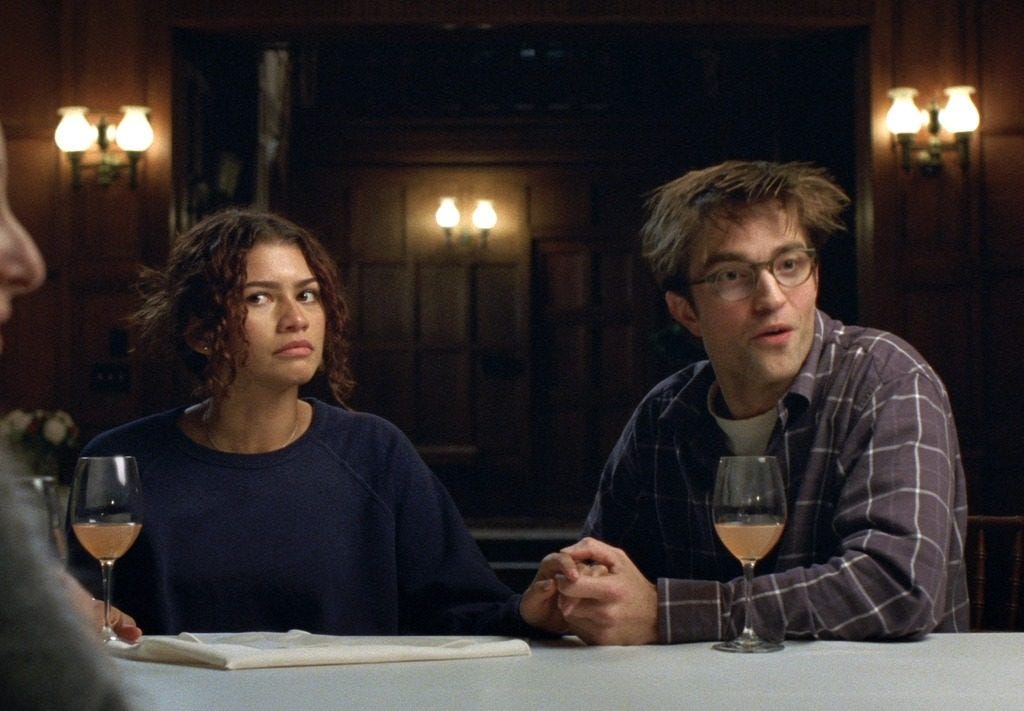
But here's where the high-minded structural empathy I've been building collapses under the weight of what's actually on screen. Because at some point you have to confront the tapes. Emma's recorded manifestos are not theoretical exercises. They're not vague teenage angst. They're a blueprint for mass murder recorded by a fifteen-year-old girl who'd already moved past the planning stage and into logistics. It is impossible to simply defend her through the lens of a bad upbringing when you’re watching footage of her hauling a rifle. The only reason she didn't leave a pile of bodies behind was because a different killer happened to get there first. Her ultimate restraint was a fluke of timing.
You can explain the assembly line that built the monster, but the monster still showed up to do the work. You can call Rachel cruel, vindictive, unable to let the past go, poorly written (if we’re being honest) but she's also reacting to a very real fact: Emma Harwood did plan the school shooting. Rachel’s cousin, sitting in a wheelchair, is the permanent, physical record of what Emma is capable of. Once you admit that Rachel has every reason to be afraid, you are forced to admit that Emma’s intent could be a permanent, dangerous part of who she is.
This all also suggests that the damage done to a teenager by 15 is so totalizing that the distinction between "wanting to kill" and "actually killing" starts to vanish. The conversation moves away from the possibility of a "reset" and toward a kind of social disposal. Everyone watching—Charlie, Rachel, and ourselves—is forced to decide if Emma is a person who can actually grow, or if she’s just a finished product of a broken kiln, written off before she ever had a real chance to fail.
Borgli wants to pivot to a reset, but the film’s own logic has already locked the doors. To believe in this new beginning, the room must perform a double-erasure: it has to un-know the blemish of the rifle and un-activate the tribal stigma that the confession set on fire. Goffman’s math says this is impossible. Once the identity is spoiled, the stains are permanent. And Emma’s tribal stigma was never a secret to be managed. It was the baseline the room used to calculate her threat the moment she spoke.
The room doesn't forget and the vibes changed and they both know it, but people do this constantly anyway. At the supermarket, at work drinks, on the tube, in their beds late at night deciding whether to stay or go. Someone walks into your life carrying something the room has already decided about — infidelity, bankruptcy, prison time, a mental collapse that leaves forwarding addresses — and you fall anyway. The mechanics still apply and stigma corrodes exactly as mapped, but the alternative is walking away from the person who makes your chest feel like something's trying to break out.
Think about the last time someone told you about choosing their person when the entire world said run. Your best friend who went back to the boyfriend who cheated with her sister and somehow made it work for three more years. Your colleague who married the woman with three restraining orders from three different states. The guy at the bar who kept showing you photos of his girlfriend — the one his family won't meet because she stole his mother's jewelry during Christmas dinner two years running — and he knows she did it and stays because he's decided that loving her beats his mother's sapphires. You remember thinking they were TOXIC and you remember the exact texture of your own judgment.
And maybe it did end in catastrophe, maybe your friend's wedding imploded exactly like you predicted. But they chose it with open eyes anyway. The room had decided and they looked at all that data and said yeah, I see it, and I’m still choosing this because the alternative is so much worse.

Charlie, in the final scene of the film, knows Emma in this diner is built from the same constitutive luck as the girl who walked into that school planning murder. And he reaches across the table anyway.
Love is the choice to write your own line when the room's script ends. Full knowledge that the stigma persists, full understanding that the mechanics say no and Goffman was right and Nagel was right, choosing anyway because what else is love except deciding that the person in front of you matters more than your own social legibility. In its context, people are the fools who decide that living in the gap between what-they-know and what-they-can-bear beats walking away with clean hands. Borgli is showing us what happens when you choose someone after the disclosure. Sometimes you choose the delusion together because the truth is unbearable and at least you're not bearing it alone.

If you enjoyed this essay — a) thank you, b) please consider tapping that lovely little upgrade button below to unlock post access to the TFS chat, The Reader Hotline, and original investigations. It’ll be the best $$ you spend all month. Annual is always cheaper 🫶🏻
This is probably the best analysis and deep-dive into the film I've read yet. So many people are trying to decode, discuss, rip apart, diagnose it, etc. But I feel like they are missing so much nuance. Yet, I feel as if you've done so much work here to pull out what Borgli is doing (or at the very least what could have been intended).
Saw this tonight. My son (19) took me as a birthday present. I’ve been taking him to the cinema since he was 18 mts old… We chatted it through in the car on the way home - far from the incredibly detailed and informed piece you write above! (Thank you for it. Brilliant. Just brilliant.)Me, the baggage of growing up in Belfast - him - no baggage. What we ended up with is we both would have stayed in the relationship. 15 is a long way from 30. And at 52, I can say 30 feels light years away. We evolve daily… At 15, well, I wasn’t sure I wanted to be on this planet any more. And that changed overnight. Because teen emotions are enormous and a rollercoaster. I actually felt aggrieved that Robert Patterson’s character was so unforgiving…