


Joachim Trier’s films hit you like a polite heist—someone sneaks in, swipes your emotional spleen, holds it up like an art piece for a hot second, then shoves it back in without so much as a “sorry for the inconvenience”. You stumble out of the theater hollowed and weirdly tender, trying to pretend you’re fine while your brain’s still stitching itself together. I sat through Sentimental Value at the London Film Festival last October, then went to a party where a poor guy handed me a cheese board and I almost wept like I’d just been personally roasted by Camembert. That’s either a tribute to the film’s subtle devastation or my tragic lactose-intolerance to feelings—maybe both.
Which is why I’m delighted to say that the film is now streaming on MUBI — a place to discover great, ambitious cinema, from emerging auteurs to iconic directors. They distributed our darlings Aftersun and Souvenir Part II and have recently put out Die My Love, It Was Just An Accident, The Mastermind and Sentimental Value (Trier gang rise up!!).
You can get 30 days of free streaming at mubi.com/finalscene 🔗
This is also why I was equally thrilled when the TFS Reader Hotline1 landed a voice note about the film. Nando, a super thoughtful supporter of the newsletter, sent it to me a few weeks ago. He wanted to talk about a specific scene in Sentimental Value — and not one of the obvious ones.
Edited transcript:
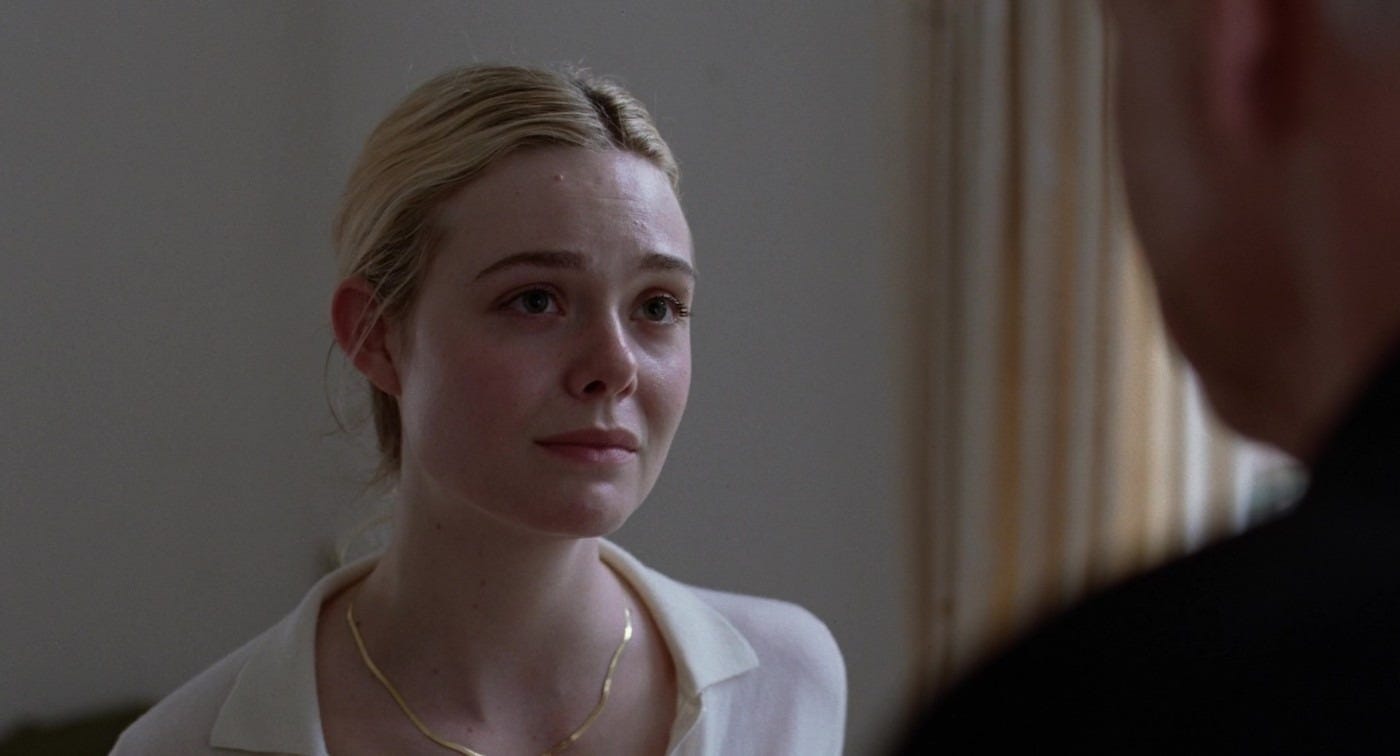
“The scene that really triggered me was when Rachel Kemp goes to Gustav Borg’s house and withdraws from the film. She says she doesn’t want to disappoint him. He answers that she doesn’t. They hug and she cries. That scene really hit me hard — even harder than the typical scenes that make people cry in this movie — because of that feeling of realizing: this isn’t your story to tell. That even though it resonates with you, you’re not the vessel for this art to be made. It’s someone else’s story. You’re merely a witness to it. An important witness, but a witness all the same.”
Hernando, I swear I grinned when your voice note started. I love movies and I love talking about movies, but I also love when I hear someone else nail a feeling I’ve been fumbling for words on. Sentimental Value is a film I adore but I also don’t think about often because when I do, I get weirdly…sad.
Witnessing sounds soft as a word—kind, even—but it drags you into everything. It means watching, yes, but also carrying, feeling, knowing. Folding yourself into another’s story without folding them into yours. It’s holding space without elbowing in, telling without owning. And god, the power packed into that. But you have to watch yourself. Witness too hard and it slides into possession, the story no longer theirs but yours to flaunt or fix. Then comes the dull throb of adjacency—a slow, persistent pain that says, I care too much, and that very caring marks me as the outsider, the one who shouldn’t have to bear the weight. This half-step, this delicate overreach, that’s Rachel’s entire orbit in Sentimental Value.
There’s also so many questions around the ethics of proximity — too close and you’re just a gossip with a press pass, too far and you’re a clueless bystander playing at empathy. Access journalism thrives on this confusion. Like every acting teacher screams at you in week one: you nail a role by inhabiting it, then ditch the ego long enough to let the character breathe outside your control.
But what happens when you’re only meant to witness? I’ve started to feel a strange combination of comfort and despair in the movies that seem to be circling the same question — what does it mean to be someone who spends all their time witnessing, understanding, lovingly attaching themselves to stories that aren’t theirs?
Nobody’s named this feeling yet, and I’d like to try. I want to think through its privilege and its danger alongside Rachel Kemp’s Sentimental Value — the story of a woman whose power is the ability to see.
Shall we do it together?
a surrogate is not the same thing as a muse, gustav
Much of the critical conversation around Sentimental Value has fixated on the family drama—the sisters, the absent father, the ancestral wounds tangled with Norwegian resistance lore and a grandmother’s suicide—and sure, that reading is correct. But it’s also incomplete. The film’s true engine is Rachel Kemp, the American actress who barely belongs to this lineage yet dismantles it from the inside out. Elle Fanning embodies her with such urgency you’re yanked closer to the screen—only to lose yourself so utterly that leaning back feels like forgetting you ever moved at all.
We meet Rachel at the Deauville Film Festival, where a retrospective of Gustav Borg's early work is screening. She has come from the universe of blockbuster YA franchises — famous, yes, but carrying the bone-deep exhaustion of someone who has been successful at the wrong things. Rachel watches one of Gustav's old films and something in it reaches her. She invites him to dinner with her entourage. He offers her the role his own daughter refused. And Netflix, sniffing the scent of headline-grabbing chemistry, agrees to finance the whole thing. From the first frame, this looks like a meeting of artistic kindred spirits. It is already an arrangement built on asymmetric need: Rachel wants artistic legitimacy. Gustav wants a surrogate. The transaction is invisible to both of them, which is what makes it so effective.
Then the preparation begins, and this is where Trier starts tightening the screws. Gustav isn’t just coaching Rachel—he’s remaking her, sculpting Nora’s body language, her pauses, her inflections, like a puppeteer abusing strings that only look delicate. Some critics flagged this as a Bergman-esque touch, though I didn’t see many directly making the connection to Persona: One woman forced to dissolve into another under a patriarch’s cold eye.
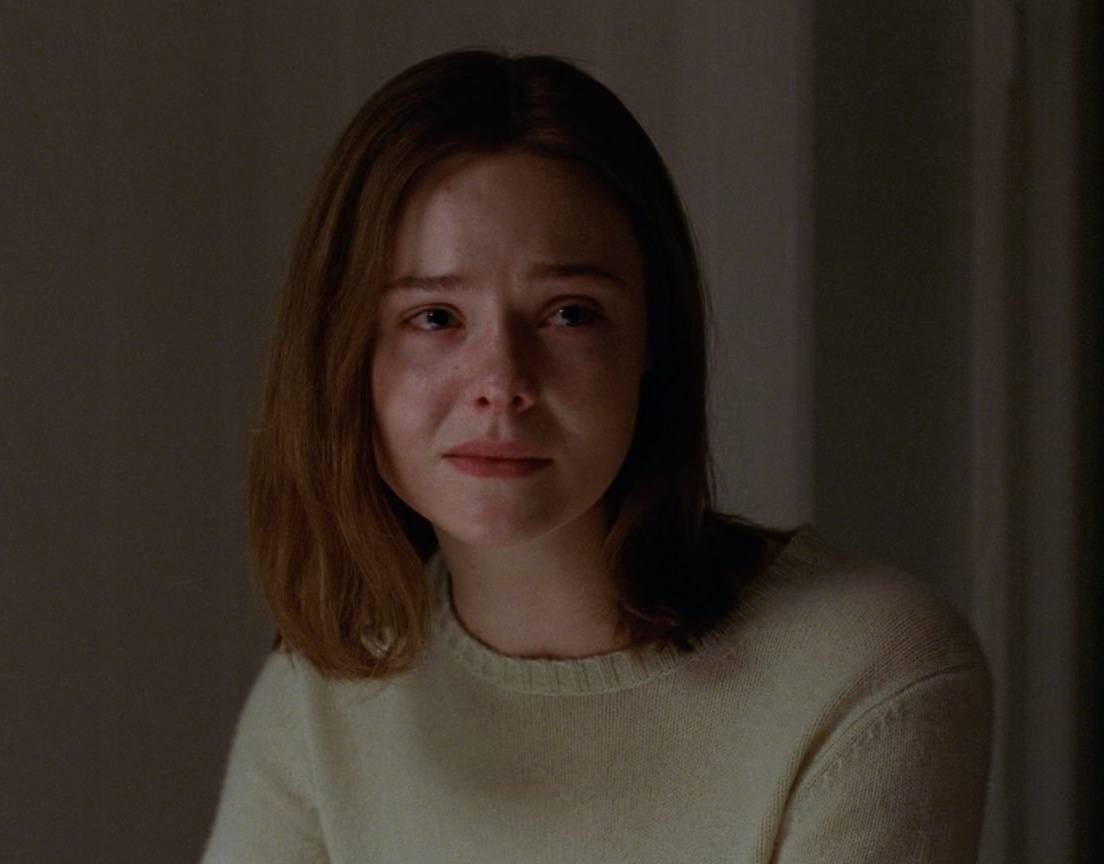
It’s the sadism of a Bergman character, paternal and possessive, ready to consume the daughter to feed the art. The hair-dyeing is an inkblot of violence, bleeding under Rachel’s skin before the psychological guillotine falls. He then gets the script translated from Norwegian to English for Rachel—a concession that both he and Rachel know is wrong. She can’t speak Norwegian. It’s the same language of manipulation that gets fathers in trouble with their daughters.
The rehearsal scene is where the film's central dramatic irony becomes visible. Rachel performs a monologue from Gustav's script — a passage about crisis, loneliness, and a desperate prayer for home:
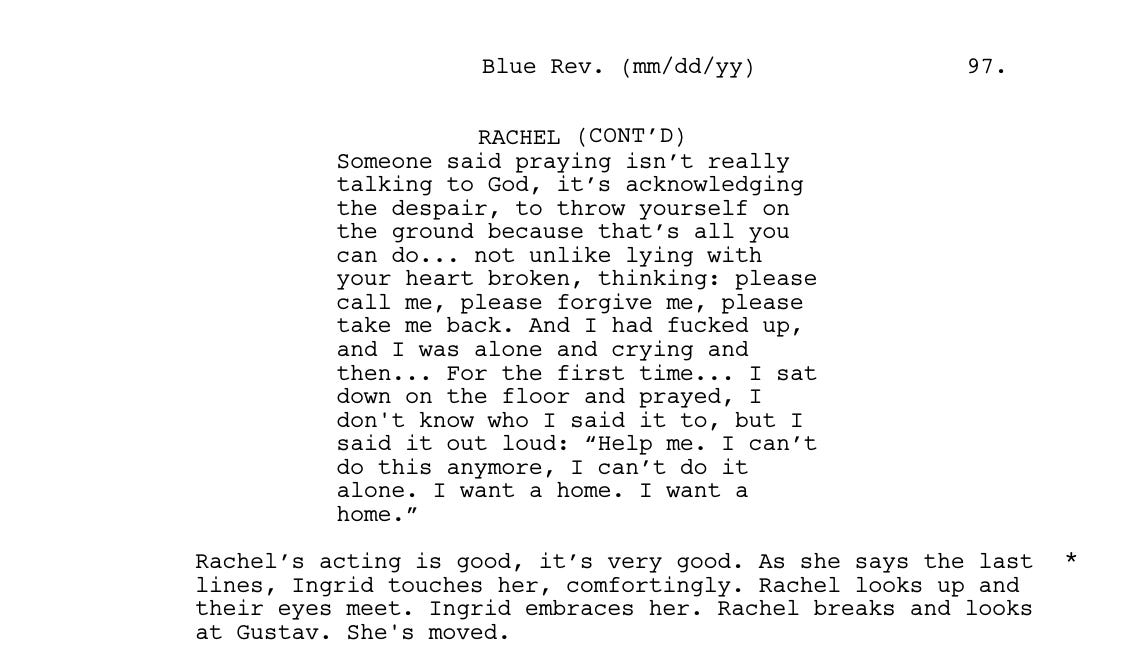
Gustav, clinging to his role as patriarch, suddenly taps into something real in her — which is just terrifying, because she’s really good. She’s a great actress, and that’s part of what makes her imaginative approximation so dangerous.
Rachel’s frozen walls start to crack. The story she’s been stuck in, the father’s secret ache—it all bubbles up just beneath the surface. Even the English sounds off; she hears it. She smells Gustav’s distractions, knows Nora’s shadow haunts every line, and that the entire project is his petition for his daughter’s forgiveness. Rachel is conscientious, conflicted, and a little like Gustav: ego-driven, but not without warmth and grace.
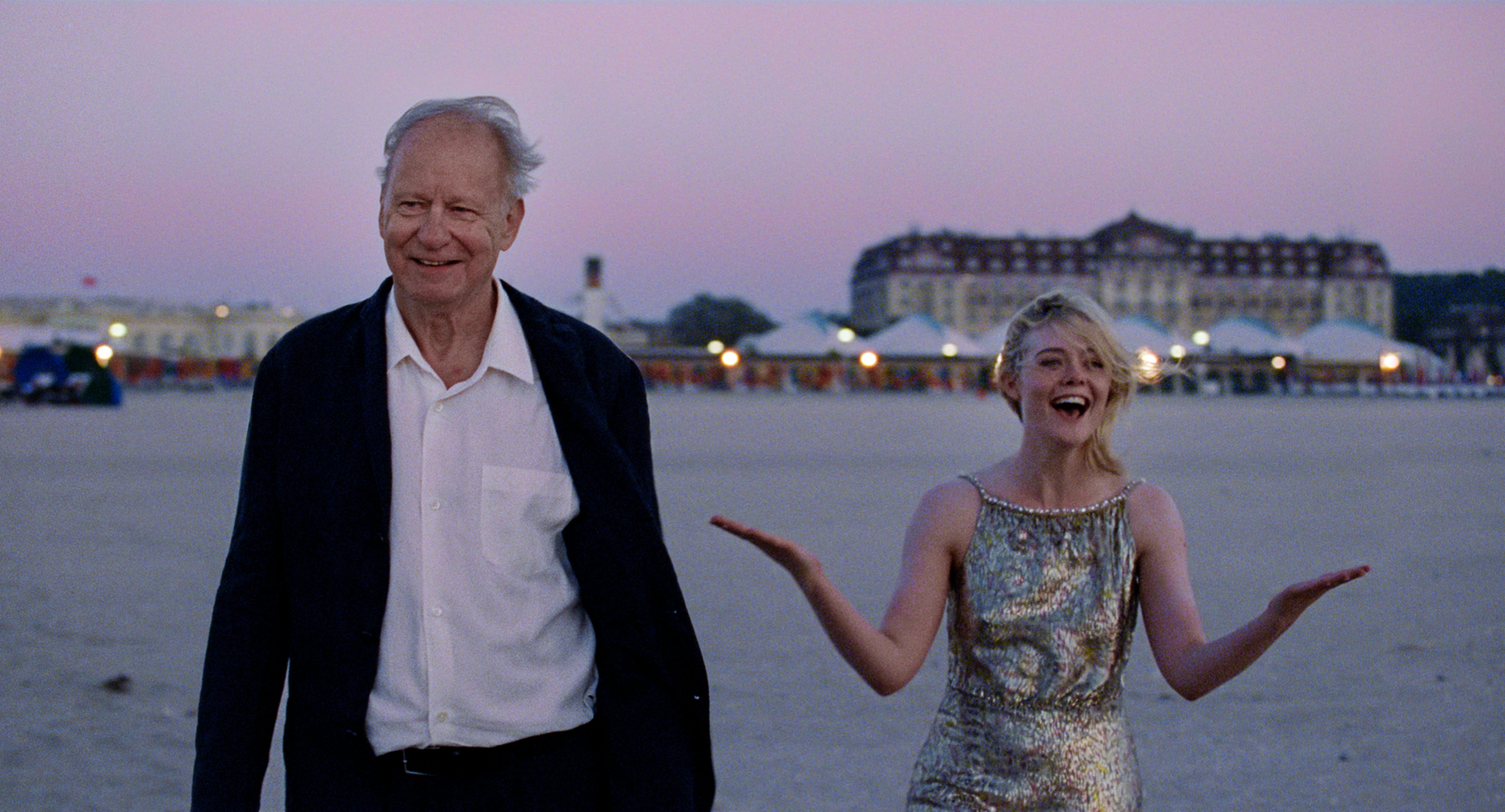
Rachel walks up to Gustav’s home. The foliage is expansive and lush, there’s a white picket fence, and the green of the trees provide a perfect backdrop for Rachel’s white dress. This is a woman who is a pure romantic at heart, but she’s also very American—in all of the ways that you might expect, but also in her frankness. She’s bracingly direct. She cuts through all the wry Nordic reserve in a way that feels ungrateful, but that is, of course, American. (I say this as a non-American of a skeptical and pessimistic disposition who goes to Nordstrom Rack every time she’s in New York).
Rachel tells Gustav she is withdrawing. She says she just doesn't want to let him down. She says it doesn't feel right.
"You asked me to dye my hair the same colour as your daughter. And, I mean, you don't want this film to be in English, do you?"
Rachel represents everything Nora resents. She is the Americanized blonde, the daughter who is willing to bend to her father’s will, the daughter who is willing to play the role that has been forced upon her. Nora is estranged in more ways than one: she has cut her father out of her life, which is what a good daughter would do, but she’s also cut him out of her work and her art. She’s an artist who refuses to be a daughter—in her work and in her life. Rachel is a daughter who is willing to be an artist, and that’s why she was chosen. But this, too, has its limits.
Gustav's response is the closest the film comes to grace: "Please, don’t look back at this as a failure. You’re a great actress, I meant it."
This exchange is deceptively understated, but the scene’s power comes from the mutual generosity between them. According to Elle Fanning, Rachel is the “catalyst” of the film—unburdened by decades of resentment, she sees Gustav and his family dynamics with a clarity that they cannot reach themselves. And when she walks away, it’s a dare: forcing Gustav to reckon with the truth he’s been dodging—wanting his daughter’s participation is, in fact, wanting her forgiveness.
Rachel occupies a specific position—an unwilling voyeuse to something she cannot enter. But is she the only one of her kind?
the taxonomy of women who carry stories that aren't theirs
In what is perhaps the most satisfying twist of Sentimental Value, she isn’t. She’s a type. And it wasn’t until I read Holocaust scholar and psychiatrist Dani Laub’s insightful work on the subject of witnessing that I realised just how many films had quietly placed their Rachel Kemp in Laub’s impossible position of the witness.
In Testimony: Crises of Witnessing in Literature, Psychoanalysis and History, Laub delineates three distinct levels of witnessing:
Being a witness to oneself within the experience
Being a witness to the testimonies of others
Being a witness to the process of witnessing itself
His core insight is simple: Witnessing is never neutral. Proximity to another’s suffering creates its own form of wound. You don’t have to live the experience to be marked by it. To be adjacent to it is to be in a position that is not only moral and psychological, but one that is impossible.
Rachel is a witness to Gustav’s grief and pain, but she is also a witness to herself as an actor, as a woman, as a lover, as a friend. She looks through the camera lens, watches footage of herself and Gustav, and sees herself witness herself. She can’t escape it, and maybe that’s why she’s drawn it so forcefully. But the cost is heavy. Carrying the weight of someone else’s grief is a heavy burden, and when you’ve created a character who, like Rachel, is as empathetic and attuned to sadness as she is, it becomes even heavier. She has to find a way to express that burden through her body, as well as the sadness she’s creating every time she steps on stage.
I've started to notice Rachel everywhere, now that I'm looking. I went back through everything I'd watched in the last few years and found her sitting in the corner of film after film, slightly outside the main action.
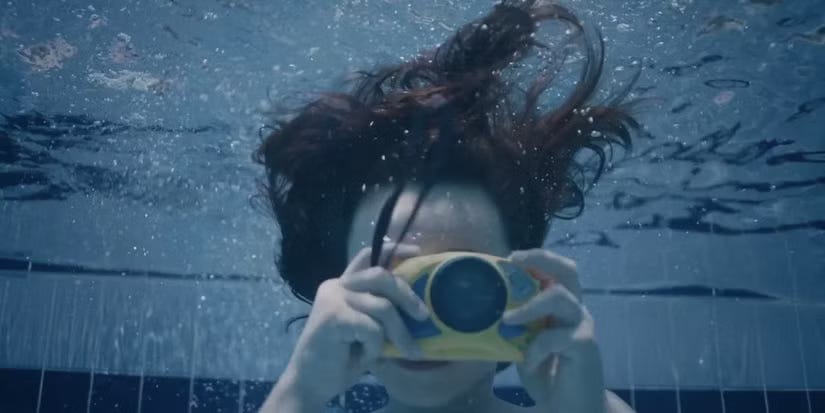
Aftersun has adult Sophie going back through the MiniDV footage of that holiday in Turkey, 1999. She has Calum on tape asking her to tell her mum she misses her. She has him on a sun lounger. She has the particular way he holds a towel. Wells cuts between this footage and strobe-lit rave sequences where adult Sophie stands motionless in a crowd while her father moves somewhere in the dark just out of reach — and the film's whole argument is in that gap, which is Laub's second level: the testimony arrives after the fact, when it is completely, cosmically useless. She was eleven. She was standing right there. She just had the camera.
Past Lives goes somewhere even more airless. Celine Song has said that sitting at that bar in New York — Nora between Hae Sung and Arthur, translating between them — she realised she wasn't translating between two men but between two selves: the girl who left Seoul at twelve and the woman who stayed in New York and built a life in a language her childhood doesn't speak. Arthur tells Nora "you dream in a language I can't understand," which is shattering in the way that only accurate statements are. She's been her own witness for two decades — carrying that earlier version, that abandoned life — and still couldn't fully bury her. When she cries at the end, walking back from Hae Sung's taxi, Song is specific: it isn't grief for Hae Sung. It's grief for the twelve-year-old girl she never got to say goodbye to. Laub's first level, the most interior one — being a witness to yourself, inside the experience, in real time — and she was doing it for twenty-four years without a word for it.
Joanna Hogg's answer, in The Souvenir Part II, is to make witnessing into a graduation film — which is the logical conclusion of Laub's third level (witnessing the act of witnessing itself, turning the position into art). Julie casts an actor who doesn't look like Anthony and a producer friend who has never acted and then tries to direct her crew through grief she cannot translate into instruction, because the grief was built on a version of Anthony she had been substantially inventing since the day she met him. Her classmate Pete tells her she hasn't reconciled who Anthony was with who she loved. He is correct. It doesn't help. The graduation film she premieres looks nothing like the one she planned — brighter, stranger, Anthony resurrected and finally cooperative, Julie carrying a camera like a gun — and whether that counts as processing the wound or simply redecorating it is a question Hogg, characteristically, leaves entirely open.
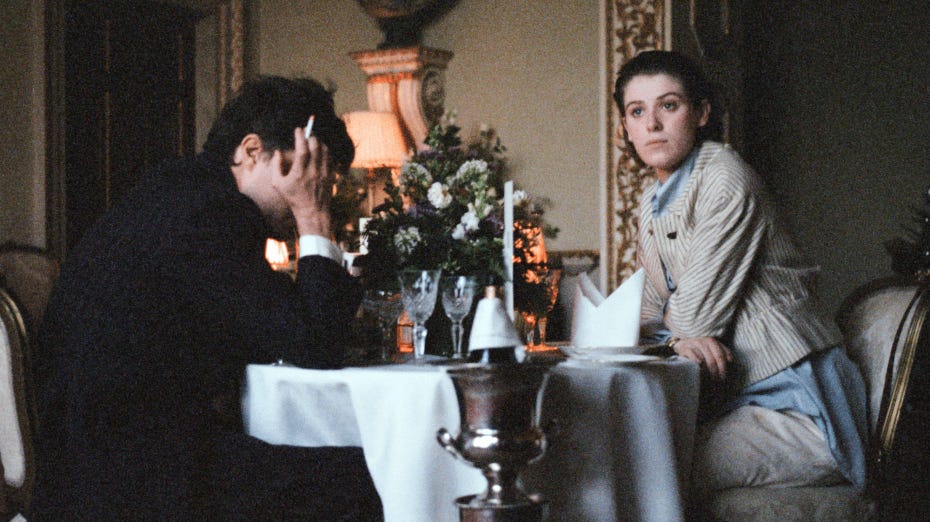
withdrawal as an act of grace
I dust off the pile of notes I’ve made on involuntary witness research and all the ways that witnessing can be significant without being transformative. I can’t find words for being a witness by necessity, bound to the event by your own existence but compelled to do nothing.
You understand what is happening in a house you do not own and have no say in the maintenance of, and your understanding is not required and is not wanted. You are close enough to be marked and to be affected but too far away to act. You are not permitted to act. You are not a bystander because bystanders have power, since they can choose to act or choose not to act. You are weightless, the witness at the back of the courtroom being marked and informed and invited and enlisted for no reason at all. But you still have that power, and that power is yours to keep.
Rachel has this and this is where Sentimental Value shows its radical streak. Because, of all the witness films I’ve discussed, it’s the only one to directly show the act of withdrawing. Aftersun ends in the ambiguity of retrospective grief. The Souvenir transforms the act of witnessing into art. Past Lives holds its characters on a never-ending hinge. Trier’s film shows a character choosing to step back, and frames that choice as the most generous thing she could do.
the ethics of celebrating a woman for knowing her place
However, here’s where we’re confronted with a new problem. If Elle Fanning herself describes Rachel as a catalyst, then we should acknowledge what a catalyst really does — it initiates chemical reactions but remain unchanged themselves. Catalysts exist to produce a reaction and then be ended, consumed. They are sacrifice. Sacrifice is the force of nature that drives the story into motion, but sacrifice is not the subject of this story. Rachel the catalyst, like all the others in this essay, is a victim of her own invisibility. Sacrifice is mouth-watering, and she exists for the appetites of others — but exactly how mouth-watering is determined by their appetites. I cannot help but be reminded of the rapacious Polyphemus from the classic Greek myth, where Odysseus’s men are consumed one by one until only the cunning Odysseus remains, clever enough to blind the creature and escape.
Sacrifice speaks only when it has been dined upon.
So if the significant witness only seems to matter in their absence — then what are we exactly celebrating here? Is this ethics? Or a beautifully crafted story about being expendable? It’s our job to be careful with such stories and their byproducts. As the protagonists of Aftersun, The Souvenir Part II, and Past Lives demonstrate, every story told must translate into a story lived. Each emotion felt has consequence. No presence can be truly insignificant. What are we saying when we shove Rachel Kemp into a category defined by absence and void? What are we saying when we glorify her wisdom and her courage? Do we not risk romanticising the absence itself?
These dangers are real and I know it. To romanticise absence is to align with an othering logic that valorises female pain, that frames lack as an invitation for reverence. To make martyrdom a female privilege is to assert, yet again, that suffering is the price women must pay for wisdom, for duty, for insight into the dark machinations of the world. And the absence of a name is not a reason to celebrate Rachel’s position. It’s a reason to look at it closely and understand it without adornment or glamour.
So what do I do with Rachel Kemp, resting that way in my hands, suspended between the need to protect her and the need to honor her withdrawal? I spoon her up in beautiful prose, large and unfurling, her body stretching out my sentences before reaching the edge of this essay. She deserves beautiful, I write. She’s a star, after all, the brightest light in a dark film, carving space for herself when no one else will. I refuse to make that beautiful, but equally, I refuse to look away. If I push her from the centre to the periphery, then I risk obscuring the brilliance of the wound she carries. That is also violence, and I want no part in it.
Rachel is an aspiring artist who aches to be taken seriously, to be not just part of the machine but the reason the machine moves — we know her. We have been her. And yet, maybe more than any other character I’ve written about, she has felt like a kind of avatar for me. As a cultural critic, this job is witnessing by design. You crawl inside other people’s stories as completely as you can, you understand them better than anyone else who saw the same movie, better than the people who made it, and then you write it down and step away, letting the work go on without you. The understanding is real. The authority is retrospective, and is sometimes at odds with the visceral experience.
Because this is the thing about witnessing and then walking away when you realize a story isn’t yours: It happens all the time. You’ve been the friend who watched a relationship implode in excruciating slow motion — you saw the whole thing coming, you knew every line of the argument they were going to have, and you said nothing because it wasn’t your relationship and your clarity was not useful, it was just yours to carry. You’ve been in love with someone whose heart was already somewhere else and you understood it before they did, which is a particular kind of awful. You’ve sat at a party reading the entire subtext of the room — who hates who, what’s not being said, which couple is six weeks from ending — and you’re not even in the actual conversation. You’re always just outside the thing.
In these situations, most of us choose to either overstay or disappear altogether. In our desperation for meaning or closure, we try to assert our own significance in a narrative that has moved on without us, like an orphaned child still reaching for their mother’s hand. Or we shrink away entirely and hope to be forgotten.
The more interesting move— the thing I want to close with, and the one Rachel makes—is one of rare ethical intelligence. It’s the thing that requires the most bravery, and least self-indulgence. It’s the thing that is most often considered rude or callous. Rachel matters not despite her replaceability, but because of it, and because she knows it.
She comes to Gustav’s door in person, says it to his face, and leaves. Not because it’s easy or graceful—Rachel is crying when she says this to Gustav— but because the alternative is a worse type of dishonesty. It’s what he tells her, before she walks out for the last time: “Most actors would do the role even if it felt wrong. Or just leave, and let the agents sort it out. But you came here. You’re a good person.”
Sentimental Value is now streaming on MUBI, and you can get 30 days free at mubi.com/finalscene 🫶🏻

The TFS Hotline, for the uninitiated, is where you send me voice notes or emails about scenes that have broken you, opinions you cannot share with the people in your life, or film discourse that has sent you spiralling. I do this both as a public service and a not-so-subtle reminder that everyone's secretly a mess.
I am flabbergasted.
Not just because you just took an abstract, almost ethereal feeling that laid both dormant inside me and bubbling up just enough for me to see it and express it.
Not just because you have completely reframed my favorite film of the year and just given me a reason to rewatch it for the third time.
I feel this way because you have encapsulated, in a way I thought was impossible, a role I have occupied more than my insecurities allow me to admit, and that perhaps I still do in some respects.
Someone once told me the music I listen to sounds like elevator music. I find a somewhat painful yet weirdly poetic embrace in that insight, the fact that I like to feel the company of artistic expression meant for the background.
There’s a Spanish song by Christian singer Marcos Vidal, called Nieve y Agua, that precisely mentions this feeling in a specific verse:
There will always be haughty snow
resting on the road,
and humble water battling
in the wheel of the mill,
there will always be guitars
that accompany
so that others may shine.
--
I think life has quietly and consistently pushed me to understand that sonder is real, that there’s a infinite number of stories we will only get to witness from the sidelines, and that there’s a very peculiar, very unique kind of dignity in accepting that reality.
But of course, with dignity, comes pain. Sadness. The unheard melancholy of the backing instruments. The unbearable weight of cognition, of understanding you’re meant to fill in a gap nobody even knows is there. The certainty of the ultimate form of invisibility. The very same feeling you so eloquently express in this essay.
I almost want to print this article and have it placed on my nightstand so I can reflect on it every single night before I go to bed.
Saying “thank you” seems far too reductive to express my gratitude with you, and with life itself for giving me the privilege of knowing you exist and reading the unique conclusions you arrive to in this virtual space.
Sentimental Value does an amazing job of packing those seemingly simple and straightforward scenes with so much subtext and meaning.