


At some point, you learn to read. That’s obvious. But if you’re anything like me, you don’t remember the actual process of learning to read, or of learning to do much else really, because it’s all subsumed into the general haze of childhood. I do remember learning to walk in the sense that I remember being a toddler, but I don’t remember the countless missteps and tumbles that would’ve been required to get to that point.
There are, however, specific moments that I can recall vividly that give me flashbacks to learning things. I remember the first time someone corrected my spelling at a sleepover and I was too embarrassed to ever let anyone see a note I wrote again. I remember pausing for a full minute on a question in 8th grade algebra, feeling like I was on the verge of some monumental breakthrough, before realizing that X being equal to X wasn’t very helpful at all. And I remember a rainy day in the summer before high school when my dad wanted to watch The Passion of the Christ and I wanted to watch a movie I’d already seen.
I remember throwing an absolute wobbler about it. Full-on teenage dramatics, complete with door slamming and accusatory journal entries. Looking back, I can see that my poor dad was just trying to broaden my cinematic horizons, to introduce me to something outside my comfort zone of early 2000s rom-coms and Disney Channel Original Movies. But at the time, it felt like a betrayal of the highest order. How could he not understand that rewatching A Cinderella Story for the fifteenth time was a matter of life and death?
What I couldn’t articulate then — what I’m still trying to articulate now, if I’m being honest — is that rewatching a beloved movie isn’t just a way to kill time or wallow in nostalgia (although it can 100% be those things too). It’s a way of learning a film’s secret language, of training your eye to catch the little grace notes and visual echoes that you might have missed the first time around.
Of course, there’s also something to be said for the jolt of adrenaline that comes with discovering a film that cracks your brain open like a walnut and rearranges the pieces into something unrecognizable. The films on this list did that for me. They took the building blocks of cinema that I thought I knew — the hero’s journey, the meet-cute, the third-act twist — and spun them into shapes I’d never seen before.
So consider this my cinematic Rosetta Stone — a decoder ring for the films that taught me how to watch and how to see film. Some of them are masterpieces, others glorious oddities, but all of them live on MUBI, and I put together a list on the platform so you can find them in one place. And you can get 30 days free at mubi.com/finalscene ✨
babette’s feast (1987)
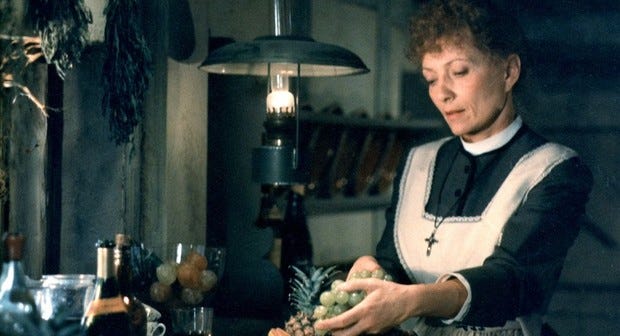
I've never been able to articulate exactly what Babette's Feast does to me1; maybe it's the way I can never retain enough Danish to understand it without subtitles, so I've always experienced the film as the world's most beautiful bedtime story. Maybe it's that sounds like rain falling on leaves, like water boiling, like bread tearing, like birds singing and the ocean crashing, are more important than score.
Babette’s Feast is about the purpose of creating art that you know will go unseen and the purpose of creating art that makes no sense to the people who are forced to experience it. It’s about going through it for the sake of going through it, without any of the other extraneous reasons that were somehow conjoined into that experience so that we could justify going through it. It’s about just going through it. It’s about being made to go through it and having absolutely no other reason for it to exist. And what’s so upsetting about that is that at the end of the day, when all is said and done, that’s really all of it, anyway.
With quiet films like this, you have to let yourself just sort of be in the moment, and be with the characters that are onscreen as they move through their lives. You can’t be waiting for the next thing to happen, you can’t be waiting for the next line. You have to just sort of let go of that impulse, and forget about Babette’s backstory and whether or not she’s going to leave, and just…be there. With her. And with the other characters, too. Just…be there. That sort of meditative way of watching Babette’s Feast has really affected the way I watch other films. It’s made me a more patient viewer. And, most importantly of all, it’s taught me that films don’t always have to have a point. Sometimes, it’s enough that they just exist.
three colours: the whole ass trilogy! (1993-1994)
Watching the Three Colours trilogy2 through the lens of ‘how to watch films’ is actually a really interesting proposition, because these films already embody a certain idea of how to watch films. With them being Krzysztof Kieślowski’s final solo directorial feature films, they also serve as a brilliant love letter to the medium. They’re deeply immersive, complex, and honestly a bit bewildering; like all great films, they hold so much within them and require everything from you just as you’re asked to give everything to the world they create.
This is a movie series that made me view colour through a more metaphorical lens. It’s not just about how a movie looks, it’s about how a movie feels. Colour can absolutely be representative of emotions, ideas, and thematic meat without physically existing in the same way as any other tangible element of a film. While they’re not the most extreme examples, I always found that the three colours—blue, white, and red—representing the three French revolutionary ideals of liberty, equality, and fraternity in the trilogy was an effective way to illustrate this meaning both behind and alongside the colour. It’s an interesting question to pose when it comes to this idea of what colour is doing in cinema—and if that’s the case, does each film ultimately end up being as much about the colour itself as it is about what colour is doing in cinema?
But I’ve also been thinking about it in terms of a larger framework — how should we think about the experiences of different characters and events across different films? Do they inherently feel like longer versions of a one-off film? Is there something fundamentally different about them? Can you even divide a trilogy like this into its constituent parts and think about them as separate, let alone think about the experience of watching them as separate? I don’t know if I’m getting at the right question, the question feels amorphous — but one of these days, I will figure out a way to answer it, even if that answer is “by watching the Three Colours trilogy.”
being john malkovich (1999)
The first time I watched Being John Malkovich, I was still young enough in my movie-watching life to be surprised by a film’s concepts. That’s not to say I don’t see unique ideas in movies anymore, but the first time I saw a film like Mulholland Drive or Brazil might’ve felt like an entirely different world of storytelling. Being John Malkovich came a bit later than those, but even still, it was an introduction to something for me, a sort of surrealism that I didn’t realize was missing from my own understanding of what films could be3.
Kaufman shows you cinema is a place where you can make things happen that would be completely unacceptable in our real lives, but totally captivating in a way that feels real even though it isn’t. That’s a lesson I’ve internalized into my own writing a lot. Sometimes that means tackling things with very serious implications, like I’m doing in TFS. Sometimes it means making a character do something logistically impossible, but narratively appropriate, like John Malkovich, or in movies like The Lobster or The Truman Show, where the stakes are so heightened and the emotion so real that it almost doesn’t matter if things make sense. What matters is that it feels true.
Being John Malkovich is already such a unique experience because we’re not just watching someone do something weird, we’re watching someone else watch someone do something weird. You know what this reminds me of? The way movies sometimes feel like a cheat code for life because you suddenly feel like you’re living through someone else’s experience. You’re in their head, feeling what they’re feeling, or at least as close to that as you can get. You’re blissfully unaware of the consequences for that person because you feel like you’re in control of their actions. I guess that’s what the movie teaches us — that sometimes we want to be like John Malkovich. And sometimes we don’t.
mean streets (1973)
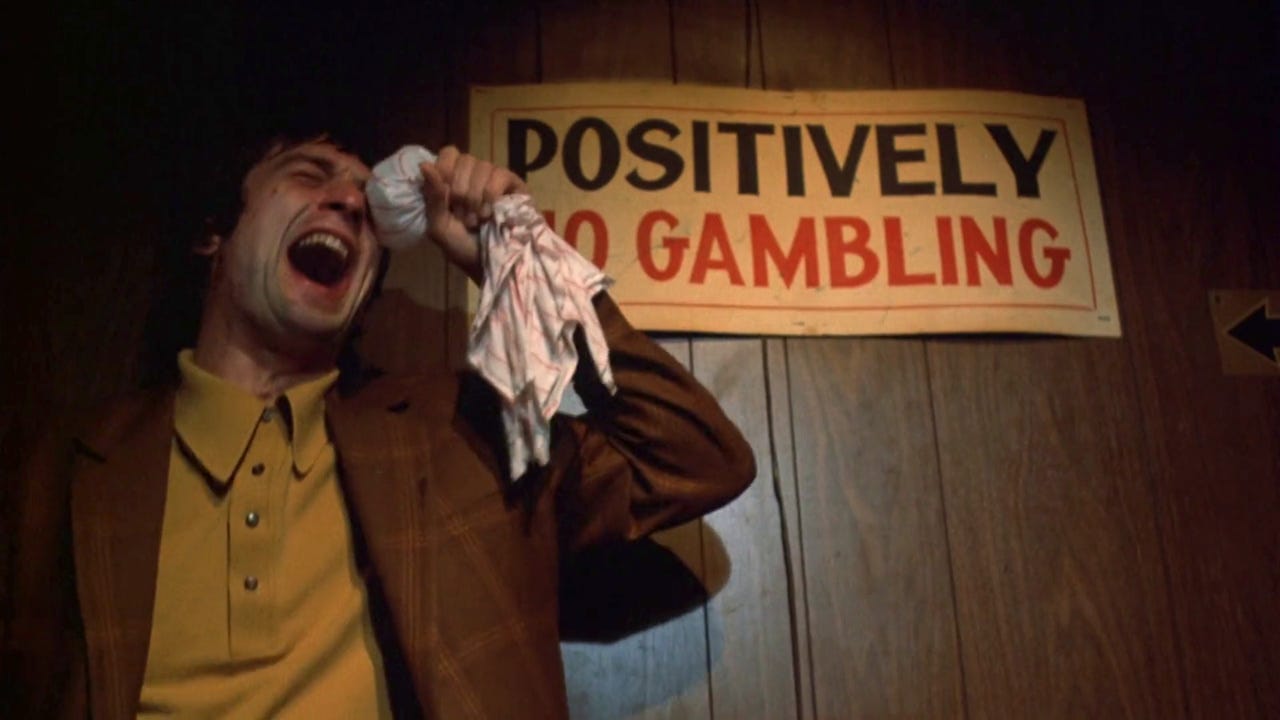
I think Mean Streets is one of the great first films for a director — even though Scorsese had worked on other films and documentaries, I consider it a debut in the sense that it’s the first time his distinct style was so fully realized. The camera in that movie does so much to establish the milieu, the mood, the difference between Charlie and Johnny Boy, and the sensibility of the “working class” Catholicism that Charlie is always going on about. It’s a movie about “the streets,” so the camera takes on this nature of being out on the street itself: it weaves and bobs like someone walking through a crowded space, sometimes getting caught up in the chaos of life, sometimes pausing to look at the small moments or catch a side-eyed glance. It’s a camera that, at times, can feel almost voyeuristic, peeking through doorways or hanging back to observe Charlie and Teresa in the kitchen without their knowledge.
On a completely unrelated note: I’ve always had a bit of a soft spot for what I call the “pity pause,” the beat at the end of a film that asks its audience to sit with the knowledge that the protagonist isn’t going to be okay, and neither are we. Mean Streets has one of the best pity pauses in cinema, and the question it leaves me with is simple: what are you going to do about it? What a film teaches you says more about you than the film itself, and what I’ve learned from Martin Scorsese’s first film is that nothing is stopping you from trying to be better, and nothing is stopping you from failing.
festen (1998)
I think that, above all, Festen taught me that you should always read the synopsis before you press play. I was pretty unprepared for that one. This movie, for those who don't know, is about a man who, at his father's 60th birthday party, stands up to reveal that his father abused him and his twin sister as children. Wonderful! Happy birthday! The opening credits are a carnival ride, shaky camera and unsteady hands. It’s not disorienting, it’s familiar. We all know this feeling, we’ve all been here before. We’ve all been at a party maybe not quite like this, but dressed up like idiots and suiting ourselves so no one else has to be uncomfortable. The opening of the film is a perfect setting of the scene for this Danish family drama and you are thrown into it so abruptly, so inorganically, that it feels like getting off a ride at Disneyland and wandering around the works yard.
I love how raw and unflinching this movie is, and I love how by the end of it you feel exhausted in a way that only a really good scream-cry can accomplish. I also love how tense it is; the buildup and anticipation of when the father is going to finally get what’s coming to him. It’s a really good movie! But only if you know what you’re getting into. Actually, it sounds like it’s about time I watched it again.
malcolm X (1992)
I’ve said before that Malcolm X is the most important film to ever exist, and I stand by it. That opening shot is a perfect encapsulation of everything Spike Lee starts with in that movie: the film begins with a refusal to pull punches, a willingness to be confrontational and discomforting, a commitment to using the full breadth of cinema to tell your story. Not that it was the first, but Malcolm X was certainly one of the first mainstream films to show you that cinema could be used as a weapon. It’s an opening that doesn’t so much set the tone as it does establish the precedent. If you can start there, what can’t you do?
I’ve always found that great films find a way to cater to your specific proclivities and fascinations, and Malcolm X is one of the best examples of that. It has spectacular performances, brilliant cinematography, plenty of iconic lines, and it’s a film about a man who lived an extraordinarily interesting life; you could argue those are the ingredients to any great film, and that’s true, but what really makes Malcolm X tick is its sheer operatic nature. Every scene is about 50% bigger than it needs to be. Spike Lee clearly believes that if a scene works and is good and fun to watch then you should just let it go on for as long as it wants to. This could easily be obnoxious in the hands of a less-skilled director, but Spike Lee manages to make it utterly intoxicating. There are slow-motion montages of Malcolm X giving speeches that go on for much longer than you’d expect, and they’re just so rad to watch! It’s astounding how every scene feels like it’s about to end and then just doesn’t.
You could argue that it’s protracted to the point of drawn out, but I just can’t, not when Spike Lee’s voice is so electrifying to experience. It’s a voice that insists on being heard, and that, in doing so, forces its listeners to confront their own prejudices, understandings, and lack of knowledge head-on.
belle de jour (1967)
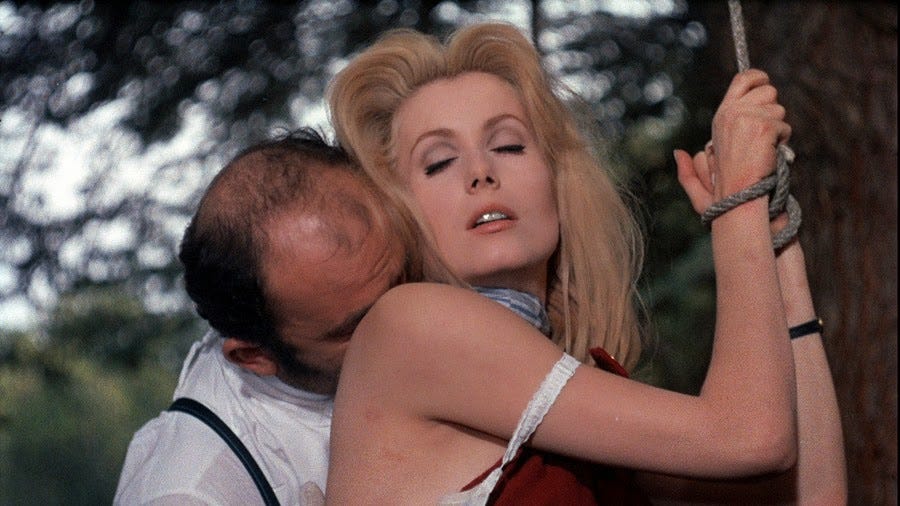
You know how sometimes you’ll be talking to a friend and they’ll casually drop some wild detail from their past, like “Oh yeah, I spent a summer training as a professional contortionist in Prague,” and you’re just sitting there like “I’m sorry, what now?”. That’s kind of how I felt the first time I watched Belle de Jour. On the surface, it’s this chic little slice of French cinema, all dainty teacups and silk dressing gowns. But then BAM — suddenly Catherine Deneuve is getting pelted with mud in a forest by some dude with a whip, and you’re like “Excuse me, did I miss a memo? When did we take a hard left turn into Fetish Town?”
But the thing is, once you adjust to Buñuel’s wild rhythm, you start to realize he’s doing something really clever with all these jarring tonal shifts. He’s using them to keep you perpetually off-balance, to make you feel as disoriented and unmoored as Deneuve’s character. Every time he yanks the rug out with a surreal dream sequence or a kinky client, it’s an invitation to share in her sense of dislocation, her feeling of being adrift in her own life. It’s a trip, but it’s a trip with a purpose. By the end, I felt like I’d been given a crash course in how to use the unique tools of cinema — the cuts, the juxtapositions, the slippery sense of reality. Buñuel tells Séverine’s story by making you live it, drawing you deeper into her unraveling psyche.
the graduate (1967)
There are two types of boredom in The Graduate that interest me: the one that Ben Braddock feels in his post-college life, and the one that the audience feels in the pauses between his movements through that life. Nichols isn’t so much playing with the audience’s boredom as he is with their willingness to sit in those moments of inactivity, longer than is comfortable, because they know that a response to those moments is building within the character. The response is the catharsis — I need to get out of this pool, I need to go to Mrs. Robinson, I need to drive to Santa Barbara — and when it arrives, even if it’s been building for an extended period of time, it’s ultimately what the film’s been preparing us for. The result feels earned, rather than static.
This is a film where I learned that yes, of course, movies are about telling stories. But they are also about manipulating emotions, and they are about eliciting specific reactions at specific times. They are about running through the aisles of a church to a Simon & Garfunkel song, and they are about doing it for long enough that you can really allow yourself to think about how complicated and terrifying it is to run through the aisles of a church. They are about the pause on Dustin Hoffman’s face right before he says the damn thing. They are about Mrs. Robinson and her slow zoom. This is a film where you spend twenty minutes staring at Anne Bancroft’s face. This is a film where a man goes to college. This is a film where you spend a full minute staring at Katherine Ross’s sad face while music plays. It is a movie so off the wall that Hoffman originally didn’t want to do it.
And it works because Mike Nichols somehow figured out how to make a movie that contained, like, fifteen million of those specific moments. The close-ups are so tight, they almost start to feel claustrophobic; it’s Ben’s world, and we’re just living in it.
written on the wind (1956)
The first time I watched Written on the Wind, I remember being inexplicably fixated on the wallpaper. It was this lurid floral pattern that made me feel like I was inside a perfume ad from the 1950s, and not in a good way. I kept getting distracted by it, wondering who on earth would choose to decorate a room like that. It wasn’t until Dorothy Malone came swanning down the staircase in a yellow dress that was somehow even more aggressive than the wallpaper that something started to nag at me. The colors in this film weren’t just loud — they were screaming.
I found myself paying more attention to the palette than the plot. The sickly green of Lauren Bacall’s sitting room. The angry red of Robert Stack’s party blazer. The washed-out gray of Rock Hudson’s suit, like all the life had been drained out of him. It was like each character was wearing their subconscious on their sleeve, and Sirk was using color to whisper their secrets before they ever opened their mouths. I started wondering if maybe the wallpaper wasn’t an accident — if maybe it was a choice, as deliberate as a line of dialogue. I’m still not sure I have a definitive answer, but I know that I’ve never looked at set design the same way since. Now when I watch a film, I find myself scanning the margins, looking for the stories the colors are telling when the characters aren’t speaking. Maybe it’s all in my head, but I like to think Sirk let me in on a secret that day; that in the hands of a master, even the wallpaper is a supporting player.
the watermelon woman (1996)
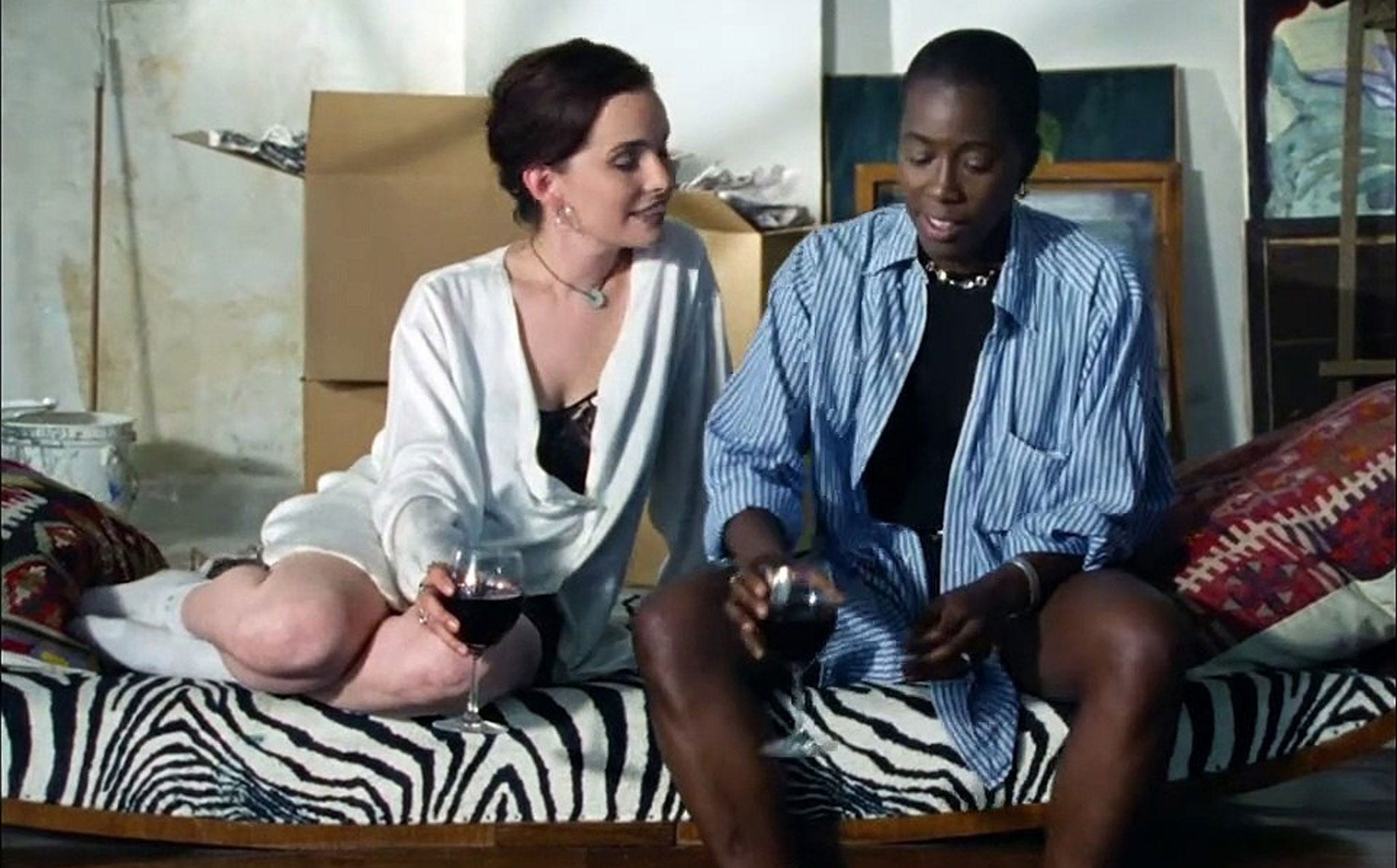
The Watermelon Woman is a film that flips the script and, with that, challenges your perceptions of documentary filmmaking. Cheryl is making a quasi-documentary about a Black actress who never got her due. Throughout the film, she interviews her family, her friends, the men who were in her life, and herself. It’s a movie full of talking heads, community organizing, and anachronistic “found footage.” The film is at once a documentary and not a documentary; it’s a series of half-truths and whole lies. Cheryl lies to herself and about herself, but she also hones in on what is true about herself: she is a documentary filmmaker and this is her film. It’s like watching someone daydream, completely in their own head.
The film helped distill to me how “realness” is a highly malleable concept in cinema, and that documented history isn’t inherently more important than undocumented history. Like, who’s to say that the real history of the United States is more important than the imagined history of the Watermelon Woman?
Stream 30 days free of MUBI at mubi.com/finalscene

If you vibed with this
A) I love you,
B) You have really good taste,
C) Weird, say more — you should upgrade to the TFS paid membership to get full access to the Reader Hotline, comment privileges on my Original Investigations and exclusive rights to starting threads on the TFS Chat.
D) Become an A-lister, aka a founding member, so I can write an essay on a film4 or TV show of your choice! I trust you to use your best judgment on that front.
E) So what are you waiting for? A recession? Please! Subscribe today and support independent, single-woman-run media!
I have only ever really loved a few things, but that final scene — that final scene — I would have given anything to have been there. I would have given anything to have known Babette.
This is a very pretentious thing to say but I stand firmly by the fact that Kieślowski’s films are best appreciated when watched as a child would watch them. They’re trippy and sometimes plain weird. They prompt you to look at the world differently and to consider ridiculous possibilities, but the way they open your imagination in turn opens up your ability to love and to hurt, and that’s a very adult feeling.
You know, ideas like: you don’t have to tell a conventional story where things make sense. You don’t have to center on a narrative arc where characters face a challenge and learn something. You don’t have to end your film with a resolution or an answer. You don’t have to follow logic or a 3 act structure or adhere to Aristotle’s rules of drama.
I’m ready to write you an entire essay about Twitches 2, and I want to! I do not have to tell you what kind of joy this brings me. I do not have to tell you that, yes, this is absurd and wonderful. But I will — oh, you bet I will.
Love the Mean Streets inclusion here. I think I got much of this from my most re-watched Scorsese (Taxi Driver) but really think focusing on what MS accomplishes as his first real film is an underappreciated way to look at it!
exemplary, this. loved The Watermelon Woman, and most of the other titles you've listed here. Though I've not seen Babette's Feast. I'll have to search it out. Thanks for sharing!