


A couple of months ago, a Substack note landed in my feed.

You see a lot of these. Notes is the unmoderated side of Substack where everyone pitches themselves sideways hoping you’ll notice them. But this note employed the word "cinephiles" with zero sarcasm which — if you know anything about the current state of film discourse online — is either very brave or very novel. I was curious which.
Benjamin Hegedus’s Substack is called The Film Critic. I clicked through. The first essay I opened was "The Predator's Gaze: Spectatorship in 'Nope.'" The second was "Aftersun and What We Never See”. I tilted my head with glee.
Teenagers building a film education in 2026 have access to more cinema than any generation before — platforms like MUBI curate hand-picked selections daily, Letterboxd has pre-teens logging and rating everything from Tarkovsky to the Super Mario movie, TikTok serves up film recommendations based on whatever they added in their TT Shop cart — and yet most of what gets produced is still "I don’t like to gatekeep which is why I will tell you what happened and whether I thought it was good". Finding someone who cares about spectatorship and framing, felt rare enough to finish reading.
As I went through the writing, I started to intuitively build the author in my head: probably mid-thirties, probably been thinking about film for years (probably should quit smoking so their voice doesn’t sound like Philip Marlowe), maybe recently found Substack as an outlet but most likely publishes elsewhere too — maybe as an adjunct or faculty member at a college you’ve never heard of, maybe programming at some mid-tier art house theater. In any case, familiar taste.
I went to Ben’s About page.
Ben, contrary to my assumptions, had just turned 17. As he came to tell me later, he'd just gotten a subscription to the Criterion Channel for his birthday, which he described as "one of his final steps in becoming a cinephile."
I don’t know why that baffled me. In theory, I should know that teenagers can write well and I’d be an idiot to find that strange. But writing like this, we are told, has a lineage you can usually trace: a professor, a parent with good shelves, the right film class at the right moment. I wanted to know where his had come from. I wanted to crack this mystery! Who taught him? Did anyone?
I reached out to ask.
What I learned was not what I expected, and changed my preconceived notions entirely.
"I grabbed a notebook"
I asked Ben to walk me through it. Where did the whole thing start?
“I can’t say that there has been a single moment where it flipped; it’s been a slowly building journey into film over many years. I guess it started during middle school during peak COVID years. Having nothing better to do, I binged the entire MCU, and made music videos with my older sister. That was the jumping off point of actually enjoying watching movies and seeking it out, becoming an interest of mine.
My brain loves organization and making lists, so in the fall of 2022 I grabbed a notebook and started to write down every movie I watched, my favorite movies, and my ratings of all of them. A few months later, you cannot imagine my surprise when I found out there was an app that would do it all for me. Letterboxd changed a lot for me, as I discovered that there was such a community around serious film appreciation, and I was opened up to a whole new world of movies beyond what I had ever imagined.”
Part of what makes me so interested in people’s journeys into film is understanding how something that seems so natural to me now was once so confusing. Even today there are people who love movies and don’t read criticism or think about film theory or care about filmmakers’ other work or whatever minutiae would qualify you as “cinephilic” in a traditional sense — hell, i know lots of people who actively avoid these things as though they suck away from the purity of the moviegoing experience (which, obviously, does not apply either way if you’re reading this!) but…here’s where I got stuck.
Millions of kids binged the MCU during lockdown. A decent chunk of them ended up on Letterboxd. Binging-franchises-during-COVID is a generational canon event at this point. What I couldn't figure out from this answer was where it all forked. Something turned Ben from a person who watches movies into a person who writes about how they work in long-form, and that's a completely different animal.
I asked him to trace that part. Where did he learn to analyze a film?
who is teaching teenagers to love cinema?
“One thing that I think had a big impact on my switch from watching to analyzing was that I would often watch a movie, and then for days after I would watch various reactions to that same movie on YouTube, primarily from channels such as Dylan is In Trouble, Reel Rejects, Badd Medicine and Natalie Gold. I would always be so interested in the section of the video after they finished the movie, where they would talk about different elements of the movie and analyze it. From there I went to podcasts such as Bill Simmons’ The Rewatchables, to reading Letterboxd reviews, to reading formal film essays.
I started to think of writing them myself during a project in my 10th grade English class, where we had to present to the class. I wrote an essay about how Hollywood is dying, and it was the most fun I’d ever had with a school project. I thought, ‘maybe I could do this on my own.”
When you’re raised on Youtube (if anyone from Vidcon sees this: I’m 33 years old), you think it is normal for channels like Reel Rejects — which has 1.45 million subscribers and 29K+ Patreon supporters paying monthly for extra content — to exist. You think it is normal for Natalie Gold, who built her channel during lockdown watching Star Wars for the first time at age 30, say in her bio that she is “just a girl who gets way too invested” get half a million subscribers and be followed through entire film canons by thousands of people. You think it is normal because you don’t know any different.
These are mid-size media companies producing hours of film discourse every week. And while I personally find that many of them are most compelling when half-watched while doing something else, technically, they are criticism. Informal, digressive, sometimes wildly uneven, but structurally it is a person with a more trained eye walking a less experienced viewer through what a film is doing and why.
Traditionally, for every Pauline Kael, there has been a Roger Ebert. Kael had The New Yorker and Ebert had every newspaper in America covering his death a decade earlier than they usually would’ve because he said nice things about The Help one time. Both were recognized while they were happening, celebrated even, because the establishment could look at them and see its own supply chain. The pipeline producing Ben runs through reaction channels, and nobody inside it — not the creators, not the viewers, not a single major publication I could find — has thought to call it what it is. A blogger at The Signal Watch came closest: “I do find it weird that the phenomenon is so little discussed online or in articles.”
Part of it might be some internalized snobbery: trying to be associated with an “elite,” Rolling Stone-y form of criticism. Some of it might just be not wanting to get in over their heads. Another reason may be that critics are worried to talk about this to not step on anyone’s toes1.
Still, I understand why Ben said he learned film analysis from these channels; they perform an incredibly accurate simulation of the modern teenage mind and social media brain. And yet, we still have a seventeen-year-old who had assembled a complete critical education from freely available internet material, guided by institutions that had no idea they were institutions.
So if the thing that taught him to analyze film was an institution he couldn’t see, what else in his answers might be one too? I continued digging.
the old guards as ghost canon
Ford v Ferrari initially grabbed Ben because — Oscar nominee. The subreddit he spends hours on — r/oscarrace. The YouTubers he follows beyond the reaction channels — The Oscar Expert, Jonathan Fujii, both awards-focused. What he does every winter — watches as many of the year's releases as humanly possible because it's awards season. All the red strings lead to the same thumbtack.
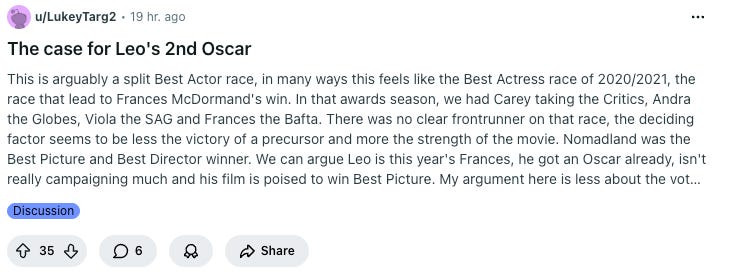
Every thread in Ben’s film taste leads back to the same ghost institutions like the Academy Awards. We all have a ghost institution like this. Yours might be Letterboxd’s top 250 or the Criterion closet or whatever Film Twitter was arguing about when it was still around.
The point is to be uncurated is to be self-directed. But can you be self-directed if you’re just recreating someone else’s curation? Young cinephiles think they’re post-institution, and in some ways they are: there are no adults curating for them, no teachers assigning or guiding or correcting them. However, there was a canyon there before he arrived. It was so big and boring that it looked like nature, like the Grand Canyon, and now it is so small and filled with all of their pixels that they2 have decided it is a river.
The annoying part is that the ghost institution doesn’t just organize what Ben watches — it organizes what he feels guilty about missing. When I asked about how he decides what to watch, he told me “there are always so many movies I want to watch at once that I can’t land on just one”. This makes him feel “shame” that he still hasn’t seen Pulp Fiction and Schindler’s List.
The guilt Ben carries is a guilt I know well. My own spills out for every film I still haven’t seen that surely could have taught me something, could have opened up a new world for me, had I only been more diligent in the homework my curiosity assigned.
That obligation, from my understanding, didn’t come from anywhere specifically. Nobody assigned Ben Tarantino. Nobody assigned me Richard Linklater. The guilt lives in this invisible curriculum of Films You Must Have Seen that not a singular force has compiled but everybody seems to be silently grading you on. It wasn’t us who decided what we should feel guilty about but we still do because the old monoculture canon is still, from beyond the grave, generating homework.
So what happens when you hand in yours and no one around you cares as much as you?
the cost of "blank stares"
“What you have to understand is that I speak a completely different language to people my age than I do to any adult. There is a whole world of slang, references and a general mentality that is so specific to Gen Z that older people can’t really understand. It’s almost like I’m switching dialects depending on who I’m talking to — same thoughts, different vocabulary.”
Sociolinguists have a term for this that you’ve probably heard of — code-switching — and they usually apply it to people navigating between cultures or social classes, not to a teenager navigating between the cinematography of Charlotte Wells and a conversation about the Minecraft movie.
Regardless, the mechanics are identical: you learn which parts of yourself are legible in which room, and you put the rest away, and after a while it stops feeling like a sacrifice and starts feeling like breathing. Ben just does it between second and third period.
“For the most part, whenever I have told people that my favorite movie is All The Presidents Men, I get nothing but blank stares.” So he reaches for what the room can hold — “the childhood staples like Mary Poppins or Cars, or the new movies like Sinners and Oppenheimer”. He also finds himself “simplifying my film knowledge and taste a lot when I’m talking to people my age, trying to make it more accessible.”
The broader landscape is no easier.
“Walking through the halls of my high school, one person you see will tell you to go watch Fight Club, and the very next person might tell you it is terrible. Some people’s favorite movies are Ratatouille, some are Mean Girls, some are Mad Max: Fury Road.”
There is no common ground to simplify into. This is individual taste at its most supreme, floating free, and Ben is navigating through it with whatever currency the next conversation will accept. His close friends know about his Substack. They like his posts though he thinks “that it is more of a gesture of faith and goodwill as friends than any real interest in the topic."
On the other hand, his school reads him through a frame that misses the point entirely:
"I've always been perceived as the 'overachieving' kid from the outside. Having a blog where I write essays just seems like another academic thing I'm doing. It's only on the inside that the true inspiration and passion is found."
The people closest to him see effort where he feels love. And that gap doesn't close, because there's no shared vocabulary that would let it.
In previous generations, Ben told me, "movie taste was much more uniform and consensus-based. Everyone had to love The Godfather, or Pulp Fiction." Less than a quarter of millennials have watched a film from the 1940s or 1950s start to finish, and by Gen Z the consensus has dissolved almost entirely.
Film studies lecturer Joseph Clark framed the shift as overdue:
"We simply don't have a monoculture that designates a select few films as deserving of being 'classics.' Thank god for that!"
It’s not a secret that alternate Gen Z canons are being made on TikTok right now." But the scale of what's being produced3 means no alternate canon can hold for long either. The old consensus was replaced by a thousand micro-consensuses, each moving too fast to become common ground.
Ben sees how this plays out at ground level:
"A person around my age will find a movie they want to see because of a TikTok they saw, or because of a recommendation they heard at school. There is no single streamlined way of choosing movies to watch anymore."
And the cost of that randomness falls on the films that can't market themselves into a feed:
"So many great movies become lost to new generations because they aren't available on major streaming platforms where Gen Z watches everything, while lower-quality streaming releases can still get millions of viewers simply because they're easy to access."
Which is why I have immense sympathy for young people who want to enter this space. I built TFS because the conversations I wanted to have about film didn't fit in any room I could find, but I had a generation of shared references to navigate by. My local mall multiplex used to be where teenagers went on Saturdays. Tickets costed five euros. An entire category of mid-budget films — the thrillers, the comedies, the dramas that weren’t quite prestige but weren’t quite disposable — existed to get them through the door, and once they were there, proximity did the rest. I could wander into The Departed without intending anything and come out different. That’s all gone.
watching a film on half a screen is not apathy
If you are seventeen and love film in 2026, right now you have access to more movies than you could watch in a lifetime even if you never slept, and your homework is due tomorrow. Ben told me he watches movies on half his laptop screen while doing homework on the other half. In fact, he was watching Are You There God? It’s Me, Margaret while answering my questions. Films he’s anticipating get his full attention; the rest share the screen. “I have never found any personal struggle in taking in both the movie and the work that I am doing.”
We’ve been asking “do young people care about film/cinema?” as if caring has one shape. That shape was a product of how movies used to reach people: one screen, one showtime, one chance. Caring looked like reverence because the economics demanded it. When a specific film required a specific trip to a specific building at a specific time, you gave it your full attention because the experience was finite and you knew it.
The people who built their taste in a world that did the organising for you, are now judging young people who had to organise it themselves for doing it differently. That’s the part that doesn’t sit well with me.
Ben’s economics are inverted. The film is always available. There are hundreds he wants to see and the list grows every week and his schedule is a teenager’s schedule, shared with obligations and a social life and sleep. Under those conditions, triage is the only way to maintain a film life at all4.
In which case, the question worth asking isn’t whether cinema culture is dying. It’s what cinema culture looks like alive, in the hands of the people actually building it.
cinephiles and it’s completely different and it’s also cinephiles
“I think that film has fallen out of the mainstream a little bit in my generation. No one goes and sees movies in theaters unless it’s an Avengers or Avatar movie, not like they used to. When my parents were my age, young people would go out and see every mid-budget thriller that was made, but now they can’t fill seats in the theater.
However, I do think that within the community of film lovers there is an extra passion there, differing from previous generations. My feeling is that this is due to the overall lack of interest within our generation, which means that if you want to get into it, you truly have to love it. I think that on the surface it seems like the ‘cinephile community’ is dying in my generation, but I think that the reality is that it is more alive than ever.”
The mechanism, he says, is connection.
“Those who do care about it are able to connect with each other so much more than before, because of social media and the internet. Online communities are created where movie lovers can engage with and support each other, something that previous generations could never find, simply because they never had access to it.”
I believe him when he says this. The evidence supports it—Letterboxd has 17M+ users, Gen Z moviegoing rates are climbing, reaction channels pull billions of views. The narrative of cinema’s death persists because the people mourning the old world mistake illegibility for absence.
And I believe him because Ben himself is the proof. But he’s also standing on data he hasn’t looked at. Letterboxd’s seventeen million users represent seven-tenths of one percent of his generation globally. Gen Z may be going to the movies more but over 56% them find social media content “more relevant than traditional TV shows and movies. His own friends—people who support him—treat his Substack writing as a gesture of goodwill. The passionate community exists because it’s self-selected for genuine dedication, and self-selection by definition means the community can only grow by converting people who already care enough to climb up without an on-ramp.
Ben saw Network—a 1976 film about the dehumanizing spectacle of media commodifying human attention—and his response was to join Substack to write about it. The film warned him about the exact system he joined. He did it anyway because there’s nowhere else to go. The internet is the disease that creates the problem and the cure that solves it and the trap that ensures you can never leave.
on cinephilia in the age of no one curating for you
I started this investigation looking for a story about loss. A teenager who loved film in a generation that perhaps didn’t as much, building something alone because the infrastructure disappeared.
I had the causality backwards.
The real mystery is: how does a teenager in 2026 fall in love with film? The answer is the same way they always have—through obsession, through one discovery leading to the next, through the need to understand why a thing made them feel something. What changed is every piece of infrastructure surrounding that impulse. The notebook is now an app with user reviews. The video store clerk is now a creator with a Patreon. The Friday night movie shares the screen with calculus homework. But the kid trying to understand why something got under his skin—that kid is exactly the same.
If you’re running a studio, I want you to know that your discovery infrastructure is mapped to the wrong generation. You’re spending money on Entertainment Tonight segments and Variety covers and premiere red carpets, and people like Ben found Ford v Ferrari because someone on r/oscarrace mentioned it had good sound design. He watches trailers when they appear in his feed, which means the algorithm decided whether he sees your film, and the algorithm cares about engagement metrics you don’t control. The seventeen-year-olds who will become your core audience in five years are being formed right now by creators you’ve never heard of. Reel Rejects has 29K+ Patreon subscribers paying monthly to watch them discuss whether Project Hail Mary works as an adaptation. These are media institutions teaching your future audience how to watch, and you’re not in the room.
If you’re a young cinephile and you care about something the people around you don’t care about—and I mean any art form that lost its mainstream foothold—I can see how Ben’s daily negotiation is your daily negotiation. You love Minecraft but you can’t tell your friends that because they think it’s for babies, so you’ve resigned yourself to spending your free time crafting and farming blocks alone. You’ve gotten really into French New Wave films, but every time they ask you what you’re watching you just say “nothing” or “something stupid” because you don’t want to deal with the eye-rolls from kids who only watch Marvel movies. You love Taylor Swift, but when your friends put on Midnights at the party, you just pretend to be annoyed by it like your in-crowd. You love all of these things so intensely, but when it comes time to share it with the people around you — the people who hopefully understand you best in this moment of your life — you have to play-act someone who doesn’t care. I see how this fragments you, and I see how much it costs.
And here’s where I struggle with this story because I owe you all that: I don't know if Ben represents the typical young cinephile or if he's exceptional. On the axis of "teenager who cares about film"—he's representative. Millions are on this path. On the axis of "teenager writing essays about Charlotte Wells on Substack"—almost certainly exceptional. But the path, evidently, exists.
I also don’t know what happens when Ben’s passion meets the economic reality of professional criticism. He’s seventeen. He’s writing because he can’t stop writing, building something because the impulse won’t quit. The landscape waiting for him is brutal—publications cutting staff, freelance rates unchanged since the aughts, Substack barely viable for most. He has years before that matters. You’re carrying the question now. What does the industry offer him when he’s ready? What world are we building for the people who care this much?
When I asked Ben what he’d tell a thirteen-year-old starting their film journey, he said: “Just feel the movie. Immerse yourself in it and forget that anything else exists.”
He said this while watching a film on half his screen.
This is the most sincere account I've heard in a while of what it actually means to love something inside a world that was never built to hold that particular kind of love. You hold the ideal in one hand—the thing you want it to be, the thing you know it could be—and you hold the reality in the other hand—the thing it actually is, the constraints you're actually working inside—and you figure out how to carry both without dropping either one.
You may think this answer is naive. Take yourself back to when you were seventeen then. Had you learned that most people need more than permission—they need roadmaps, they need scaffolding? Had you realized something the rest of us forgot, which is that the roadmap doesn’t actually help because the roadmap is always someone else’s path?
The new ways of being a cinephile are not failures. They’re adaptations that let the love exist at all. And yeah, something’s lost in that adaptation—I’m not going to pretend otherwise—but something’s also preserved that wouldn’t survive any other way.
Ben's going to be fine. The kids always are. And somewhere right now there's another thirteen-year-old grabbing a notebook for the first time, and that kid's going to be fine too, even if fine looks different than it used to. The caring makes it real. The rest is just conditions.

This story took my brain hostage for 3 months, alongside my full-time job and I’m making it free for everyone. Commenting on Original Investigations is for paid members, so if you want to tell me how wrong I am or correct my grammar — do it below, I can take it 🙂↕️
Plus, paid subscriptions are how you’re directly funding more original reporting like this, so thank you for your support as always.
Finally, a big thank you to Benjamin Hegedus for taking the time to speak to me for this story! Make sure you go check out his work over at The Film Critic.
If you spent years studying how to name color palettes and shot types, a conjecture-based nuanced theory essay on Nomadland’s sound design probably isn’t going to do it for you — but if my favorite leftist commentator loves Fleabag so much they made a whole video about it, why should I care?
And who could blame them?
In 2023, Ted Gioia catalogued a hundred thousand songs uploaded daily to streaming, 1.7 million books self-published yearly, 2,500 videos hitting YouTube per minute…so we can only assume these numbers have further gone up!
The alternative is watching fewer films which is not what we want.
I worry often about the world that the younger generation will be inheriting, both in the sense of the jarringly stupid cultural (not to mention socioeconomic) infrastructure we've committed to and that they now have to come of age in, and whether or not there will be a world, period.
But I'm also the oldest of eleven grandkids, and it is unwaveringly clear to me how prepared this younger generation is to become so completely themselves to an extent we haven't seen in centuries. Watching folks like Ben and my teenage cousins and others doing their thing the way they are, I am just so absolutely sure that the toxic pseudo-abundances of yesterday and today aren't going to know what walloped them; literally, tomorrow's prerogative will be incomprehensible to all who will inevitably take it on the chin, and I can't friggin' wait to watch the kids wind up that first haymaker.
This is genius on multiple levels. Literally sending this to collaborators as I type to s t u d y. You are on fire.