


When I was a kid in Athens, before I even understood the shape of the world or the weirdness of its people, I knew Tom Cruise was strange. I grew up in the Orthodox church, and in Religion class at school we studied the lives of the saints so that, by adolescence, each of us could choose one for “protection”: a name and a role model in heaven we would draw on to help us reform our ways and be better people. My first choice was Mother Mary; unfortunately, Mother Mary was already taken by a sixth grader in my class. So I went with St. Paul, the patron saint of missionaries and writers, who was basically just a Jesus nerd. But what I really wanted, what I really begged for, was Tom Cruise.
I didn’t have a word for it then, but I understood that he was a weirdo and brilliant and breathtakingly odd — like a Gremlin who got overzealous with its Hollywood Magic and became a star instead of a monster. I understood that there was something so uniquely American, so uncontainable and untranslatable, about him. He was a Crusader and a Commando and a Captain and a Knight, and all of it was coated with a level of lunacy that felt vaguely in the spirit of America. I understood that he was an angel and a spawn, and that he had the power to do incredible things, and that he was full of riddles and secrets. I read his name and I thought of Hollywood as a place where anything could take on a life of its own.
Today, Tom Cruise is a loud advocate for the thing I love the most, and for that reason he should deserve nothing but praise from me for eternity. My love for cinema is almost as unconditional as my love for the Mission: Impossible movies. So while the way people bask in his holy light approaches delusion at times, I don’t mind it because when it comes to cinema, I’m as loud as Cruise is: scream, kick, and put on my boy’s suit.

But I couldn’t quite figure out why, exactly, this had happened. Why did Cruise, of all people, become the last bastion of hope for a “dying” industry? Why him specifically?
Him being the most famous advocate for our cause is one reason. Cruise is a man of dualities: He’s a filthy rich daredevil who loves movies and can bring the world to the movie theaters like no one else, while also locking down his legend with a Tupperware seal. He appears in public only when necessary, is seldom photographed in private, and only when he wants to be, and always with a bright smile that promises the thrill of life. I imagine Tom Cruise living like a medieval king, incognito within a series of fortresses, mostly communicating with the outside world through courtiers1.
In the past year, Cruise and his team have been cheering on Paramount’s merger with Warner Bros. He went on The Pat McAfee Show to say, “I think it’s awesome. You know, here’s the thing. They’re going to deliver 30 movies”. He sends white chocolate coconut cakes to friends and co-stars at Christmas. My favorite Tom Cruise junket rumor is that, by 2006, journalists had taken Scientology orientations just so they could speak intelligently with him about it. You cannot laugh at this.
The sacred and the laughable are tightly wound in Cruise’s world, wreaking havoc on the senses, just as they do in his films. The beauty is in that confusion, I think, but it also sets up a constant fight-or-flight state. Even as his movies begin to deal more directly with his own life on a meta level, such as Top Gun: Maverick’s exploration of legacy and the idea of being “washed up,” Cruise keeps running. The closer we get to him, the more labyrinthine he becomes. He’s spent decades building the world’s most elaborate, otherworldly franchises, but he charges through the finish line like a peacock, arms outstretched, whooping like a kid.
Cruise also has a singular charisma, and as regular folks will often tell you, he is “a real movie star.” There are other big stars, of course, but none look out for the theatrical experience quite like he does. In the parlance of regular (non-cringe) people, he’s a real one. But beneath the (very hot) surface lies something more complicated than the archetype of Boy Scout Movie Star. The question of what kind of person Cruise is, at the end of the day, has proven to be very hard to answer. The more I’ve tried to understand him, the more confused I’ve become. I’ve read tons of articles, and watched lots of interviews, some of which are fascinating, and others which are disorienting.
He’s a committed improviser.
He is a dedicated showman who often seems to forget he’s not in a movie set.
So the more he gospels on the idea of theatergoing as a sacred space or wins hearts and minds through spectacular stunts, the more we have to reckon with the question: what is being left unsaid? Is it just that his movies are so good and his love for them so sincere, or is there something more unsettling going on?
When Tom Cruise agreed to do the cover of GQ’s October issue, he was asked whether turning 64 meant anything to him: “It means I’m 64”. Cruise, who seems endlessly youthful2, and whose face, at this stage of his career, glows like it’s covered in a thin sheen of Jiffy peanut butter, has long styled himself as the star of a Tom Cruise movie. He brings the same relentless energy to blockbusters and high-concept projects like 2014’s Edge of Tomorrow. Cruise’s job is to convince you that what Tom Cruise is selling is the most important thing in the universe. (To wit: In his honorary Oscar speech, Cruise said, “Making films is not what I do. It is who I am.”)
Cruise was born in 1962 in Syracuse, New York to a struggling family. His father was an abusive man, “a bully and a coward” in Cruise’s words, who moved the family around, and his mother, a special education teacher, was a dedicated Catholic who brought Cruise with her when she left his father. Cruise spent part of his childhood in Ottawa, where he began to learn how to act. He was diagnosed with dyslexia and went through 15 schools. He moved back to the United States, where he spent a year at a Catholic seminary in Cincinnati before finishing high school in Glen Ridge, New Jersey.
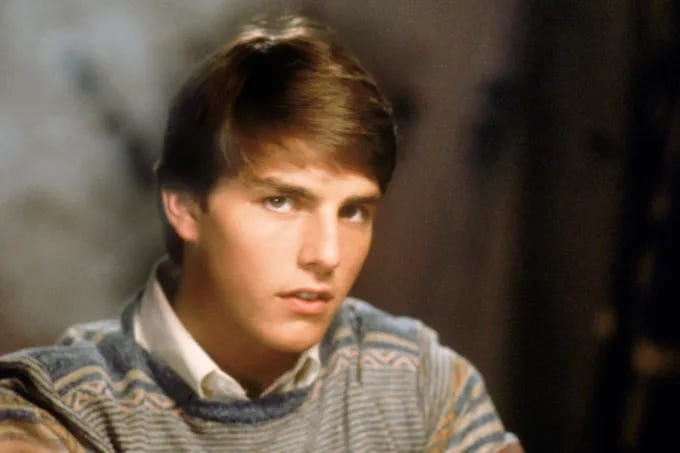
As a child of the 1970s, Cruise came of age with a strong attachment to the movies. Hollywood was still a glamorous place where stars lived their lives openly; the paparazzi had yet to take control. Stars were the Brat Pack, who made films like St. Elmo’s Fire and The Breakfast Club, and the leading men who dominated the best picture winners of the 1980s.
His first starring role was Risky Business (1983). Cruise plays Joel Goodson, the son of a wealthy family whose parents are about to leave for a long vacation. Convinced to spend the night with a call girl, he ultimately gets in over his head. Risky Business was a major success and cemented Cruise as one of Hollywood’s brightest young stars. The film contained the image that would launch a thousand odes: Cruise dancing in his underwear and pink shirt. These are the skinny, lactose-intolerant legs of a boy who is still partial to a low-rise jean. They are the bare feet and tanned calves of a kid who still runs as if he hasn’t broken his ankle leaping between rooftops. He was lacking the sheer sexiness of a genuine leading man, but made up for it with charm and wit. In other words, Cruise was destined to be a real movie star.
“Still becoming a man!” Cruise told Cameron Crowe in a 1986 Interview magazine cover story, when Crowe asked about the criticism that he still hadn’t played a grown man. “When I get to be Newman’s age, I’m looking to still be playing the great characters he plays,” he said. And yet Cruise came of age and lived in a period where actors weren’t supposed to have a boyish quality in the first place. Cruise sought to build an image in direct opposition to some of the most famous leading men of the day.
Cruise was introduced to Scientology in 1986 through his first wife, Mimi Rogers. He married Nicole Kidman in 1990. They adopted Isabella and Connor. They divorced in 2001. Reporting later, as well as the 2015 HBO documentary Going Clear, alleged church pressure around that split, including the idea that Kidman was treated as a Suppressive Person.
In 2005 he began a very public courtship of Katie Holmes. There was the infamous Matt Lauer clash on Today in June 2005, when Cruise attacked Lauer for asking about psychiatry and Brooke Shields’ use of antidepressants. He called Lauer glib and said Lauer did not know the history of psychiatry. (Later, he would apologize to Shields in person and to Lauer on Today in 2008, telling him he had come across as arrogant). In November 2006, he married Holmes in a private ceremony in Italy, with David Miscavige as the best man and Brooke Shields among the guests. In 2012, Holmes filed for divorce in New York. The case settled in about 11 days, and reporting at the time focused on Suri and how she would be raised in relation to Scientology.
This all gave rise to Tom Cruise’s infamous PR fortress that you may have already heard of. When I was working in film marketing, it was common knowledge among journalists that there are whole subjects you are not allowed to discuss with Cruise, and talking about them is like entering a minefield. It’s terrifying, and I get the sense that it’s terrifying because he knows precisely how to exploit every weakness you have. It’s not worth the trouble to ask questions that he’ll either refuse to answer, or answer in cryptic, nonsensical riddles that require a psychology degree to decipher.
Here's some default examples of the Cruise defensive playbook: if you ask him what an ideal Father's Day looks like, he will tell you, "Just having fun, man. Making movies, big adventures, having a great time." If you ask him whether he worried about dying and sinking the whole film, he will recall a story about climbing out onto the roof when he was two and a half, and how his mom would bake a cake to coax him down. If you ask him how he spends his time when he's not making a film, he will respond with, "I'm preparing for the next”.
It’s all incredibly baffling and mildly interesting, and in some ways it does inadvertently make Cruise feel more human: he is so boyish as he fidgets and squints and throws a slight tantrum when someone does not follow the rules he has set. But it’s also dehumanizing. Because what Cruise is really doing, in this attempt to prove Xenu is better than your god, is trying to convince you this is all what Tom Cruise is about and you don’t get to question that.
Fast forward to today for his Digger Oscar campaigning, Cruise still doesn’t say anything concrete about himself. Though he sure does love to talk about how much he loves the movies! Their priestly embrace leaves very little room for the kind of candidness that would unseal Cruise. He thinks movies should look like movies (yes, sir). He’s not interested in sharing his life with us outside of the work.
These latest Cruise appearances have had me thinking about the last time in which I’ve felt the same way about an actor. During COVID, I got deep into my Nicolas Cage obsession (a constant obsession, if you will, but sometimes more acute than others). I spent months watching interviews to try to figure out the Cage riddle. Is he crazy? Is he just a super dedicated method actor? Is he just weird? I never came to a conclusive answer, but the fun was in the guessing. Cage’s interviews are like his movies: you never know where he’s going to go, and he always manages to surprise you.
Cruise and Cage share a lot of similarities. They’re both obvious weirdos who seem to operate on a different plane of consciousness than the rest of us. They’re dedicated to the craft in a way that only the most committed of weirdos would be. They’re outspoken advocates for the artform itself. It’s a delight to watch both of them do anything, whether it’s trying to film in space, or living with two pet king cobras, one of them albino. They’re both devoted to you, and they want you to feel that.
But the biggest difference between the two of them is that Cage is, in fact, a lunatic. He’s a man who bought a pyramid to be buried in and a haunted mansion to live in. He named his own acting style “Nouveau Shamanic.” He loves movies so much that he’s willing to debase himself in service of their greatness. He paid $276,000 for a dinosaur skull and later agreed to give it back to Mongolia. He’s a man who, despite the wackiness, is grounded by his connection to cinema in a way that Cruise doesn’t seem to be. The other difference, of course, is that Cage never reached the level of superstardom Cruise did.
Movies were in real trouble during the pandemic, and during that time, it seemed like Cruise’s voice was the only one that really mattered in the industry (bar Nolan though Tenet didn’t help him). At the time, he also seemed to find a newfound audience thanks to his insistence of keeping Top Gun: Maverick off streaming, saying later, “That [streaming] was never going to happen.” He was relentless on the phone, reportedly ringing his cast each time the date moved, delay after delay. If you were going to write about Tom Cruise, the famous Hollywood star, you were going to write about the mission: to save movies.
It’s not just that Cruise loves the movies — it’s that we love that he loves them. The way that translates into blind faith from the public eye is either wild or exactly how it should be. Look around: Is there anyone else who carries a banner for this stuff like he does? Nowhere else is there a multimillionaire studio exec whisperer for keeping the movies alive. When you get someone who’s willing to go this hard for the movies, you must be an obliged audience. What other choice do you have?
Our love for Tom Cruise is often built on a kind of begrudging acceptance. Sure, maybe he’s a sicko, but at least he’s sicko for movies!! You don’t know what he’s ever going to do, but you already know that he’s going to do something insane when he’s hovering from the helicopter’s side like a mountain goat. You’re elated but also nervous that he might now do something stupid, like lifting off his helmet and loosening all of his straps. He lifts off his helmet and loosens all of his straps. “What the fuck,” you say. “He’s going to fly.” And then, moments later, in a moment that is only ever going to happen once in the history of cinema, Tom Cruise indeed fucking flies. It’s the ultimate Cruise thing: so personally transgressive and insane that it has the power to bring entire armies of worshippers to heel.

I don’t want to make the argument that love for Tom Cruise-as-an-actor is misguided. He’s a great actor! But that love is often built on a foundation of cynicism toward everything else, a base belief that Cruise will go to the ends of the earth to save the industry. What’s missing from all of this is an acknowledgment that, unlike Cage’s success, Cruise’s success is a product of illusion: a life built on stunts and deflections that make him seem more like a movie star than any other movie star.
So yes, the famous willingness to do anything for a movie is one thing. But more than that, Cruise has a childlike obsession with the act of making a movie, what it can do, and what it can be. There’s an openness to experience that makes him fearless on screen and a true partner to his directors, even as it creates gross blindspots in his personal life. It’s why his PR maneuvers are so odd, and why he brings the same energy to playing an action hero as he does to playing a singing hair-metal god. Most actors have a gear they stick to, a type they feel most comfortable within. Cruise has no such limitations. It could be because he never had a normal childhood, and so is completely unafraid to go all in on silliness. Or it could be because he really never grew up, and is so deeply in love with the magic of cinema that he has no need to hide it.
Running next to all of this is the Cruise escape: the way we, as an audience, choose to look away. Bigger than a look, really, it’s a choice to ignore, to deny, to compartmentalize, to indulge in our devotion to the star. To decide, time and time again, that he is worthy of our adoration. Bigger than his obsession with the cinema is our obsession with him. The Cruise escape might be the most successful example of what Susan Sontag describes in her book “On Photography,” where she writes that “reality has come to seem more and more like what we are shown by cameras. It is common now for people to insist about their experience of a violent event...that ‘it seemed like a movie.’”
And yet the fact remains that the other details of his public persona are not space magic. He’s the rube who joined Dianetics in the mid 1980s that will never die; he’s the Cowboy Scientologist with a brain like a pasta strainer; hundreds of thousands of people are damaged and abandoned by the cult he actively funds; he’s estranged from his daughter who has dropped his name; he’s a seemingly-obsessive and possessive ex-husband. At the end of the help line, there is no magician to keep you safe, only a man who is so far gone into the land of mystery and darkness that he has long since lost the ability to know what all of those mysteries and darknesses are.
Perhaps, the answer is a little more complex than that. Most likely he is both. And you could ask, does it matter? No, it does not, because Cruise doesn’t allow it to matter. The fact that Cruise has devoted so much energy into protecting his image gives us a unique opportunity to analyze it however we want, but it also makes it impossible to *really* know who he is. It is only the wildness of his heart that makes us aware of the things that he does. It’s an impossible heart, and we cannot help but want to cradle it, too.
So it is so, so easy to forget that, despite our adherence to everything else that makes him a man, he has a heart that belongs to no one. He will never tell you what he needs or likes; he is never wrong, because he is never anything that could put him in the path of weakness. He’ll never share with you his life or his love or even the simplest pleasures of his life, like what he really thinks of Paul Schrader or even his favorite Star Wars. He’s the biggest star on the planet and I have no idea if he plays Minecraft or has ever eaten a McRib. He has a heart that has not the slightest interest in the center of another heart, only the absolute obsessiveness of distance, and still he’s a king that is lonely enough to let his millions of fans just exist there, orbiting at the horizon.
And he obviously knows this, which is why he continues to do it. But it also runs deeper than that, and this is where I’m frustrated. I think that everything Tom Cruise does on screen and off is indeed sincere, in that he is a true believer in the Church of Tom Cruise. He believes in himself, he believes in the showbiz, he believes in the cinema-as-religion rhetoric, but I also think that he harnesses all of it into this performance, almost, as a means of control.
This is one of the reasons you will often see him talk about “cinema” in broad grandiose terms instead of platforming debut directors or micro budget films. It’s why he champions conglomerate billionaire mergers that are, in fact, terrible for our industry (but great for him). It’s also why, I believe, Digger has been a box office flop3 despite its indestructible main guy. Tom Cruise doesn’t know how to sell you Digger because selling you Digger would include engaging in the politics of climate change, wealth inequality and America’s supremacy. Tom Cruise can’t do that. But he can sell you Days of Thunder 2 because cars and sports4. I’m not claiming that he’s some sort of sinister Mephistophelean figure per se, but he has also never been a man who willingly lets go of control. And letting go is a prerequisite of being an artist and a champion of the arts.
Tom Cruise thinks of cinema as the most pure expression of his control, because the illusion of cinema is a controlled space where he gets to dictate the rules, for all intents and purposes. I’m aware that’s a little reductive when you consider all the other people involved in making a movie, but he is still the star, and that’s the position he clings to.
And in the end, he has to make sure it’s a controlled space for you, the audience, too. The dark room, the big screen, the whole spectacle. I’m intrigued and uncomfortable by the way Cruise has found control in a world that constantly exerts power over him. While that’s the work of a savvy and talented individual, I still can’t help but feel that it’s the work of someone who has found the best way to have a little bit of power in a world where he has very little.

Want to have your thoughts featured on That Final Scene?
I’m always on the hunt for your confessions as part of my Reader Hotline.
Here’s what I’m looking for:
Plot armor: The show or film that got you through a difficult time.
Spicy take: Your most controversial film opinion that you’ll defend with your life.
Reality check: The film or show that completely rewired your worldview.
Triggered: When something on screen or in the theater hit you unexpectedly hard.
Send your confessions to sophie@thatfinalscene.com or record your voice message on the link below. Everyone who submits gets a free 3-month membership, whether I use your story or not. See you in the confessional.
I came across this article after writing this sentence, and you know what? Checks out.
Though Cruise would tell you he’d never have plastic surgery!
And no, it’s not the film critic reviews! It’s never the film critics reviews because “people” don’t read them. Latest exhibit: VERITY has been smashing it in the box office despite catastrophic reviews.
So the reason you should see Digger in a cinema isn’t that it’s a great film. It’s that it flopping would give Tom Cruise every signal he needs to start remaking his greatest hits instead.
I haven't seen Digger yet but was planning to catch it. The trailers look deranged and I'm not sure they connected with a general mainstream audience, and that coupled with TC's lack of press maybe it never stood a chance. The marketing blitz around the last couple of Mission Impossible's were so OTT that it almost spoiled the cinema experience
M:I franchise >