


Avatar: Fire and Ash opened to $345+ million globally on its opening weekend. I know this because I've been online, which means I've witnessed the return of a discourse so predictable that I could have written the posts myself months ago and scheduled them to post. "Name three characters." "No cultural impact just hit $136M lol." Saturday Night Live once did a sketch about the Papyrus font choice and that four-minute bit has more cultural penetration than three films that have collectively made $6.35 billion. The takes are identical to December 2022, which were identical to December 2009. This is simply the world we live in now, and pushing back on it feels about as productive as arguing with your mum about whether you need a jacket—technically you might be right, but is it really worth the energy?
The film's already shattered China's opening weekend record for the franchise—$57.6 million, if you're counting, which apparently we're not because it happened in Mandarin. Biggest debut of the year in France, Germany, Spain, Korea. A 90% audience score on Rotten Tomatoes, an A CinemaScore, the fifth-biggest IMAX opening in history. But sure, let’s talk about the cultural void.
Over the past few weeks, I’ve been investigating into the matter because I wanted to know if this paradox actually held up when you looked at it closely, or if there was something I was missing due to my buying into the premise. And I found things! Genuinely surprising things that made me think I'd figured it out.
By the time the weekend rolled around, I had seventeen pages of notes in a Google Doc I'd optimistically titled "Avatar Cultural Impact: The Investigation” —basically walk you through each piece of evidence methodically, build the case like a prosecutor, land on "see? Avatar DOES have cultural impact, you just weren't looking in the right places.". I was so ready to prove everyone wrong and to write the piece that would make people stop having this same stupid conversation every three years. I’m telling you I was SO ready!
And then I sat down to write it, I got stuck on this nagging thought that wouldn't go away: what if I’d spent all this time building an incredibly thorough answer to what might be completely the wrong question?
A note before we begin:
This is a one-time free investigative essay open to everyone. I’m planning on doing more rabbit hole essays like this (if you want to call them that) in the future, but they require even more work and resources than the regular stuff I do, which is already a lot! This one ended up being 5000+ words, blimey. So if you like this kind of thing and want to see it continue, please consider upgrading your subscription to include full access next time around (and support independent film criticism in the process).
If you regularly question things that others take for granted or notice small details that make you say “huh,” these types of investigations might be for you. No filmic or cultural question is too weird or small — I firmly believe that small questions can lead to big answers. I would love to release these types of essays maybe quarterly…but we’ll see! As someone who has only recently begun to train themselves on this type of research, I acknowledge I’m not an expert so your feedback will be immensely valuable to me. Alright…onto the investigation✨
how the avatar paradox goes (what i’ve read)
First things first, I want to say that the consensus position deserves far more than a dismissive hand-wave. When people say that Avatar isn't culturally impactful, I don’t think they are being contrarian for the sake of being a contrarian — they're pointing to real absences and patterns that differentiate this franchise from others that made far less money. By taking their argument seriously (and accepting that it's okay to disagree with them), we can get a sense of what exactly it is that they're measuring.
the quotability “problem”
Quotability is perhaps the most important factor in cultural spread. The Avatar franchise has produced next to no dialogue that ever left the confines of Pandora’s atmosphere. “I see you” never made it past the ears of a non-chatbot filmgoer. It didn’t even reach the level of “Yippee-ki-yay, motherfucker,” or, I don’t know, “Talk to the hand.” Even something as basic as “May the Force be with you,” which was not especially innovative on release in terms of film dialogue, remains iconic due in part to simple mechanics — it’s kept alive by its use as a sort of pop culture punctuation mark. (Were you really working on that McDonald’s Big Mac crossover Episode I special edition without using it?).
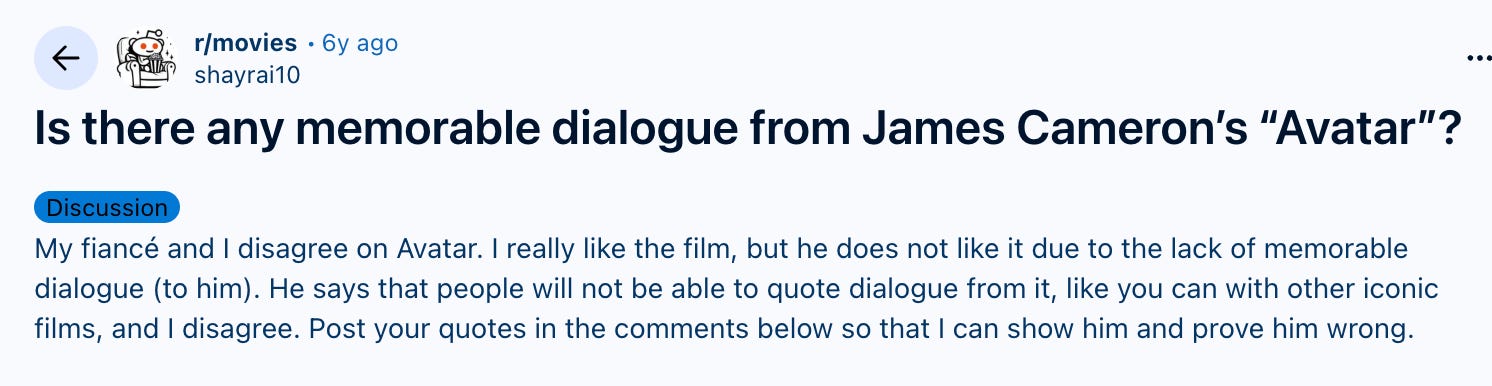
The lack of quotable dialogue does more than shut down water cooler discussion. It seems to hamper the very mechanisms through which culture circulates. When a piece of dialogue is memorable enough, audiences can reference a film without having to break into an exposition monologue about what happens in it (or even feeling pressured to show more than half an hour of footage before any marketing will allow). These lines become cultural fuzzy dice — touchstones whose continued existence isn’t contingent on specific viewership. Limited quotability only serves to siphon fewer things to discuss into conversation.
the character “problem”
The film's character naming only makes the memorability problem worse for us Westerners. It's not just the strangeness of the Na'vi names that make them hard to remember — Jake Sully is way dorkier than that. I mean, his name sounds like he could be an overzealous fan of The Office. Neytiri doesn't help: what b-movie alien sexipede is she from? (The rest don't even rate: Mo'at? Tsu'tey? Sounds like another planet's version of Simon and Garfunkel.) Try as we might, no one's going to remember these names like Luke Skywalker or Ellen Ripley or Katniss Everdeen, right?
Part of the “problem” is also Byung-Chul Han's linguistic barbarism. Paul Frommer constructed the Na'vi language using ejective consonants—sounds produced with a sharp burst of air that don’t exist in English. The language was built for alien authenticity, to sound genuinely non-human, but that same authenticity creates a barrier to casual recall. The names resist the mouths of anglophone audiences, and you can’t reference Tsu’tey at a dinner party if you’re not sure how to pronounce it.
The way I see it, when you can't remember a character name it often just means they weren't memorable, but these characters actually aren't there. In fact, supposedly, they're not functioning as cultural references outside the film because they have no significance to anyone outside their plot function.
the derivativeness “problem”
You’ll often hear that the story itself is a mix of Pocahontas, Dances with Wolves, Ferngully, The Last Samurai—that "white guy goes native" structure that we've all seen before. This obviousness has a very specific effect on cultural conversation. I don't say that to imply Avatar is themeless or unintelligent. It has clear messages about postcolonialism and anti-racism (perhaps too clear) that are worth critiquing. But because the arc of the story is so recognizable from the first few minutes — you know Jake will betray his people, fall in love with Neytiri, lead the Na'vi people into battle, and become one of them — its legibility affects how we talk about it. You'd never call everything in a Marvel movie "obvious," because they're so stuffed full of twists and turns and setups that you can never be sure where they're going with any given plot thread (though if you've seen one Deadpool movie you've basically seen them all). A predictable narrative means that instead of asking "what's going to happen next?" (which no one does for this movie) or "what just happened?" (which also isn't really relevant), we focus more on asking "what does it mean?". Narrative legibility results in a conversation dominated by thematic discussion rather than puzzle-solving.
Another thing that affects how we talk about a film is spectacle. You can describe cool action scenes and impressive explosions in a James Bond film, but those things barely generate conversation — if anything, they serve to emphasize how little there is to say. But again, just like with the narrative legibility, we reach a point where those descriptions start sounding like platitudes: yes, yes, it looks great. Spectacle in and of itself doesn't create conversation, this camp will tell you. It simply exists as part of the "experience."
the fan culture “problem”
Franchises live on remix culture. Fans steal content, write fanfics, turn Pedro Pascal into memes that manage to express every human emotion. This keeps stories alive between releases.
James Cameron protects his franchise like it's the Mona Lisa except the Mona Lisa is also classified military technology. Industry commentators have dubbed the Avatar approach "the lawyer stick”, meaning the franchise would rather let its story go untold than collaborate with fans on it. Star Wars dumps assets online and pretends not to notice when you make little fan films. Marvel actively encourages you to draw their characters as whatever your heart needs to process your emotions—cats, bread, small melancholic creatures. Avatar never releases anything.
The legal stuff is one barrier but the technical problems might be even more prohibitive. The film's assets are crafted using cutting-edge CGI that strives for perfect photorealism. Beautiful, genuinely. However they resist translation into the lo-fi formats meme culture requires to survive. You cannot easily edit the Na'vi characters even if you wanted to (not without looking like a blue naked mole rat who missed her mark anyway). The technology resists looking cheap even when you want it to look cheap, which creates this fascinating problem where the visual language of the film is fundamentally incompatible with the visual language of how people communicate online.
And then there's the biological design, which I have such sympathy for anyone who's attempted.
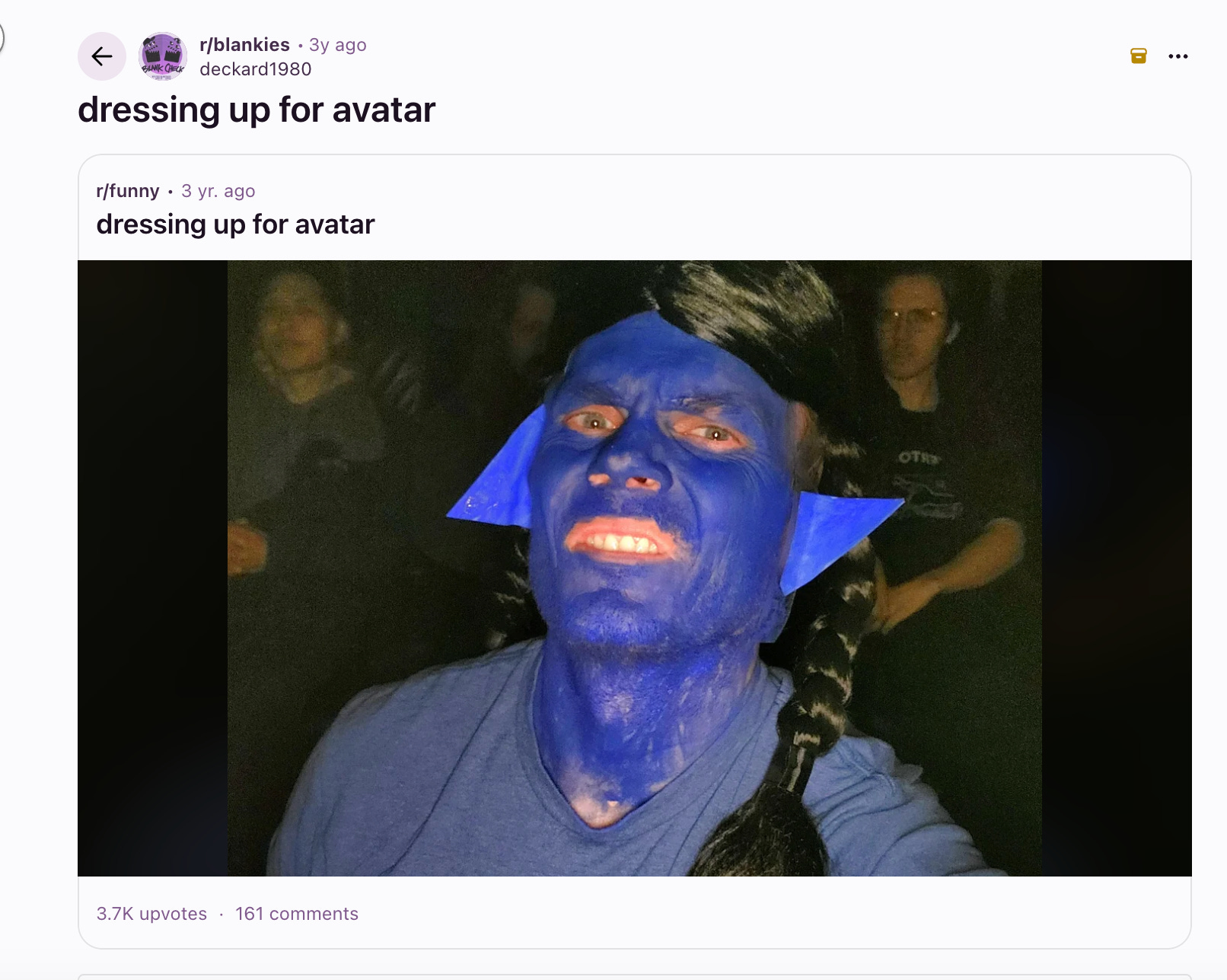
Fan engagement hinges on emulation—cosplay, fan art, DIY costumes at conventions. These are ritualistic displays of devotion that create community, signal belonging. The Na'vi present a sincere conundrum here and I'm not being facetious. They aren't humans painted blue. Third eyelids. Elongated limbs. Tails. Which means that when someone cosplays Na'vi—and people try, God bless them—they're fighting against physics and biology in ways that are heroic. Full-body paint that takes hours. Elaborate latex prosthetics. Friends who dedicate entire afternoons to helping you transform into a ten-foot-tall blue alien, which is honestly beautiful if you think about it.
You pour all that labor and love into it and instead of looking like Eric Lutz playing an alien warrior, you come across as a flesh-eating spirit in a gone-wrong horror flick Dorian Gray would be proud to own.
Finally, there's also Pandora itself, which presents its own obstacle course for fan participation. You cannot separate the seduction from its bioluminescent dreamscape—those phosphorescent jungles, that fiber-optic flora, those landscapes pulsing with alien light. None of it translates to DIY recreation. You can build a lightsaber in your garage. Sew a Hogwarts robe. Construct an Iron Man helmet from foam and prayer and acrylic paint. But no one is cultivating convincing bioluminescent rainforests in their basement. The films' glowing fabrications exist exclusively on screen. They refuse to be in our world.
the merchandise “problem”
In 2009, Mattel thought they would finally crack the movie tie-in market wide open with what they believed was genius-level innovation. They embedded augmented reality into the Avatar action figures—each toy came with an i-TAG that you'd scan with your webcam to unlock "interactive content," which sounded exactly like the sort of promise that would later seduce every tech bro in Silicon Valley into pivoting to the metaverse. The animated model would spring to life on your screen as if they were really there with you, which was a noble ambition and a spectacular disaster.
This had less to do with concept than execution, because late 2000s hardware simply could not handle what Mattel was asking it to do. Webcams couldn't track properly. Instead of your Na'vi warrior gracefully gliding across your desk in a display of alien majesty, latency and jitter caused these cursed digital figures to stutter around like malfunctioning animatronics at a bankrupt Chuck E. Cheese. They didn't respond to you. What was meant to feel like wonderment instead felt like watching something die in real time on your computer screen. Within a year, Avatar merchandise started vanishing from shelves, not because it sold out but because retailers were quietly moving it to clearance aisles where toys go to die.
And then there's the paradox: The film's entire moral architecture rests on rejecting earth-killing mass consumerism, on valuing connection to nature over accumulation of stuff. Pandora's ecosystem operates on spiritual interconnection—those glowing trees aren't decoration, they're the nervous system of an entire planet. The Na'vi plug their hair-tentacle things directly into animals and trees because belonging matters more than owning. So when you try to mass-produce millions of plastic action figures based on characters who represent anti-consumerist values, you've created this bizarre ouroboros of hypocrisy that even the most devoted fan can feel in their bones.
the content drought problem
From 2009 to 2022, aside from the occasional theme park ride, Avatar went dark. Marvel Cinematic Universe released twenty six films in the time since. Star Wars five films and animated series and books and comics (someone fact check me?). And while all of that sounds tedious I do mean it, because those franchises made sure to remain “culturally relevant” by never going silent. Avatar very purposely did the opposite thing. James Cameron spent thirteen years working on his sequels and then he just didn't release anything else in the meantime.
A generation of people grew up watching other movies and shows. And then when Avatar came back in 2022 it was presented to an audience that had been conditioned to expect new content all the time. By that standard something like Avatar clearly had no cultural cachet whatsoever. And yet…and yet…Way of Water still made two billion dollars.
So all in all, this is what "no cultural impact" means when people say it, I think. They're not actually claiming that no one ever saw the movie—the box office numbers make that sound silly, and they're not stupid. They're claiming that the movie doesn't keep working when it's not playing. It doesn't generate quotes, characters, products, theories, communities. It doesn't circulate (I’ve often heard people call it an "absolute movie"). It just exists, monolithic and silent, until the next sequel materializes and jolts everyone into remembering it happened.
And by the metrics we've inherited from critical tradition—the ones tracking whether stories colonize imagination, infiltrate conversation, generate that ambient presence even dormant, Avatar does indeed flunk spectacularly.
the counter-arguments (i did my best)
Here's what they don’t tell you about spending weeks building someone else's argument: you start to believe it. By the time I finished laying out the consensus case, I half-wanted to abandon my investigation entirely. The "no cultural impact" position isn't stupid—it's rigorous, coherent, and supported by every metric I know how to check. So either I was about to waste my time hunting for evidence that didn't exist, or I was about to find something the consensus had missed. Neither option felt comfortable.
So let’s lay out some of the counter-arguments.
The consensus claims Avatar vanishes between releases, that it doesn’t sustain engagement, that people forget it existed until the next sequel reminds them. But Avatar holds the record for the fastest-selling home entertainment release in US history—6.7 million units sold in four days. On Facebook (boomer of me I know BUT it’s still technically the biggest social platform in the world), it remains the most engaged-with film on the platform, with 42 million likes. The combined box office of the first two films, $5.26 billion, outgrosses the entire Twilight franchise and the entire Shrek series put together.
So where was all that engagement going? If 43 million people liked the film on Facebook, why weren’t they generating memes? If 6.7 million households bought the DVD in four days, why weren’t they quoting it? The numbers tell me the engagement was/is real. What I couldn’t yet see was where it was manifesting—because it clearly wasn’t manifesting in the places where “discourse” lives. The answer, I discovered, was that it was manifesting, first and foremost, in political action.
the political and social activism footprint
In 2010, five Palestinian activists in the village of Bil'in painted themselves blue, donned Na'vi ears and tails, wrapped themselves in traditional Keffiyeh and Hijab scarves, and marched toward Israeli soldiers at the separation barrier. They'd been protesting for years with minimal international coverage, unable to break through the noise. The Avatar imagery changed that. Camcorder footage of them being assaulted with tear gas was cut together with clips from the film, their message spliced into the narrative: "This is our land!" The video spread globally. News outlets that had ignored Bil'in for years suddenly had a visual too striking to pass over. The activists had found what one researcher called a "pressure point" in the global imagination—a piece of cultural vocabulary legible enough to make the world pay attention.

Meanwhile, the Chinese government was drawing its own conclusions. After exactly 14 days in theaters, Avatar got yanked from 1,600 screens across the country. Why? Because it turns out watching blue aliens resist forced displacement was hitting a little too close to home for citizens watching their own neighborhoods get demolished for development projects. And the thing is, governments don't censor movies they consider culturally inert. You don't ban something that has no impact. The suppression was itself an admission—the film was resonating hard enough to feel like a threat to state stability.
But it gets weirder (or maybe just more interesting, depending on how you feel about Hollywood directors actually showing up). Leaders from Cherokee, Maori, and Xingu nations used the film to spotlight land rights struggles. James Cameron didn't just post support from his yacht—he physically joined the Amazonian Xingu tribe's legal fight to halt a massive dam project in Brazil. The line between Pandora's fictional resistance and actual indigenous advocacy got real blurry real fast. Then there's the Avatar Home Tree Initiative, which planted one million trees across 15 countries including Haiti, Brazil, and Japan. In Zhangjiajie, China (the national park that inspired those floating mountains), they renamed one of their rock pillars "Avatar Hallelujah Mountain" and restructured their entire economy around the connection. Tourism now accounts for 60% of the city's GDP and has lifted 40% of the local impoverished population above the national poverty line.
So when the consensus argument claims Avatar has been “vanished”—that it's just passive entertainment consumed and forgotten—I have to ask: vanished by whom, exactly? Because it was being used for political resistance in the West Bank. For indigenous land rights in the Amazon. For economic transformation in rural China. The film became a tool, a shared vocabulary, and a resource for people pursuing goals that had absolutely nothing to do with Hollywood's bottom line. You can call that a lot of things, but a “vanished” blockbuster isn't one of them.
I know the obvious objection and I can already hear the counterargument: Activists repurpose imagery all the time—someone's always slapping Guy Fawkes masks on protest posters or holding up three-fingered salutes borrowed from YA dystopias. That doesn't make the source material culturally significant on its own.
Okay, I’ll play. What I found next was harder to dismiss because it wasn't happening to activists with agendas.
It was happening to ordinary viewers with no political stake at all.
the psychological footprint
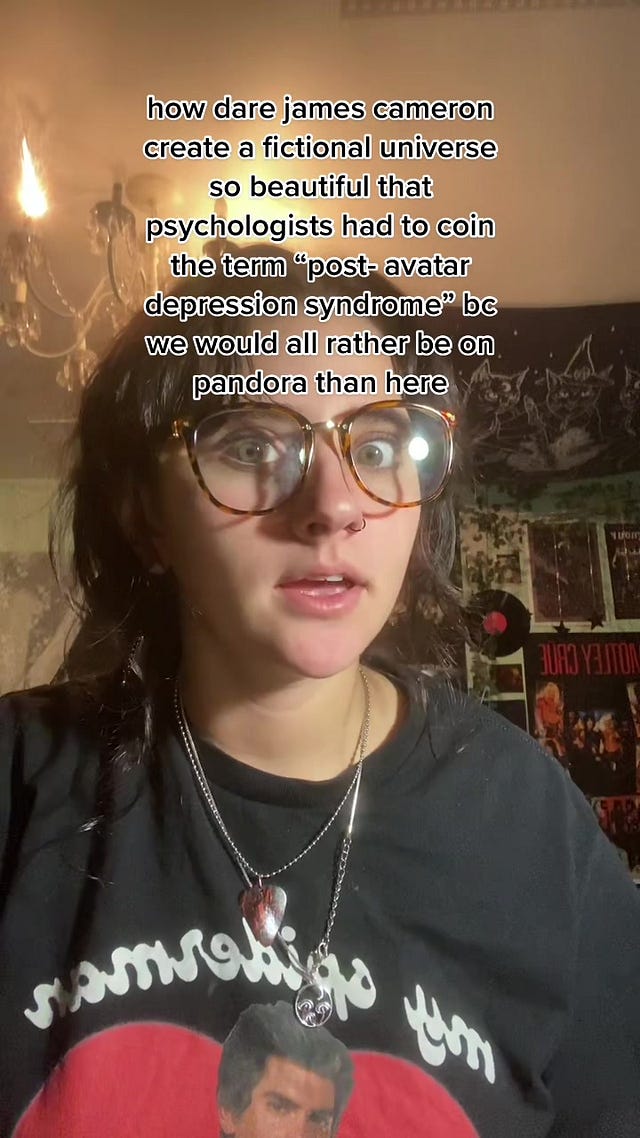
In the months after Avatar's release, thousands of viewers started reporting something they called "Post-Avatar Depression Syndrome"—a profound despair triggered by the fact that Pandora looked better than their actual lives. On forums like tree-of-souls.net (yes, that existed), users wrote that their human existence felt like a "meaningless hollow illusion." Some reported suicidal ideation, expressing hope they might be "rebirthed" into a world like Pandora. Others went full lifestyle conversion: veganism, rejecting "wasteful greed," spending more time in nature, longing for the Na'vi way of communal living without money or—and this is key—40-hour work weeks. (So really, did they want to be Na'vi or did they want Danish social policy with glowing trees?).
 Tiktok failed to load.
Enable 3rd party cookies or use another browser
A forgettable blockbuster doesn't trigger existential crisis. Fast & Furious movies don't send people into despair spirals because they can't drift cars through Rio de Janeiro. PADS was evidence of psychological impact so deep it destabilized viewers' relationship to reality itself—people were genuinely depressed that they couldn't live on a CGI moon. And the phenomenon revealed something crucial about why Avatar's engagement remained invisible to the discourse. PADS sufferers didn't make memes. They didn't write fan fiction or debate lore on Reddit. They went back to the theater—five, six, SEVEN times—to re-enter the world that had made ordinary life feel insufficient. The engagement was real, but it was a closed loop: repeated consumption that boosted box office numbers while leaving almost no external cultural residue. Psychological devastation is hard to measure when it’s happening inside nervous systems and not on social media feeds.
But while I was digging through all this—the forums, the repeat viewings, the existential despair—I kept running into something more obvious. This is the argument you’ve all heard of: Avatar had physically restructured cinema itself.
the scientific and industrial footprint
Over 80% of ticket sales for the original Avatar came from 3D and IMAX formats. I was 17 when it came out, and to say that the 3D thing felt huge would be an understatement. I remember begging my parents to take me to see it in IMAX 3D on our family vacation in Crete. Things were tight at the time so going to the movies still felt like a special treat, and seeing something on that massive of a screen and wearing those gigantic glasses almost felt like walking into a fairytale.
Pandora was special and magical because of this movie event sensation none of us had actually gotten before, that if you lived through it, imprinted on you like imprinting on a baby creature. I remember being put out by how “real” the screen felt — as if it was talking directly to me in one long inside joke that only our small-town high school understood. I remember going all-out at Hot Topic store because they were releasing a ton merch for the movie (Aang cosplay wig; check!). I felt genuine awe that my 3D glasses had very authentic-looking Na’vi sitting on them and buying into Pandora’s promise Avatar was going to be an entirely immersive theme park experience for fans, thanks partly through its ingenious use of infrastructure.
And now, 3D babies by its chief architect James Cameron aside , Avatar’s groundbreaking motion capture technology has been repurposed in service of new kinds of magic since such as: tracking motor symptoms in movement disorder patients. Technology that made Jake Sully walk again is now assisting doctors in observing Parkinson’s patients’ gait. Fab stuff!
The film has also entered scientific record. A new pterosaur genus identified in China was named Ikrandraco avatar because the creature’s crest resembles that of the flying dragon. In 2019, the moth species Arctesthes avatar was named specifically to raise awareness about an Australian coal mine threatening its delicate ecosystem. Love it or hate it, Avatar imagery is now embedded in taxonomic literature and may as well soon appear in biology textbooks read by thousands of kids desperate to impress their teachers with characters from Pandora they wish were real.
Well, well, well. Hasn’t Avatar had a tremendous cultural impact on our world?
realizing my faulty premise
This should have been the conclusion of my personal investigation, or whatever you want to call it but even with this evidence, my conclusion was still deeply unsatisfying. Sure, I had data on political appropriation, psychological rupture, industry transformation, technological and scientific innovations— all distinct categories, none of them circulating in the conversations where Avatar's legacy was being adjudicated. Why not?
At first I assumed the problem was visibility. Maybe people just hadn’t encountered my material. My job was to surface it, that felt like a simple enough solution. But as I sat with my notes trying to figure out where I’d gone wrong, I started to see something else. The evidence I had gathered wasn’t random — every piece of evidence shared a quality. It was legible. Legible to whom? To me, obviously. To the outlets I read. To the critical frameworks I had internalized (frameworks that, importantly, mostly don’t come from or exist in conversation with the Global South).
My investigation started because I was focused on proving Avatar has cultural impact only to translate this evidence into terms that would make sense to the audience I was imagining—which is to say, the Brads from Bushwick who can’t name three Na’vi besides Neytiri despite the fact that there are entire Weibo forums cataloguing every background character’s clan genealogy.
Bil’in protestors mattered because they were photographed by international wire services. They mattered because they were written up in anglophone publications and went viral on social media platforms centered around english speakers rather than anywhere else (that isn’t meant as blow off — those are massive platforms but there are other very large platforms where things could go viral where they did not). My PADS case studies mattered because they happened on forums at least someone like me can read (and then write an essay about white people letting James Cameron do whatever he wants with their brains!!!). The Zhangjiajie rebranding was accessible because it got the kind of coverage in Western travel press aerosol aspired to emulate (and managed to secure).
So here I am, so deep in my scarcity mentality that even when given the chance to redefine “cultural” to include non-English voices and perspectives, I still played by the rules of a game that wasn’t built for me. The question I was trying to answer—”does Avatar have cultural impact?”—isn’t actually the question. It obviously does no matter what people tell you.
The real question is why we insist we cannot see it.
What counts as "cultural impact" in how we talk about art? Is it whether something trends on Zuckerberg’s social platforms? Is it whether white millennials who went to Sarah Lawrence make memes about it? Is it whether you can buy the merch at Target next to the Funko Pops and those weird reversible sequin pillows? What happens when your entire framework for measuring it is built around one very specific type of conversation—the type that happens almost exclusively in English, on platforms you choose to prioritize, generating the discourse you recognize and consider legitimate?
Over 70% of Avatar's box office has historically come from outside the United States. When The Way of Water opened in 2022, audience interest surveys showed 11% of Americans planned to see it in theaters. In India, the figure was 48%. In the UAE, 45%. In Mexico, 36%. The same film, producing radically different levels of enthusiasm depending on where you asked the question.
The "Avatar has no cultural impact" argument requires you to ignore that these films dominate globally—in ways that are non-discursive, non-participatory, and not heavily indexed to anglophone internet culture. It requires you to forget about millions of people who see the films four times in IMAX and can tell you the difference between a thanator and a viperwolf and certifiably care about the spiritual cosmology of Pandora's bioluminescent ecosystem—in markets we routinely dismiss as "just showing up for spectacle."
I get it. Spectacle is only real if Timothée Chalamet’s wearing Givenchy suits while namedroping André Bazin or if it’s Nolanian (and I say this as a unironically big-Christopher-Nolan fan). But I’m sorry, when was the last time you cried about a bioluminescent forest or went home to make fan art of zero gravity water? Yes, H₂O is super cool guys but what millions of people remember—what they know all the details about and what they care about in terms of star lore and in-universe cosmology—is literally being dismissed by American film critics as $5 spectacles for dumbasses.

This is the same film discourse that treats international box office as this weird asterisk—"well it made money in China"—as if that's less real than making money in Akron, Ohio. Everyone rolled their eyes at how far-reaching and penetrative Avatar was into Manila but don’t worry—it never came to Manchester. The Avatar "paradox" is just us discovering that Western cultural hegemony in film criticism doesn't extend to defining what people care about globally, and instead of examining that, we've come to treat it as evidence that something's wrong with the franchise.
Nothing's wrong with Avatar1. Something's wrong with us.
So long as we continue to measure ocean depth with a ruler designed for IKEA furniture, we will continue being shocked when the numbers don't make sense. So long as we're more interested in whether Chris Pratt's oversized head successfully attached to blue-spined Mario than in why a film that restructured global cinema gets called culturally irrelevant, that fucking ruler is the problem.
Avatar’s lack of cultural footprint in Western film discourse isn’t a paradox.
It’s data.
And the data tells us exactly where our attention lives: in an echo chamber that mistakes its own conversations for the entire world, where cultural impact is measured by whether something can be turned into a Halloween costume you can buy at Party City. You know, next to the inflatable dinosaur suits.
A special shoutout to this guy

a very important final thing
Realistically, you’ve made it this far because you either love me or have way too much stamina for scrolling. Either way, I respect that about you.
Anyway, here’s the situation. I know you’re not here because an algorithm served this to you between ads for meal kits. You’re here because you’ve decided, week after week, that this specific voice saying these specific things is worth your time. That matters, and frankly, it’s the only reason I keep doing this alongside a job that pays my bills.
That Final Scene is an independent project that has no media empire behind it or VC funding. If that’s worth supporting, why not upgrade your subscription?
The extra goodies you get:
The TFS Hotline—where your truly deranged film questions get the full treatment instead of sitting in my DMs like a digital orphan
Lengthy TFS Original Investigations that go deeper than “here’s a take I had while scrolling BlueSky” (like this one)
Ability to start conversations in the TFS Chat (a community that doesn’t make you want to delete the internet)
It’s only £49/year for an annual subscription—which is about 20% cheaper than going monthly (great deal tbh). That’s less than a mediocre sandwich per month; hell, cut out that Disney+ subscription that you forgot to cancel and boom—there’s your TFS subscription right there.
I’m not defending Avatar on artistic grounds—that’s a different essay, and one I’m not interested in writing because I’d rather eat glass than spend 3,000 words analyzing James Cameron’s white savior complex through a postcolonial lens.
This was actually very hopeful to read. It's comforting to see evidence of the notion that the internet (more specifically, the parts of it that are in English) doesn't actually represent the world. Outside of our little corner, people aren't as jaded. They still know how to wonder and marvel and find joy in beauty, imagination and nature. That's heartening. Thanks!
Firstly, it's great to see you back and writing again, Sophie! Love your essays as always.
This one is a fabulous deep-dive on the Avatar impact. I genuinely had no idea about the activist footprint, but it makes complete sense.
Something that I realised in 2022-2023, after The Way of Water was released and clinched $2 billion at the box office, is that a digital cultural footprint does not equal a real-world cultural footprint. Nearly every online publication kept predicting that the Avatar sequel would be James Cameron's Waterloo for sure (never mind that they said the same thing about Avatar in 2009, and Titanic in 1997). Did you notice that for Fire and Ash, the discourse has changed from "James Cameron Gonna Flop" to "Will Avatar 3 Also Make $2 Billion?"?
We've gotten so entrenched in believing that the internet reflects the real world that it feels like a shocker when something proves us wrong, like Avatar's success. The best example would also be the Morbius meme power- Sony thought fans were interested in re-watching the film based on the meme popularity so they re-released it... only to watch it fall on its face with yet another thud.
Even though some films do genuinely find success through savvy digital marketing tactics, I really hope that we can eventually move on from relying entirely on that. Not everything needs a digital footprint to be a success in the real world.
P.S. I do have one nitpick with your essay, and that's the line, "You'd never call everything in a Marvel movie "obvious," because they're so stuffed full of twists and turns and setups that you can never be sure where they're going with any given plot thread." - I beg to differ! They're about as formulaic as it gets.