


I’m an Andrew Kevin Walker girl through and through. If I had to pick a favorite “screenwriter boy,” if you will, it would absolutely be Walker, the mastermind behind my all-time serial killer fave, Se7en. Evil is crafted to be so frightening in Se7en not just because it is evil, but because it is ordinary — “he is still just a man,” as William Somerset (Morgan Freeman) described it. Walker’s unique perspective that evil is cheap, petty, whiny, annoying, and tiresome, rather than majestic or supernatural, is core to the Se7en experience, but we can do a much better job of resisting and acknowledging that this nihilist mood, which sometimes gets described as “90s cool,” is the specific semiotics of Walker’s writing and that of his many imitators.
Walker’s influence outlived the 90s serial-killer cycle that began with Se7en, but I dare you to tell me that any of the countless Walker-like movies we’ve been left with over the last two decades are as interesting, as vital, or as good. Walker’s influence is still clearly visible in the culture and on streamers (see: Mindhunter), which is what made the discourse around David Fincher’s Netflix The Killer (2023) so fascinating. The internet vilified it as a return to form for Fincher — Walker’s bestie — and it seemed like maybe even Fincher himself. In any case, it was a new decade, and Andrew Kevin Walker wasn’t the only one who had fallen silent in the interim.
In February 2026, Walker’s new screenplay — Psycho Killer, directed by Gavin Polone in his feature debut — opened with a 0% on Rotten Tomatoes. It has since climbed to 9% (woohoo). But critics were not kind. The Guardian described it as “the sin of boring us.” MovieWeb called it “a misfire that lacks the atmosphere and thoughtfulness of the film that put Walker on the map.” Shot in 2023, Psycho Killer sat in a vault for almost three years before being released earlier this year with no press screenings and almost no marketing.
This looked clearly like a dump.
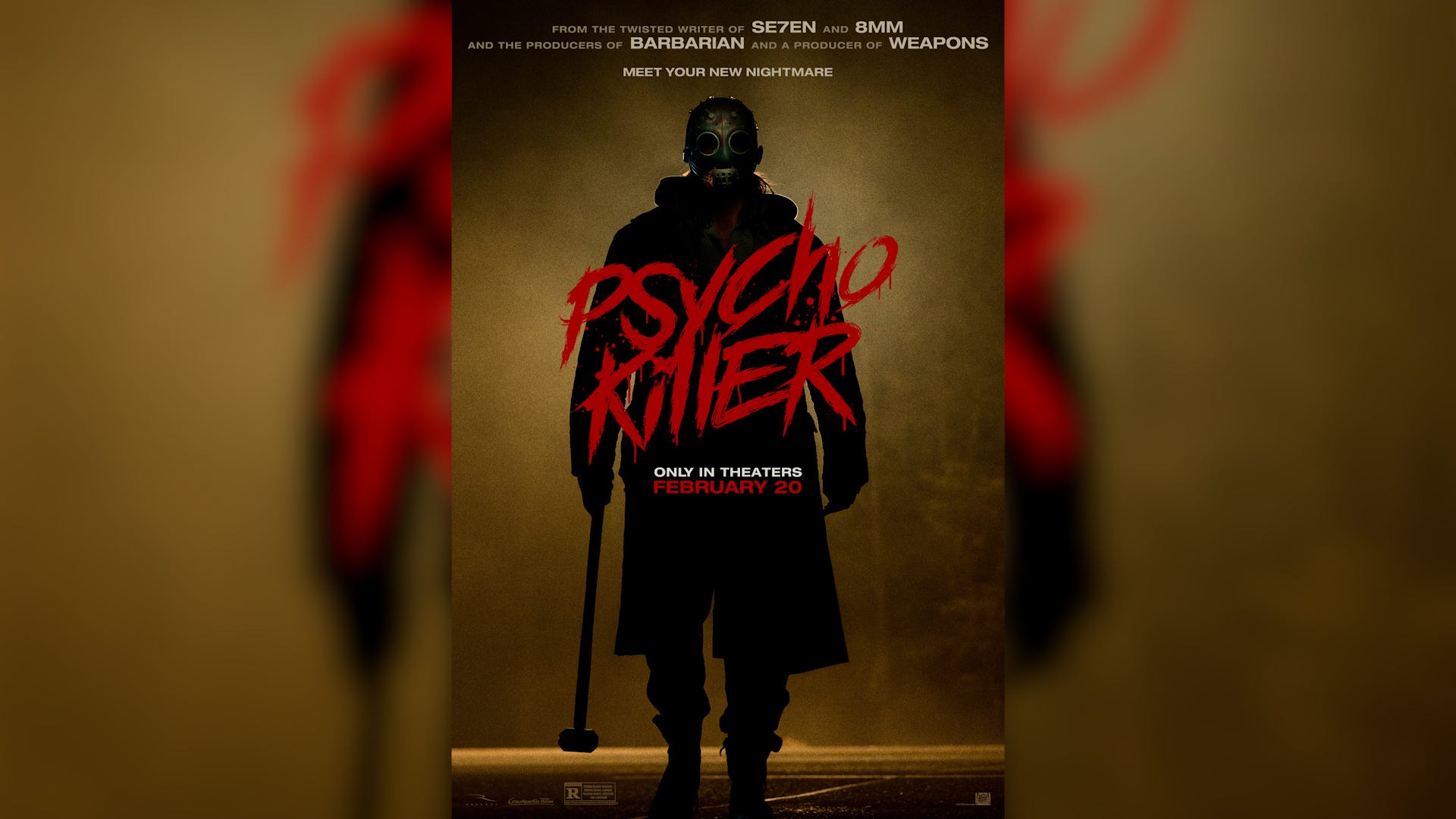
I say all this to explain why I was surprised when C. C. Simmons reached out wanting to use their founding member commission credit on a TFS piece devoted to defending Psycho Killer. I was shocked, but also intrigued. I don’t think I’ve ever seen someone go to bat for this movie yet, and Charlotte is one of the most interesting film critics I know. If they think there’s something there, I owe it to myself and to you all to hear them out. Some of the best conversations I’ve had on the internet have been with people who are intelligent and interested enough to talk about something they love, no matter how silly. And who am I to deny Charlotte the opportunity to convince me of something?
What follows is not exactly a conversation about whether Psycho Killer whips objectively or the common case of a movie being allowed to languish by its own studio. This is about what happens when a once singular sensibility becomes obsolete, especially inside the film industry. It’s a story about what we as film lovers lose when something that should have been an event becomes a failure — and then a source of embarrassment.
As a film critic who grew up on Walker’s writing, I want to reflect on a story that’s felt very personal, very matter-of-fact, and also very bizarre. And well, here I am.
So let’s welcome Charlotte to help me untangle it.
Sophie: First, I want you to set the stage for our readers, who might not be familiar with Psycho Killer. How would you pitch the film to somebody who hasn’t seen it, and what direction do you want them to go in when watching it?
Charlotte: Plot-wise, it’s mostly right there on the tin; there’s a psycho killer called the Satanic Slasher, he’s up to some nasty stuff, he ends up killing the husband of highway patrol officer Jane Archer (Georgina Campbell), and she pursues him with a ratio-ambiguous mix of vengeance and more-people-will-die-otherwise altruism. Interestingly, we spend about as much time with the slasher – hiding out in motels, making shady phone calls, what have you – as we do with Jane; probably a nod to Walker’s perspective on evil that you mentioned, as this ostensibly serves to demystify him to us. That’s an important detail, though not in the way you may think (yet).
Anyway, as for which direction people should take for viewing this, I would answer that in two ways:
The first is the advice I give for watching any movie, which is to dissolve your expectations; not lower them for the sake of not being disappointed, but completely decenter expectation as the pivot point for experiencing or quantifying a film, and instead replace it with curiosity. With expectation, you invariably end up defining your experience based on how well the film conforms to what you want to think or feel or observe, at which point you’re basically killing the purpose of art. With curiosity, though, you empower yourself to regard the film on its own terms; what’s “good” or “bad” about the film simply becomes what “is” (as you perceive it), and that final step of clarity on what you’re responding to enables a truer, more empowered emotional response as you simultaneously gain more literacy in your own emotional proclivities. “I cried at The Iron Claw and it’s good because that means it did its job” is very different from recognizing “I cried at the love within these men getting wiped out by the machinery of patriarchy; how does that reflect my perspective on these things? What would it have reflected if I didn’t cry? Do I even need to have cried to claim a certain perspective on these things? Can I not consider The Iron Claw a great movie for the room it makes for me to have/iterate upon these thoughts and therefore my person?”
The second, for Psycho Killer specifically, I’ll keep brief since A.) I imagine I’ll be touching on the film’s subject matter frequently as we chat, and B.) I simply will not be able to elaborate on what I’m about to say here without getting winded. But basically, Psycho Killer wants you to consider the differences between how Satanism is depicted for the American public vs. what Satanism actually is, with particular respect to the links between government scandals and sensationalized depictions of Satanism. Serendipitously, I had a very rudimentary and academic familiarity with the philosophies of the Satanic Bible prior to watching Psycho Killer, so it was very clear to me what the film was playing at, and it very much enriched my perspective on the subject.
We’ll of course dig in to this more as the conversation goes on, but the last thing I’ll say is this: More than I care to admit, I struggle to decouple Psycho Killer’s subject matter from the fact that it was transparently butchered/set up to fail by a corporate studio that – at the time that the first draft of its screenplay leaked online (2007) – was owned by Fox, and is now owned by Disney. This to say, I very much agree with the sentiment that we as film lovers have lost something with the cultural failure of Psycho Killer, but I can’t help but wonder if it came on account of Andrew Kevin Walker being the furthest thing from obsolete, so to speak.
What did you make of Psycho Killer, Sophie?
Sophie: Well, let me just say I first heard about Psycho Killer from you! You DMed me about it a few days ago, and you were one of the only people I saw talking about it. I didn’t even have high hopes, but I love campy 90s horror, Americana, and the distinct energy of a slasher movie. I hadn’t thought about it until now, but Psycho Killer was kind of a litmus test for me in two ways. One, my commitment to supporting the kinds of movies that get made once in a blue moon, and two, whether I still believed if Walker had anything else more in him as a screenwriter.
Psycho Killer is a curious case. I did find it very funny in some parts, very stupid in others, and frustrating in many more. It’s a movie that’s very much about evil, but even more about masculinity, and features a woman-driven narrative that’s nevertheless very much about men. Jane is a compelling protagonist, but the titular Psycho Killer really does feel like the star, echoing not only the titular killers of Se7en and the countless movies inspired by it, but the distant killers of Walker’s other films, from The Wolfman (2010) to 8MM (1999).
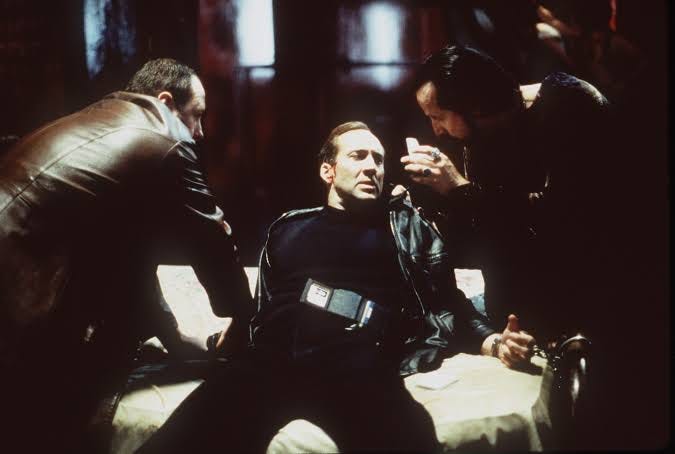
Personally, I was delighted by how thematically dense and politically engaged it was — I too was familiar with the philosophies of The Satanic Bible (remember Rebecca Brown? 💀) prior to watching and, as a result, the film’s, subversive potential was all but screaming at me — but I have to admit that, had I known more about what the film offered before going in, I might’ve lowered my expectations in terms of camp. It’s a shame, because there’s so much to like here! Its opening prologue and early pursuit setup are really fun, and Georgina Campbell’s Jane is a brusque and capable heroine, full of expressive rage. Gavin Polone has a knack for the absurd that really could have lent itself well to Walker’s sensibilities, and I love so much of what Georgina Campbell and her other co-stars are doing in the movie.
I appreciate that it was attempting to do something a little different within the slasher genre, and I can see how most of the ideas could have been successful in other hands, but it frequently felt messy and half-baked. Plenty of slasher movies get by on a sense of silly fun one doesn’t find in Psycho Killer, like it was too self-serious for its own good, too concerned with its own respectful patina to really embrace the gutter as Walker so deftly did. I would have loved a grimier and more unruly slasher engine, more lurid trash energy, and more aggressive misdirection with sharper narrative volatility. Walker has such an incisive ear for over-the-top monologue; his derelict, run-down sets deserve to be fully exploited here. And while that sentiment sounds harsh, I say it as someone who has considerable affection for disreputable midnight horror. I like its texture and personality, and Psycho Killer simply doesn’t have enough of either.
“Inherently conservative” is a descriptor that comes to mind for Psycho Killer and I wonder if that conservativeness, more than anything else, is what made it so “embarrassing” to see walk around in 2026. It’s a purity-respecting, woman-hero-deified, original-sin-hogging, masc-abusing, satanic-panic-baiting id-punishing kind of conservativeness.
Having said that, you’re right to say that a lot of that dated Walkerian element came down to the studio’s mishandling of the film and that there’s something really cool about the fact that it was made at all. I’m not trying to sound like a gatekeeper or say that Psycho Killer doesn’t have a place within that lineage — it obviously does, and I’m grateful that we have it. But I can’t shake the feeling that, whether by accident or design, Psycho Killer is part of a larger conversation about what horror is allowed to be in the homogenized era of modern studio filmmaking.
All in all, I love that you’re so passionate about it, so I’m really excited to see what you have to say in defense of it!
Charlotte: Well, to tie it into your assessment of it, I would actually say its self-seriousness gels quite nicely with the nature of its political engagement. To explain what I mean by that, we need to start swinging between the film and the Satanic Bible for a second here.
Perhaps the single richest thread in the film is the setup/payoff of Jane in a diner booth, having fallen asleep in the middle of some research, only to be woken up by a waitress who refills her coffee mug. The waitress remarks giddily about the new motherhood textbook that Jane has on the table (because Jane, as we find out earlier in the film, is pregnant, and the film dedicates a scene to underlining this fact), and Jane smiles politely. Then the waitress’ face falls nervously when she also sees the Satanic Bible on the table (which Jane is of course researching for her slasher hunt).
That’s the setup. The payoff is when the film ends with the pregnancy plot thread being left totally open.
Most would dismiss this as lazy writing or major studio butchering, but you have to realize that what the Satanic Slasher gets up to is not actual Satanism as according to the Satanic Bible, and he’s in fact the least Satanic character in the entire movie. Thus, Jane studying the Satanic Bible for clues on how to catch him is a complete, utter, counterproductive dead-end; exactly as dead of an end as the pregnancy plot thread turns out to be. There is not a doubt in my mind that the purpose of that setup/payoff was to call attention to the incongruence between the Satanic Slasher’s actions and the Satanic Bible’s doctrine.
And indeed, were one to follow that lone note of discordance to a reading of the Satanic Bible themselves, they’d learn a couple things. First, they’d learn that, according to the Satanic Bible, the act of harming an innocent human being is tantamount to requesting to be destroyed, and the true Satanist is obliged to fulfill that request. Jane becomes a sort of divine Satanic force in this respect; all she can think about is shooting the Slasher, and she defies institutions, conventions, and even the purported bulletproofness of bulletproof glass to destroy this man.
Readers would also learn that one of the broader principles of the Satanic Bible is (and I’m paraphrasing here) the self as God; to maximize pleasure and happiness and indulgence in lockstep with one’s strongest possible will to live. This, of course, makes the act of suicide frowned upon in Satanism, except in cases where it would end extreme physical suffering. Lo and behold, the slasher’s master plan involves committing suicide and getting welcomed into the Kingdom of Hell, which the Satanic Bible also insists isn’t actually a real place.
So not only is Jane more actively Satanic than the slasher, but the actions taken by the slasher are in fact distinctly anti-Satanic. This guy is a really bad Satanist; ditto the “Satanic” mass murderers and the “Satanic” rock bands who inspired him. The false Satanism they and others foolishly practice is in fact the exact propaganda that’s long been peddled by the U.S. government (for lack of a less-reductive entity) since at least the heyday of McCarthyism, and you can of course imagine how bad of a time a kabal of rich pedophiles would have if true Satanism – a faith that claims offending pedophiles and other violent ingrates are begging for a destruction that must be granted – were widely embraced without social scrutiny. Satanic panic spun out of one of the oldest political playbooks out there.
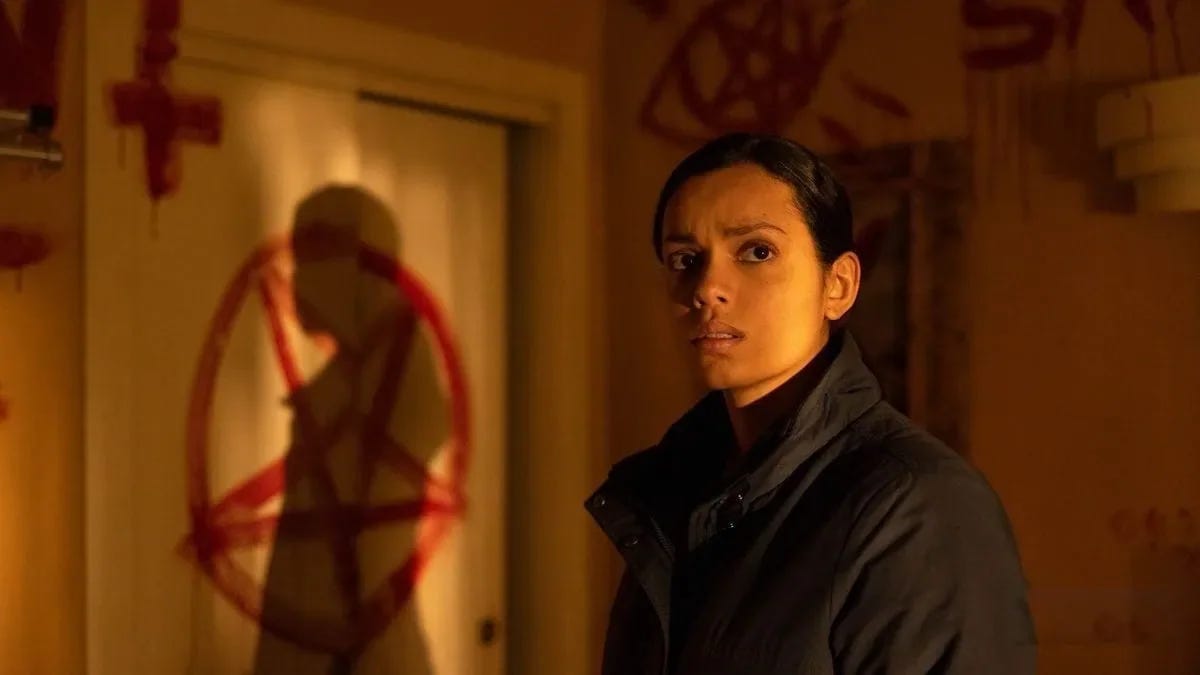
I want to pause here to give you a chance to respond, because this is just the primer for the thematic jungle of Psycho Killer we’re about to dive into here. Having seen Psycho Killer, do you see where I’m going with this? Why I think Andrew Kevin Walker was doing some galaxy-brain storytelling here? Why Hollywood maybe wasn’t too keen on platforming this particular story?
Sophie: I love that reading of the Satanic Slasher’s doctrine, and I do think that Jane’s pregnancy is far more fascinating than her actual motherhood. It’s a symbol of her modesty, containment, and willingness to be a pawn for the state, and I wish the film took it further. To your first question: Mayyyyybe. I know a lot of what you said came from Walker’s signature style, but I still struggle to give him credit for much of this. I can’t help feeling he still had the same puritanical urge, this sense that punishing the sinner would be effective, even ironically, in a world filled with sin. If he was doing this all on purpose then...slay. But Walker’s sensibility produces meaning whether he’s steering it or not. Where I sit is that your reading can be right and he can still be smart by accident.
Walker has a real sickness in him, and he hid it well enough that Hollywood could barely stomach it. He could attach himself to a man like Polone and say: now you make my project sick in the right way. Have my evil women and my evil boys. Funnily enough, it turned out Polone was sick in the same way (just not sure if it was the right way). The director’s intentions are much clearer; The writer’s are much murkier and perhaps this is why I see a disconnect in terms of the script and the end product. I’ll take that murkiness any day of course, even if it’s a shame that Walker never got the chance to clarify.
I agree that the government angle likely made a lot of people uncomfortable — it dared to be a slasher without the showy deaths we expect of the subgenre. That’s just showbiz baby! Boring and dangerous are not mutually exclusive for a studio. When Psycho Killer got to 20th Century Studios it became too intelligent for its own good. (This may sound like a compliment until you realise it’s just a studio saying they didn’t know what shelf it belonged on.)
I also don’t think it’s a movie that wants to exist in the world they want to make. We know Psycho Killer was being set up as the first in a franchise and a sick, demented first movie in a franchise is not what 20th Century Studios wants on its hands. That’s perfect for the vault. Ultimately though, it’s truly, deeply frustrating to see a film like Psycho Killer be so deliberately sidelined, especially because the horror community is much larger and more unique than mainstream media often gives it credit for. Still, I don’t see the film’s commercial failure as a death knell for disreputable midnight horror as much as a glaring exhibition of the mainstream horror community’s refusal to support and celebrate its own.
This all reminds me of the controversy around Andrew Dominik’s Blonde — not the movie itself, which I hated — but the fact that Hollywood seemed scared of it. Blaming Marilyn Monroe for the abuse she suffered, adapting Joyce Carol Oates’ novel about celebrity victimhood, framing everything through a white heteronormative Hollywood lens — that was all the result of a man with something to prove. Dominik wanted to say something, even if it was something horrible and ugly. Hollywood was careful to make sure that something horrible and ugly wouldn’t spread too far or too wide, as if protecting the memory of their eternal victim. Blonde was about protecting the mythologized victim. Psycho Killer is about taking down a mythologized monster. That, I suppose, scares them.
Se7en’s John Doe, on the other hand, is not a mythologized monster. He could work in middle management for all I know! He is whiny, tiresome in his certainty, so airtight in his logic he could be anyone who has ever sent a strongly worded email and meant every word. Walker’s evil has always been the evil of men you recognize, petty, accruing quietly, ordinary in the most skin-crawling way. The Satanic Slasher is enormous, theatrical, grand in a way Walker has spent his entire career refusing to write — and Walker writing him that big feels like what a sensibility does when the industry struggles far too long doing impressions of it. In the 90s the notion used to be: small evil is good, but big evil is better. Walker’s sensibility at its best has always been small evil, evil that’s annoying, mugginess and selfishness and ego all curled up. He’s now scaled up when his signature is templatized. But we now seem to reward small evil more.
On a side note, and I’m completely derailing our conversation here, imagine being Andrew Kevin Walker. You break into Hollywood with one of the most transgressive, disgusting, daring, and beautiful scripts ever written. You give the world Se7en, a movie so undeniably yours it has become shorthand for your entire career — even when they don’t bother attaching your name to it. You write a dark, camp classic in 8MM that has since been forgotten but was, at the time, a massive hit. You hook up with David Fincher, whose movies might be even more Walkerian than Fincher would want to admit. You watch as the ideas and sensibilities that made your early work so electric are turned into an industry template, then a paint-by-numbers project for a streaming service, then a joke. You become the king of being uncredited, of binding yourself to a creative spirit that can never fully be yours. You end up writing The Killer. And then Psycho Killer, finally, after everything.
This leads me to the bigger question I want us to grapple with: What happens to a writer’s sensibility once other people keep finishing his work without him steering it? Is that collapse, or just the ordinary math the industry eventually runs on writers? Something like Psycho Killer — which obviously wasn’t made with the same love and care that went into Se7en or 8MM — feels like the inevitable result of having a walking industrial brand, the “Andrew Kevin Walker” sensibility commercially exploited until people became so disillusioned with it they’d rather it didn’t exist at all. Artistically violent and cruel, even if it is the practical reality of running a business. Walker has become the writer studios and producers think they’re hiring every time they ask for “dark” or “psychosexual.” I don’t think they’ve ever really understood Walker, which means they’re destined to keep disappointing him. Psycho Killer feels like a product of someone who doesn’t exist anymore.
Charlotte: Well first I would say that human beings are, fundamentally, smart by accident. And when we correctly identify intelligence — and it’s common for us to incorrectly do so — it’s often simply a case of somebody being deeply fluent in themselves. I think Walker has this fluency, but I don’t think a puritanical urge is a key kernel of the equation.
With Se7en, he seems less interested in punishing the sinner and more in observing how the prospective anonymity of the city — which he and Fincher were also careful to highlight the decadence of — creates an environment conducive to a hyperfixation on the self, which can lead to the empowerment of vice and sin if one isn’t careful; Satanic-coded indulgence to the point of deeply non-Satanic self-destruction, if you will. This anonymity thread is further compounded by John Doe being… well, named John Doe, but also simultaneously being the catalyst for the antihumanist tragedies dotting the film’s plot – anonymity (John Doe), throttling sin to the point of death.
Meanwhile, two of Somerset’s and Mills’s key lifelines in the case come from distinctly human cooperation against the very institutions that make up this city. Somerset’s colleagues point him in the right direction to books that the government doesn’t want him to have, and Mills pays a homeless lady to give a statement to the police that covers his and Somerset’s deviation from the police rulebook.
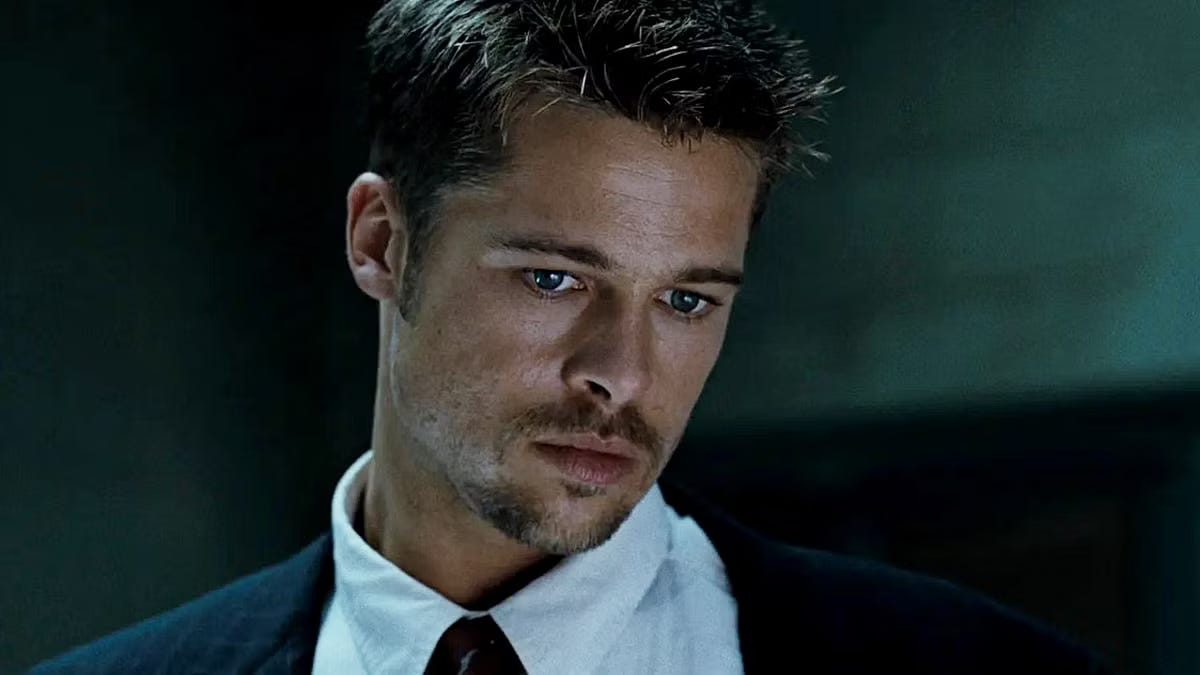
In these ways, the city’s anonymity becomes a test; do you embrace and abuse it with passive and even fatal irresponsibility, or do you rise to the occasion and commit to seeing yourself as a person while also stepping outside the parameters of anonymity to see others as people, too? Or are you a John Doe who declares yourself a homunculus of God’s omniscience, dissolving the spectre of anonymity without any commitment to the human element, and thus only letting yourself see sin, ruinously uncontextualized by its non-violent pleasures?
Anyway, I agree that Psycho Killer is definitely not a movie that wants to exist in the world that Hollywood wants to make. I mean, a story about a killer — hopped up on Western medicine and whose rampage is constantly sensationalized in this proto-clickfarming media landscape (even a jazz station puts aside its culturally nutritious programming to talk about this guy) — who is hellbent on “opening the gate” via nuclear catastrophe, and whose “Satanism” isn’t actually Satanism at all, but in fact a false interpretation of the religion that, if its actualities were truly embraced, would mean literal open season on billionaire pedophiles (who, let me remind you, have proximity to nuclear codes)? And as if that weren’t enough, the film ends with the FBI insisting that the killer is now dead, and the media sensationalism moves from the Satanic Slasher to the Three Mile Island incident; indicative of a sociocultural apparatus that once paralyzed the masses with Satanic panic and is now moving onto anxieties resembling those under something like the Cuban missile crisis, whose truths found themselves similarly butchered in the transmission from mass media to the American zeitgeist.
Finally, of course, we learn that the slasher is actually still alive, and that he’s being held in a top secret facility in Death Valley, throttling our conspiratorial neurons and all but screaming how the Satanic Slasher was a government psy-op, tar-and-feathering a religion whose truths would threaten many guilty wealthy elites, and whose false interpretations so closely mirror their predatory practices.
Tell me one can’t look at all that and draw a parallel with something like the Epstein timeline or that wretched QAnon manifesto, or at least wonder why this specific film got so weirdly bodied by critics and so obviously butchered by the studio. Those reviews seem to have done their job, as — as you’ve said — the horror crowd didn’t end up rallying for this one (although that didn’t stop them from helping the likes of Tarot turn a fat profit). Still, there’s not a doubt in my mind that this will go on to find a lucrative home with someone like Arrow Video. They performed a similar rescue mission on Mike Hodges’s Black Rainbow, if I recall.
(To be clear, I don’t actually, literally believe that Fox/Disney colluded to ensure that Psycho Killer got dumpstered; no cut of this film would amount to a meaningful political powder keg. I just think it’s an interesting metatext expansion for the film’s conspiracy-heavy subject matter, though that’s not to say I discourage skepticism around entities as powerful as these.)
Anyway, I love your point about mythologized evil versus non-mythologized evil, because I think the most present real-life evil is a mixture of the two, no? Small, petty, reptilian nodes of bureaucracy whose depraved truths are shielded by a big, carefully-engineered, theatrical evil whose lack of grounding in reality is instrumental in both shielding the small evil and misdirecting challenges against it. Fascist politics in a nutshell. We see a version of this reflected in the Satanic Slasher, actually. If he – this big evil – were grounded in facts, the world around him (perhaps even the Slasher himself) would realize that what he’s doing isn’t actually Satanism; not that that would stop the populace from associating Satanism with wanton murder, of course. For that to happen, facts would actually need to hold some modicum of power in the realm of politics.
To that question in your last paragraph, I suppose that’s just the grand tragedy of unchecked capital: its ability to absorb and repackage, absorb and repackage. Walker proved there was an appetite for gourmet burgers of psychosexuality and dark spiritualism, and Hollywood stuffed those bellies full of vaguely grimy McDonald’s meals; the easily-deployable Walkerbots strutted out as if they could stand in for the bells and whistles of Walker’s mind.
Perhaps the aura of self-sabotage you sense from Psycho Killer is Walker fighting this machine that was assembled out of his DNA. Even writers who direct their own scripts can find themselves challenged by a similar opponent; I wonder if Shyamalan, for instance, would have found himself with a different career if the cultural obsession with his twist endings had instead been one with his more emotional and elemental storytelling sensibilities? Not that that speaks to any definitive encapsulation of Shyamalan’s career, of course, but…
Sophie: You make a bunch of excellent points, as always! I appreciate your refusal to fully hand Walker that puritanical urge (or sickness, even) despite agreeing that it’s at play.
To your M. Night question: My take on this is that the beginnings of his career would still remain the same — his early films are already both things. The Sixth Sense and Signs had these massive cultural moments where people were chomping at the bit to see the twist. This is why I can’t say for sure that he would have been able to resist the gravitational pull of the industry’s obsession with his “type writing”. From a marketing and financial perspective, it would make sense that studios wanted to lean into that. If I were a studio head, I would obviously want to market my movie as the next “I see dead people” (or “swing away, Merrill”). And that’s not something you can really escape.
Where things would likely shift is the middle. Had people been sold his familiar emotional themes instead of the twists, the critics/audience reaction for more “linear” films such as Lady in the Water or After Earth perhaps wouldn’t have been “but where is the twist?”. I think he did try to shake it at points, and that it may not have been as much of a problem as people have made it out to be. And maybe even if it was a problem, it didn’t come from his own lack of trying to do something different, especially in the second half of his career.
And yes, Walker is in a similar trap, because they shunned him after Se7en harder than Shyamalan ever got shunned. Walker’s wilderness years are a complete act of erasure.
As I’m typing out this response and reading your arguments, I am left pondering: how much of my initial unease towards the film was simply that I expected a Walker film to go lower? How much of it was the inherent contradiction of an artist I admire writing a screenplay that did, in fact, make me feel terrible? How much of the Walker dread originated in this simple fact: in his long, storied career, he hadn’t finished anything that felt like this before. The evil that Walker writes, if not always inescapable, is often self-imposed, and he can’t help but bring you in on his jokes. His many plots and their accompanying horrors are rarely moralistic. Walker has always been a writer who finds honour in temporary dirt, even when that dirt is gory and fantastical. The accusation of the accursed in his works is liberally offset by an intimacy in making you the witness. His propulsive wickedness as a screenwriter is in his insatiable need to give you the last word, the final push.
I had never considered Walker a purposeless punisher, though I agree with you that he has had more fun and less cruelly exaggerated punishment in his other films. Yes, Se7en isn’t purely about punishing sinners, and connecting John Doe’s name to the allegory of his everyman identity makes a lot of sense.
This is part of why I’ve always loved the film. Evil exists in every man. But Walker was so good at that insight, and Hollywood became so consumed with it, that they slowly erased Walker himself from the equation. Even now, as you say, Walker is up against imitations of his own temperament, but the evil that has to contend with him is also Walker-esque. 8MM is a sick film that perfectly captures the Walker condition, but Walker’s temperament there is hidden in a Boy Scout’s costume, and it would reappear a decade and a half later on True Detective in the form of Matthew McConaughey. The imitators never stopped imitating.
Which brings me to my final reflection: I liked The Killer fine, but it frankly felt more like a parody of Walker’s sensibilities than the real deal, and if Psycho Killer is direct proof that American studios don’t know what to do with Walker (and that they don’t want him in the first place), I wonder if there’s any way back for him now that he’s so grossly (and very embarrassingly) been put out to pasture. And in that sense, I actually wonder if we would have seen Psycho Killer die in the manner that it did if The Killer had come out after it, rather than before. The birth and adolescence of Walker’s brand of evil are the truly transgressive parts, and now that they’re stuck in this cycle of imitation, I don’t know what can be done about it. I just hope Walker can escape them all before his next chance comes.
Ahhh this conversation has been so much fun! I feel like we’ve pulled off a trick so few have attempted: talking about Psycho Killer with love and curiosity, as if it’s a special film with a future, rather than just a bomb that was sent to die. You’re one of those wonderful people who, when something is so special that it’s been made to feel embarrassing or shameful, cares enough to try to understand what it means and why it’s that way.
As for where I sit with all of this…I guess the answer is pretty much where we started. I still think Psycho Killer is a disaster in most ways, but you’ve done a brilliant job persuading me to look at the film all wrong, which is to say that you’ve persuaded me to look at it right. I hope that in the coming years it finds the right audience that will cherish it with open arms. (After all, a lot of the films that matter to us now were flops and/or neglected by the very media that patiently awaits our destruction!)
And I agree that it would be a horror nut’s dream to have it in the Arrow Video library. I think it’ll get there one day. It has to. That’s true love.
Any final thoughts?
Charlotte: Yes! Re: pipeline of The Killer-to-Psycho Killer, it’s definitely worth acknowledging that both films are satires; The Killer as a satire of this atomized sector of genre storytelling that Walker and Fincher both frequented and attracted a spotlight (which we now know to have been ominous) to, Psycho Killer as one of the political overton that machines like Hollywood and other institutions are downwind of. Just as the slasher performs Satanism without the Satanism, so too did Hollywood perform Walker without the Walker. It’s a delicious and brutal one-two reaction by Walker to his faux self and to the people that Frankenstein’d it together, if you ask me.
This has been a blast and a half, Sophie; your curiosity is one of if not the foremost TFS staple, so when I found myself as one of perhaps three critics on Earth willing to champion Psycho Killer this early in its none-too-glamorous lifespan, I knew I had to get you in on this. Now, five or ten years later, we’ll be able to say that we were there first, because if Chris Sivertson’s I Know Who Killed Me can arbitrarily go from worst-of-the-year frontrunner in 2007 to misunderstood giallo gem today, I see no reason why Psycho Killer can’t be handed a similar, very deserved metamorphosis.
Anyway, keep walking the walk(er), my friend, and may great things dog those steps!

Want to be featured on That Final Scene and get a free 3-month membership?
I’m always on the hunt for your confessions as part of my Reader Hotline.
You share your most revealing, weird, or controversial takes on films and TV.
I respond and my readers chime in. Think of it as therapy, but I’m not licensed and your thoughts might end up on the internet.
Here’s what I’m looking for:
Plot armor: The show or film that got you through a difficult time.
Spicy take: Your most controversial film opinion that you’ll defend with your life.
Reality check: The film or show that completely rewired your worldview.
Triggered: When something on screen or in the theater hit you unexpectedly hard.
Send your confessions to sophie@thatfinalscene.com or record your voice message on the link below. Everyone who submits gets the free membership, whether I use your story or not. See you in the confessional.
As one of the very few who saw Psycho Killer in theaters, I find this discourse riveting - and coming from two of my favorite Substackers, no less.
This is interesting.
I can't help but feel that for all his influence, AKW is a one hit wonder. I never found 8MM all that good .... In fact, I found it surprisingly tame and boring, too much of it Phoenix and Cage watching something off screen and yelping like parodies of dogs.... And by Wolf Man, AKW had lost me.
I also did not find The Killer very interesting, neither as a modern Le Samurai nor a parody of it. People gushing about "Fincher's tight control and attention to detail" seemed like the old paradox about, if you really loved the editing, was it good editing? (As an editor: yeah sometimes). There was one article about how it was really about "Sigma males" that justify all their weaknesses as strengths, which would comport to much of your discussion above, but even so I just don't get the point of it, particularly how after so much killing the protagonist lets off the Big Cheese with... a stern warning. Like fighting his way to Epstein Island just to say, "A-and don't let me catch ya again or you'll be sorry!" Is this purposeful or is AKW literally unable to threaten the executives?
In fact the thing I found funny about The Killer is you don't need to watch it at all. Seriously, the audio tells you the whole story, in a way beyond the rule of thumb that a good audio mix means the image can be turned off: The Killer is far more a podcast than a movie.
This conversation reminds me a lot of the movie Suspect Zero. There's sort of a want to like Suspect Zero outside the scope of Suspect Zero, because it's weird, and because it's made by the weirdo who made classics like Begotten and Shadow of the Vampire (and, personally, because it was shot in New Mexico and features Carrie Anne Moss). But is it weird because it's "good," or "has something to say" or "subverts our expectations"? Not clear. It might just be weird because Merhige believes film is Magick regardless of whether it's good, meaningful, well performed, etc so forth.
Thanks for the dialog. You two are legend.