



If you’ve been following along here for a while, you know I went to Cannes last year. This year I missed out on all the glamour and chaos because of some very exciting life stuff (all of which will eventually make their way into TFS, I promise).
But I couldn’t let the festival pass without any coverage, so I did something a little scary and a little fun: I announced that I was looking for a writer to be the official Cannes 2026 correspondent for TFS. Thank you all for submitting your pitches!
I’m thrilled to have secured Dan Schindel who got the job done AND captured the wild and wonderful spirit of everyone’s favorite overrated French film festival.
This piece is such a great fit for TFS, and I’m so grateful to Dan for making the time to write it. I’m also endlessly grateful to the paid readers who made this initiative possible. When I started building the community behind TFS, one of my goals was to create a space where readers and writers could support each other to do more of the work they loved. So if you want to see more initiatives like this, please consider upgrading to help me pay for them 💖
Now, to Dan’s expert coverage of the festival’s 79th edition. Enjoy!
“The White Lotus people are here somewhere,” I kept thinking during the week I was at the 2026 Cannes Film Festival. For its fourth season, which is set at the festival, the hit HBO series has set up shop in, among other locations, the Croisette’s historic Hôtel Martinez. I didn’t see any sign of the production while I was in town, but one friend did spot an errant steadicam, and glimpses of shooting have started trickling out. Film festivals are often great attractors for the kinds of people Mike White could have written—monied, image-conscious, and conflicted over the gulf between their professed and practiced values. The beauty of the French Riviera (*No amount of burnout can make the way the sea bands from aquamarine to wine-dark any less breathtaking) and the festival’s reputation make Cannes an ideal White Lotus setting. Time will tell if that actually helps the show find new and interesting ways to explore the themes it’s already been wearing thin after just three seasons.
The most useful structuring idea for my first year attending Cannes came from, of all things, Ron Howard’s aggravatingly cliched biographical documentary of Richard Avedon. Cannes’ nonfiction curation has historically been lacking, to a degree that seriously belies the festival’s general prestige. There might as well be a template for this kind of movie: Open with the least imaginative song you can think of (Spoon’s “I Turn My Camera On,” in this case), put on a slideshow of archival footage and photographs, and have a few talking heads shepherd us along. And yet Richard Avedon’s genius is still powerful enough to grab your attention. In one interview, he said, “I don’t think there will be photographers in the future,” predicting (before social media, mind you) the way the internet would cause image-sharing to metastasize. There are no more photographers because everyone is a photographer.
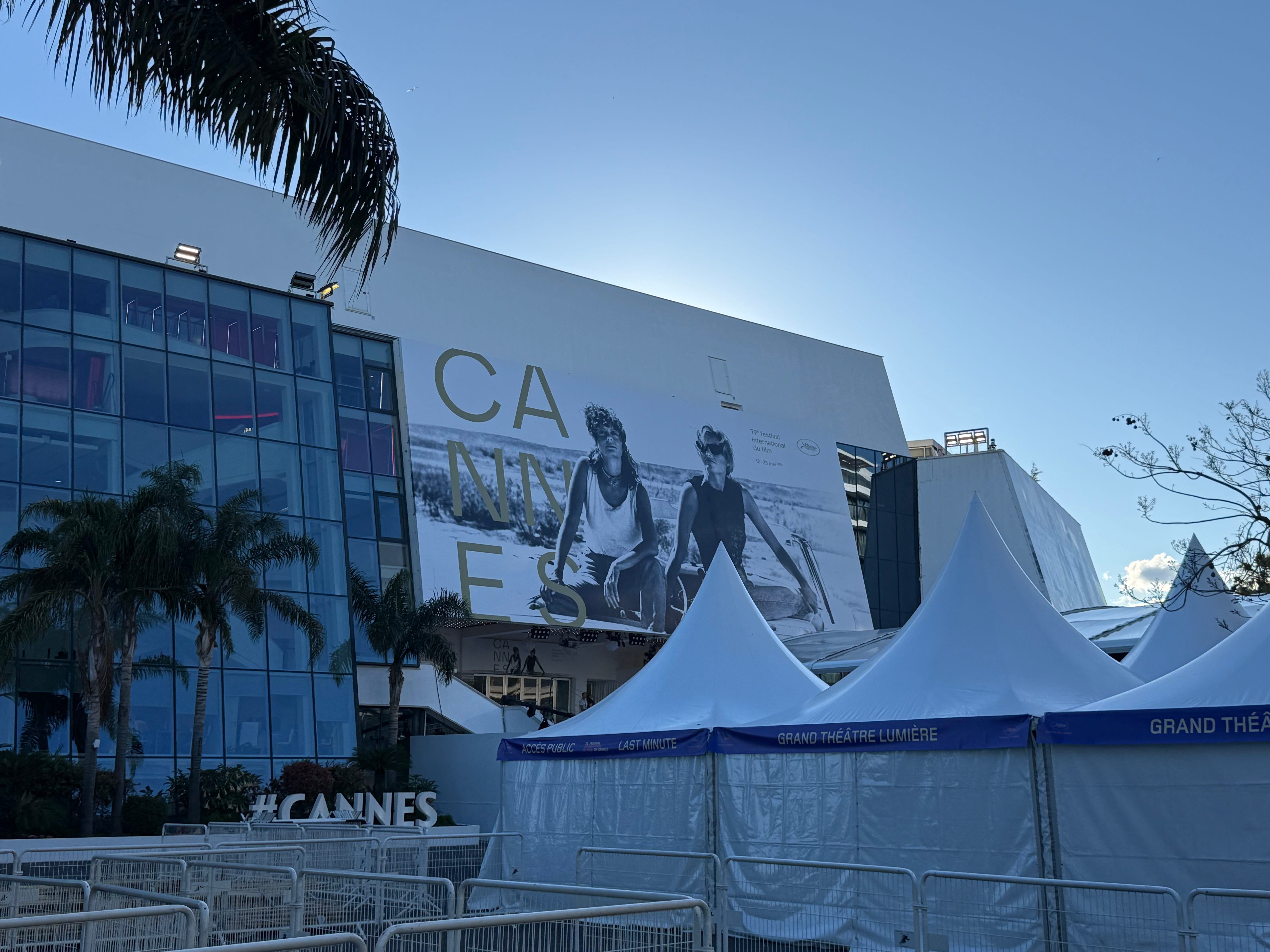
Cannes tries to defy this. It is the last major festival whose prime movers put in place certain guardrails to maintain it as a capital-I Institution. This is why it did not have a digital edition during the COVID-19 lockdowns, why it still refuses to cooperate with Netflix over the platform’s apathy toward theatrical distribution. No other festival’s opening press conference is given so much discursive weight, with participants expected to opine profoundly on The State of Cinema. (*It’s unfortunate, then, that the most memorable part of this year’s opening press conference was Demi Moore, in a beautiful stroke of Actor Brain, signaling her open-mindedness about AI on the basis that “against-ness breeds against-ness.”) Sections of the various venues are rigorously checkpointed to ensure talent, press, and civilians are in their proper places. (*No matter how many times I saw police officers with machine guns, it never stopped being unnerving.) The red carpet leading up the stairs to the Grand Palais has separate entries for different players—photographers enter at one point to fill the bullpens on either side of the aisle, celebrities get dropped off from cars, ticketholders enter from their own queues. It’s an elaborate, rigorous choreography for the stylish images you’ll see in your news feed moments later. Selfies are forbidden on the red carpet, and photography is restricted in other places; I watched a journalist get scolded for attempting to take a picture of the handsome view from the press lounge balcony.
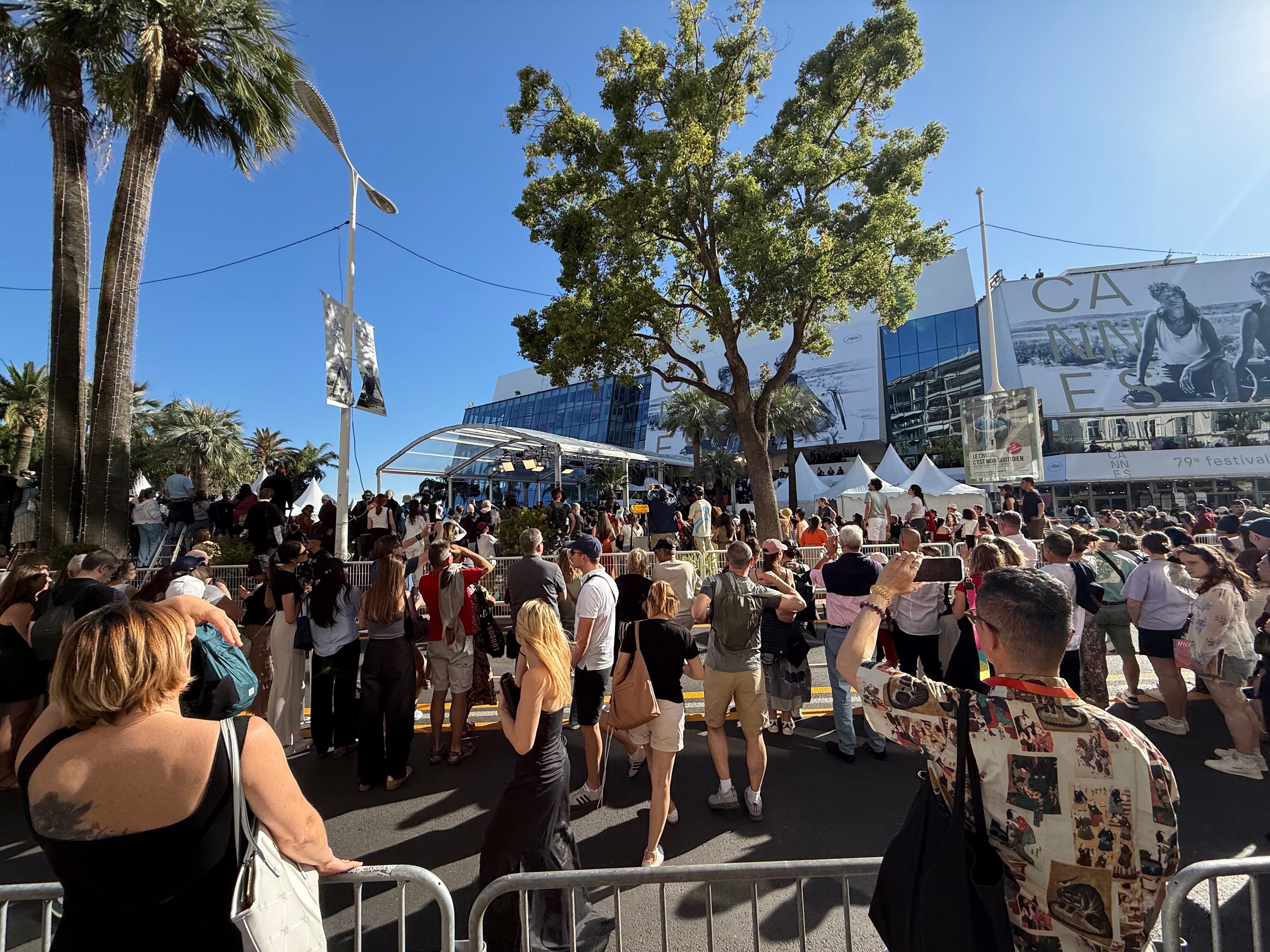
These strictures are easy to mock and, naturally, hard to enforce. Elijah Wood blithely defied the red carpet selfie prohibition on opening night. More pointedly, just outside the official bounds of the festival’s premises, countless people thronging against the metal barriers that turn the Croisette into a labyrinth are gleefully snapping their own pics. (*The festival is also more than capable of puncturing its own mystique, like with kitschy mermaid photocalls.) The proximity not just to celebrity but to the idea of the festival itself is intoxicating for so many. This is in no small part where the 20th-century conception of fame and its glamour were refined. While the parameters around celebrity have changed significantly since Avedon’s day, the clout of Cannes lingers. The festival’s boundaries are almost more important as part of a performance that affirms this perception than they are at serving any practical utility.
The line between media-informed perception and reality is blurred into a pink opaque in Teenage Sex and Death at Camp Miasma, the latest feature from Jane Schoenbrun. Billed as a horror picture, it in truth seldom tries to be scary, despite having slasher films as its focus. Its investigation into the ways media shapes our sense of self is familiar territory for the director of We’re All Going to the World’s Fair and I Saw the TV Glow. But where those films were concerned with how art and the internet affect identity and gender, this one specifically explores desire and eroticism through the Persona-esque tension between Hannah Einbinder’s repressed filmmaker and Gillian Anderson’s sultry, reclusive retired actor. What if the Slasher and the Final Girl are performing a kink? What if the lurid, bloodthirsty gaze of the camera could not just dehumanize and dissociate, but sometimes help you recognize what you want? It’s a heady, talky film that I’ve found more intellectually rigorous the more I’ve thought about it, though the omnipresent scare quotes around the action can be a bit of an obstacle. It’s also gorgeous in its deliberate artificiality, featuring painted backgrounds and sumptuous color work.
The gulf between the real and the imaginary is much starker in Asghar Farhadi’s Parallel Tales. Isabelle Huppert plays a housebound writer who spies on her neighbors and imagines plots for her novels based on what she sees. Due to shenanigans, the sound FX artists across the street get their hands on her manuscript, and reading the sordid love triangle Huppert prescribed them causes them to spiral. This is a drastically reimagined (and punishingly elongated) spin on Kieślowski’s Dekalog: Six / A Short Film About Love, and the first installment in a planned series of adaptations of the Polish auteur’s seminal Ten-Commandments-themed anthology. The project is not off to an auspicious start. Farhadi’s talent is in pitting people against each other in seemingly straightforward situations that grow more complex as he unveils information that dramatically recontextualizes their circumstances. This is instead a spin on the concept of fiction’s capacity to affect people, except the people in question are wincingly stupid.
There is a compelling kernel to Parallel Tales, though, about the self-consciousness that comes with being watched. Amid the paparazzi cameras and cellphones, cinephiles at Cannes are engaging in their own performances. This is a chance to playact at a classical ideal of beauty and chicness. I’m not above this, by the way. In anticipation of my first Cannes, I went to the top-tier menswear boutique Rothmans and purchased two pairs of chino shorts and a dressy T-shirt. Just like everyone else, I wanted to look good in photos. My hubris was punished with constant wind and surprisingly chilly temperatures, which kept me in jeans and a light jacket for most of my week there. Every film festival has its panhandlers outside theaters hoping for spare tickets, but only here are they doing so dressed in formalwear. They hold handmade signs begging in multiple languages for entry to their desired screenings. Or some of them simply want to be in on the action, regardless of the title. I saw one woman with a placard reading N’importe quel film fera l’affaire—“Any movie will do.”
The protagonists of Paper Tiger, brothers played by Miles Teller and Adam Driver, are themselves striving. It’s 1986, and they see an opportunity to cash in on the redevelopment of Brooklyn’s toxic Gowanus Canal with Teller’s engineering know-how and Driver’s cop connections. Unfortunately, they’re movie characters, and chasing the American Dream never works out for those folks—especially if you get in bed with the Russian Mafia. James Gray renders the resulting calamities with characteristic technical precision. The film’s recreation of ’80s NYC is immaculate, and multiple sequences stand out (gunfighters stalking through tall grass in the climax is a real treat), but like a lot of Gray’s work, it worked less for me in practice than it does on paper. He starts with deliberate, magisterial archetypes (this one has an epigraph from Aeschylus), but doesn’t completely hone them into real people.
In contrast, Fatherland sands down real people until they feel like generic Euro arthouse movie characters. Nobel-winning writer Thomas Mann and his family were subject to frequent tumult and so, so many lavender marriages amid Germany’s calamitous 20th century. Paweł Pawlikowski, with his typical formal austerity, elides much of this fascinating history as he puts Mann (Hanns Zischler) and his daughter Erika (Sandra Hüller) on a postwar road trip across both West and East Germany. I have been continually frustrated by the painstaking legibility of Pawlikowski’s work; the Themes are aggressive, crowding out the humanity of his characters and leaving almost no room for the viewer’s own interpretation. What’s left is a pat exploration of lingering fascism and basic Cold War both-sidesist ambivalence.
One facet of Fatherland that resonates is its emphasis on artists whose work has been dramatically eclipsed by both global events and personal tragedy, who feel adrift amongst the pomp different organizations have thrown on for them. Cannes is all pomp, to an overwhelming degree. More than anything else, I was unprepared for how omnipresent the red carpet is. It’s not just leading into the Grand Palais; it’s everywhere, guiding you where to go like hospital floor markings. Female volunteers wear shirtwaist dresses that match the carpet’s blood-orange color. The red carpet is even the main feature of Cannes’ pre-film introductory animation, adorning a glass staircase that rises out of the sea to the stars to the tune of Saint-Saëns’ “Aquarium.” It verges on a specifically French varietal of camp, which means it can still pass as cool for so many people.
The vagaries of hipness are a major theme of Club Kid, in which a veteran New York scenester learns that the one heterosexual encounter of his life a decade prior has produced a child, forcing him to grow up overnight. Jordan Firstman, who wrote, directed, and plays the lead, is one of the more White Lotus-esque figures at this year’s Cannes (*This could be taken either as a pejorative or a compliment, but I assure you it is just an assessment without judgment.), known for adopting a playfully abrasive persona in much of his work, and sometimes in life. The film’s sweatily lived-in depiction of the New York club scene is one of its strongest suits, and the way the protagonist tries vainly to fit his newfound son into it makes for some novel friction—turns out the little guy can DJ!
Community, art, and how one can shape the other is also core to All of a Sudden, the best film I saw at the festival. Ryusuke Hamaguchi is a rare filmmaker who asks for your patience and truly rewards it; this picture runs more than three hours, and I’d have gladly sat with it for longer. Set mainly in a nursing home, many of its characters require close attention and care. Virginie Efira’s character wants to set new standards for such care in place, which chafes against the more mercenary demands of the market. She clarifies her philosophy for the audience through her budding friendship with Tao Okamoto’s terminally ill theatremaker, who becomes the home’s artist in residence and comes up with physical and mental exercises for the residents inspired by theatrical practice. The two freely switch between French and Japanese in conversation; this is a film with bone-deep conviction in humans’ ability to transcend all potential obstacles and connect. From a grammar of simple, careful framing and editing, Hamaguchi again builds a full dialectic of manifold musings about what we owe to each other and how we can fulfill those demands.
After several years of high-profile bidding wars for Competition titles during Cannes, that activity was notably lacking at this year’s iteration. Neon presumably didn’t feel like it had to buy everything in hopes of securing the eventual Palme d’Or winner, since they came in with All of a Sudden, Paper Tiger, Fjord, and more. Club Kid woke things up a bit, with distributors fighting until (who else) A24 acquired it for seven figures. The general mutedness speaks to the greater shrug that’s greeted this year’s festival. There were stirrings about it being a flop year from the time the lineup was announced, and getting to see the movies hasn’t yielded many surprises. No amount of glitz can compensate if the artistic core of your institution isn’t sound.
There have been mutterings about Cannes’ lack of risk-taking in its mainline programming for a while now, how its love of specific auteurs and celebrity generally makes for predictable picks. How much can these returns diminish? All festivals have many industry attendees who will be going to more meetings than films, but it might in fact be possible for the industry element to overwhelm the whole intended purpose of a festival. That happened to Sundance, which has pulled up stakes for Boulder. Cannes won’t be moving anywhere, of course, but who knows where it may go.
Dan Schindel is a freelance writer living in Brooklyn. He is a former associate editor at Hyperallergic, and his work has appeared in Film Comment, Reverse Shot, Documentary Magazine, and more. He has a Substack called It's Been Said.

I appreciated the way the dispatch keeps returning to performance: celebrities performing glamour, cinephiles performing taste, institutions performing authority, and even the city arranging bodies through carpets, queues, and checkpoints. That could easily become only satire, but the piece is more interesting because it sees the serious need underneath the absurdity. Cannes wants cinema to remain an event, not just an upload. Still, the red carpet everywhere becomes a telling image: an institution so committed to preserving aura that aura starts to look like infrastructure. Maybe the future question is not whether Cannes can preserve cinema, but whether it can preserve the difference between cinema and its own ceremony.
just want to point out the mermaid photo calls were for a film called Titanic Ocean by Konstantina Kotzamani, in which the main conceit is that girls go to boarding school to learn to become professional mermaids (although really the film can be read as a metaphor for art/film school in general). It wasn’t just kitschy. It’s a very emotional film.