


One of my first formative experiences in London was in the post office.
It was 2016. I had a package to send.
The man ahead of me let the door go when he was still two feet past it. In Athens this is a small act of violence. You hold the door from six feet, sometimes more; you make eye contact; you perform the sincere mime of I see you, I am a person, we are doing this together. I reached for it with the confidence of someone who has never in her life been left holding nothing. The door swung shut in my face. I stood on the pavement with my arm outstretched, package in hand, looking, I can only imagine, absolutely deranged.
You already know this, even if you've never stood outside a Hackney post office at 11am on a Tuesday in November with a padded envelope addressed to a landlord called Sveta. A woman in a grey coat stepped around me, caught the door with her shoulder, went in. The city had always been hers and her body knew it. I followed her inside, joined the queue, and tried to arrange my face into something that communicated I meant to do that.
Next please, said the man behind the counter. I stepped forward and put my package down and told him where it was going, and he said something I didn't catch. I think he dropped the end of the sentence and swallowed it in a way I hadn't yet learned to anticipate — and I said sorry? He looked up at me with a slight mid-transaction recalibration, and repeated it slowly in the voice1 that English speakers deploy for children and tourists.
I felt my face do something I hadn’t asked it to. A smoothing over. A performance of unbothered, executed automatically by a face that was, in fact, very bothered.
I sent the package. I walked back out onto Mare Street, which smelled of wet concrete and bus exhaust and something sweet and softly rotting from the market stalls2. The grey coat woman was gone. The man who’d let the door go was long gone. And I stood on the pavement in my wrong coat — wrong weight for London cold, which is damp and insinuating rather than the dry declarative cold of Athens, cold that finds the gaps between fabric and skin and installs itself there like a houseguest who has decided the spare room is actually theirs.
I was also in my wrong shoes, which I didn’t know were wrong yet but would discover later in the year, and I thought:
Right. So this is a place I don’t know how to be.
London runs on a grammar that nobody explains because everyone who knows it learned it too long ago to remember it needed learning. I became a student of it the way you become a student of anything being lived inside: from small, humiliating corrections administered by a city too busy to notice it was teaching.
The door distance (there is a correct one; it is not metaphorical; getting it wrong produces a flinch so micro-calibrated that by the time you've registered it, the other person has already decided you're Brazilian).
The queue-face. Rueful, contained, communicating this is absurd and I am above complaining via the coordinated depression of exactly three facial muscles I had to locate on my own face. Fine meaning something other than fine. Not bad meaning rather good. Interesting meaning your idea is a catastrophe and I have decided, specifically, not to tell you this.

I learned to iron the enthusiasm out of my sentences before releasing them into company. This is what I think of now as enthusiasm-laundering, aka the practice of running a feeling through several ironic cycles before presenting it as a considered position. In Athens you announce what you find exciting and people respond in kind or challenge you directly and either way the table gets louder. Everyone is leaning forward simultaneously like a room full of plants turning toward the same window. The warmth is expressed through volume and interruption. You get intimate talking over each other because you physically cannot wait for the other person to stop.
In London, raw enthusiasm lands as a social alarm. People clock it, shift slightly, produce a polite oh, lovely containing a faint but unmistakable note of clinical concern, as though you've disclosed something that requires gentle management rather than a response. Enthusiasm-laundering takes the better part of a year to learn. You know it's worked when the pre-deflated opinion arrives before you've decided to deliver it. The Greek in me still rattles the cage — the look a dog gives a door it could have sworn was open a minute ago — and the Greek in me is also, I now suspect, why I used to say things before I'd finished thinking them.
On the bus home one evening the month after, a woman in the seat ahead was smiling at nothing. She looked at the dark outside the window, visibly inside some private thought that London hadn't interrupted. I noticed she'd just left mentally, gone somewhere else while her body managed the commute. Three stops I watched her, with the focused, slightly desperate ambition of the newly arrived: that. Whatever that is. That's where I'm trying to get.
We're now ten years later. The edges between the years have gone soft in the way that years do when you stop counting them individually and start measuring in lease renewals and dentist switches — I know the doors. I know the platform geometry of every Piccadilly line station well enough to position myself at the exact spot where the doors will open, which is the closest thing to sorcery available to a person in Zone 3. I say lovely as punctuation without hearing myself say it, which is, I would argue, a very successful integration on my end.
I have a GP who calls me "my dear" in a way that is either affectionate or geriatric, I still can't tell. I have a corner shop where the man knows my order and once, unprompted, told me his daughter got into medical school, and I said Oh that's wonderful in a voice so English that I startled myself. I have a Home Office reference number I could tattoo on my forearm, and a filing cabinet's worth of documents proving I am who I say I am to a government that, up untl now, never seemed fully persuaded.
I tried explaining this once to a British friend, in the sixth year, over a pint.
“Isn’t that just called settling in?” he said.
“Yes,” I said. “Exactly. That’s what I’m describing.”
He shook his head and changed the subject. I sensed a mild, total indifference of someone for whom the question had never been interesting because it had never, for a single day in his life, been a question. His belonging predated his memory of acquiring it. He’d always just been in London the way fish are in water — unaware of the medium, completely dependent on it, completely without access to what it actually is. I have come to think of this as a kind of poverty, though it would be obnoxious3 to say so to his face.
Last week, an email arrived from His Majesty's Government. His Majesty's Government, in my experience, communicates with the warmth and frequency of an estranged father who only makes contact when money is involved, so I opened it with hesitation. BUT NO. YOU GUYS NO!
It was an invitation to drum roll British citizenship ceremony.
GUYS I MADE IT.
In a week, I will officially become British.
And since I got that email, I haven’t stopped thinking about a very specific film.
Certified Copy is Abbas Kiarostami’s 2010 film and it contains the most accurate portrait of immigration I have ever seen, which is funny, because it has nothing to do with immigration. It is set in Tuscany and stars Juliette Binoche in a silk dress looking like she was put on this earth specifically to make the rest of us feel underlit.
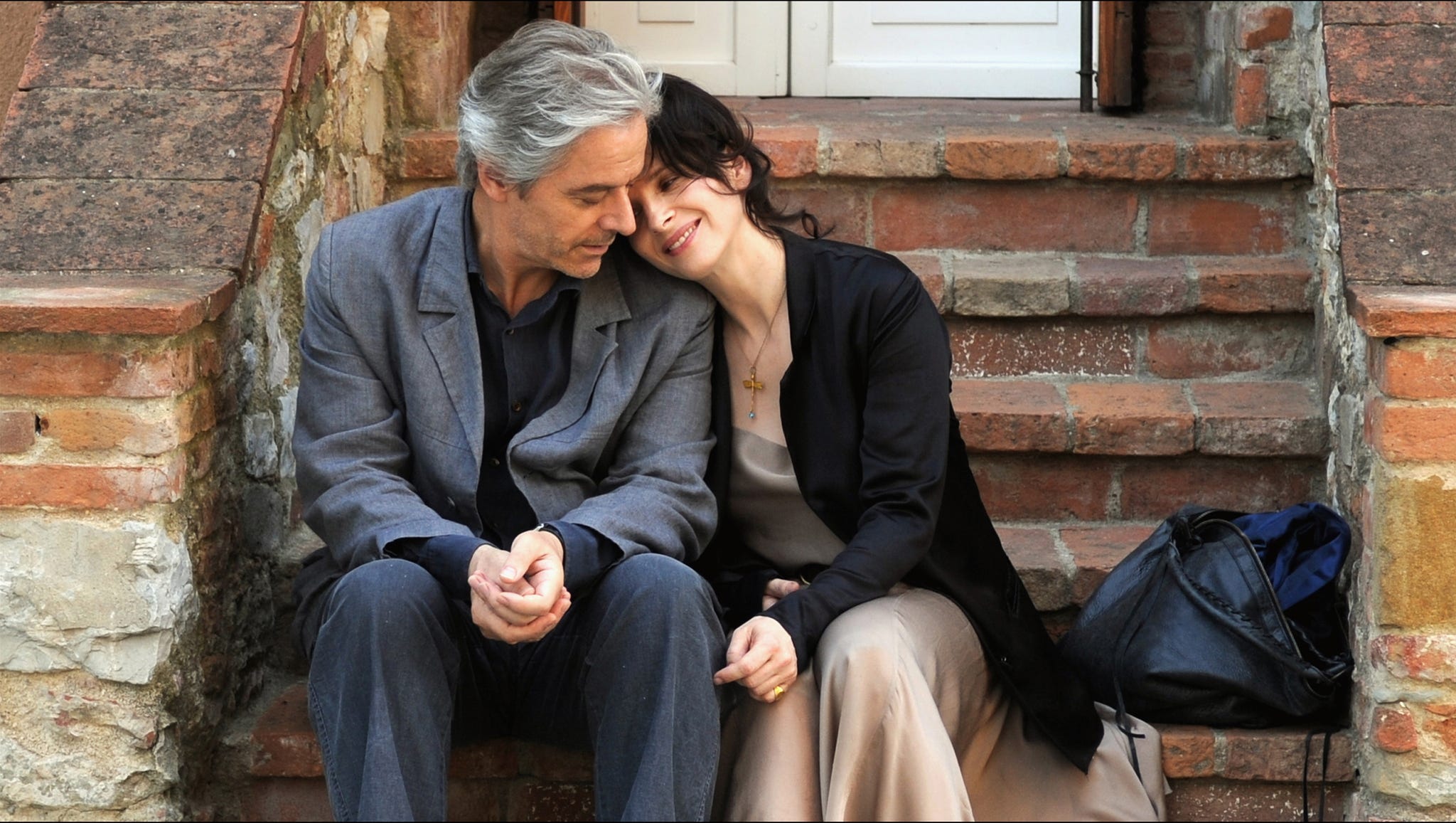
William Shimell plays James Miller, a British author and art historian promoting a book whose thesis is that copies of artworks hold the same value as their originals. Think of it as the plastic Venus de Milo your aunt bought for eight euros near the Louvre, wedged between a dying succulent and a Penguin Classic she picked up at Stansted in 2009. Shimell is an opera baritone in his other life so a Tuscan lecture hall containing thirty-five attendees and one spectacularly bored ten-year-old is unlikely to faze him. The boy belongs to Binoche. You can see him trying to get his mother’s attention convinced that she is about to follow an intellectual into a car and ruin his afternoon.
She does.
They drive into the hills arguing about art. The dream! Two people who fancy each other and have decided to channel it through disagreement (if you’ve dated in London you’ll recognise this as the entire foundation of British courtship). They stop at a café where the owner mistakes them for a married couple, and Binoche lets it stand, and Miller takes a phone call and when he comes back they are married. Fifteen years.
Kiarostami refuses to cut. He refuses to show you the edit, the seam, the moment of transition — one frame they’re strangers performing closeness and the next they’re spouses performing distance and there is nothing between. I felt this. You cannot point to the morning you woke up and the performance had become the person — the bins, the Tesco, the pronunciation of Marylebone that no longer sounds like you’re having a minor stroke. At some point the rehearsal settles into fact. The transition can’t be filmed because it can’t be found, so Kiarostami did the maddest thing. He skipped it altogether.
Binoche excuses herself from dinner and goes to the bathroom and Kiarostami turns the camera into the mirror — she faces us, applying lipstick, trying earrings, taking them off, trying a different pair. She goes back to the table.
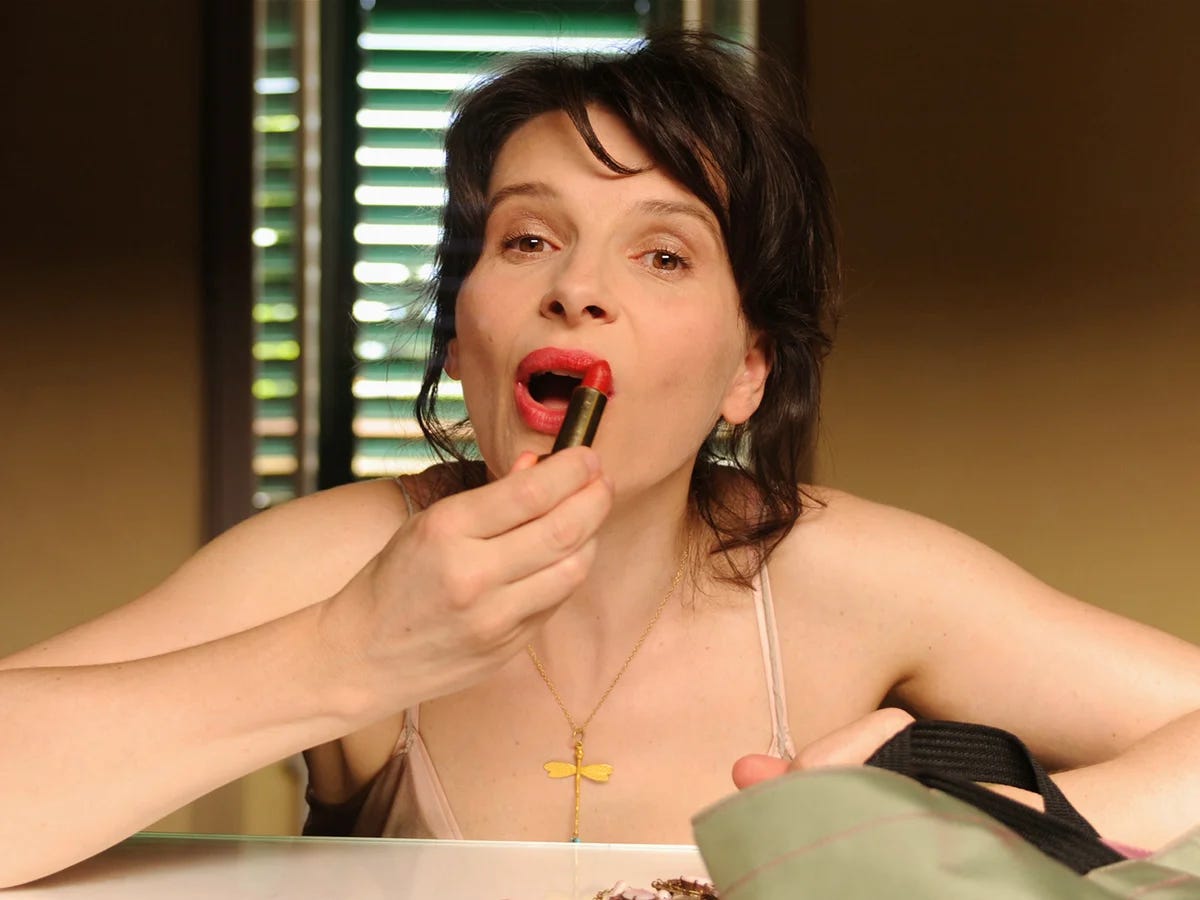
"Look at your wife, who's made herself pretty for you," she tells him.
He ignores the earrings and complains about the wine. I wanted to climb into the screen and shake him by the collar, but then again I have been that woman.
I am that woman.
I have made myself pretty for London. I have made myself pretty for London for ten years. And the reward for getting it right is that nobody can tell you got it right, because getting it right means becoming invisible, and becoming invisible means the effort disappears, and the effort disappearing is realizing that the highest compliment this city will ever pay you is to forget that you weren't always here.
Reupholstering your entire personality involves a certain grief. You can’t become a new person without the old one going quiet, and another thing nobody tells you is that the old one goes quiet the way a child in another room goes quiet. She’s not fine but she’s also stopped asking for attention.
Eventually, you lose your phone voice.
Your mother calls and the first word out of your mouth is English — hello? — and she pauses. Just a fraction. She then answers in your language and you switch to that language and the conversation carries on and neither of you mentions the fraction because mentioning it would make it true. You dream in English for the first time and wake up feeling obscurely guilty, as if your subconscious has been conducting private negotiations with the host country behind your back and forgot to cc you on the minutes.
Someone in the pub asks where are you from? and your mouth opens and the answer takes a second longer than it used to because the answer is now complicated in a way that requires either one word or fifteen minutes. There is no version in between, and by the time you've run this calculation they've said oooooh, I love Santorini! and the moment has closed.
Miller would call this a successful reproduction. I would call it something else but I don't have the word for it because it doesn't exist in Greek or English. Perhaps there are just versions, and the version of me who lands at Athens airport and reverts to Greek volume and Greek hand gestures and orders a coffee in Greek is the same woman who says sorry when someone steps on her foot on the Central line and means it.

Kiarostami tells us both are the original, both are the performance, and you know what? Yes. That. The loneliest thing I know now is that selfhood is constructed daily from whatever materials the city will give you, assembled and reassembled until it coheres, until it holds, and is, therefore, more or less, you.
The film ends on Miller, alone, staring into a bathroom mirror. Church bells at eight, a train at nine. Kiarostami holds the shot and the credits roll and he never tells you whether Miller stays or goes. He died in 2016 and I am fairly confident he timed it specifically so he'd never have to answer questions about this ending at another Q&A.
My mother has asked what I'm wearing to the ceremony four times already. My father said "kopela mou" on the phone and then went quiet for a long time and then cleared his throat and said something about the weather in Athens, which is what Greek fathers do instead of crying and also what they do instead of saying I can hear that you are different now and I love you anyway.
(brief pause as I’m crying typing this….3,2,1, okay we’re back)
I’m going to sit underneath a portrait of Charles looking mildly startled and pledge allegiance and become, on paper, what I’ve been in practice for years. Ten years ago a woman held a door open for me at a post office and I walked through it wrong and she looked at me like I’d arrived from the moon. In a week I’ll walk through another door, this time into a municipal room, and I’ll know exactly how far to hold it for the person behind me.
I should probably figure out what to wear.

Want to be featured on That Final Scene and get a free 3-month membership?
I’m always on the hunt for your confessions as part of my Reader Hotline.
You share your most revealing, weird, or controversial takes on films and TV.
I respond and my readers chime in. Think of it as therapy, but I’m not licensed and your thoughts might end up on the internet.
Here’s what I’m looking for:
Plot armor: The show or film that got you through a difficult time.
Spicy take: Your most controversial film opinion that you’ll defend with your life.
Reality check: The film or show that completely rewired your worldview.
Triggered: When something on screen or in the theater hit you unexpectedly hard.
Send your confessions to sophie@thatfinalscene.com or record your voice message on the link below. Everyone who submits gets the free membership, whether I use your story or not. See you in the confessional.
This is a voice I have since come to think of as the Remedial Tenor, applied here to a person who has been speaking this language since she was nine, who counts it as her second, and who would very much have liked to explain this but somehow couldn’t locate the sentence for it while standing at that specific counter.
Plantain going soft at the edges, or overripe mangoes, or possibly the litter bin three feet to my left which no one appeared to have emptied since the previous government.
This is also completely obnoxious to put in an essay. I am Greek. We do not let a good point go unmade simply because it might cause mild social discomfort at dinner.
"I learned to iron the enthusiasm out of my sentences before releasing them into company. This is what I think of now as enthusiasm-laundering, aka the practice of running a feeling through several ironic cycles before presenting it as a considered position."
This is one of the things I detest most about British culture and being a Brit (or half of one). I don’t think it’s just a London thing. It's beaten into you psychologically and sometimes physically; a process that starts in the first year after moving from primary to comprehensive school, when the insecurity and cruelty of early adolescence imbues a Lord of the Flies-esque environment.
Suddenly, any exclamation of enthusiasm, creativity or ostentatious pleasure is subject to ridicule, and unwritten hierarchies of power are asserted. Because everyone is desperate to have friends and fit in, the sense of innocent exuberance needs to be locked away in the dungeon of cynicism and apathy.
Maybe this is exacerbated by the fusion of shit weather and the class system as a whole, which underpins this socialisation. Certain events, usually sporting, are moments of temporary hiatus. The 2012 Olympics are a good example. The misery-mongering in the lead-up to the event dissipated and was overtaken (in the main) by a swelling public sense of national self-love and excitement. This happens if the England football team performs well at a tournament. But when they invariably crash out, the disappointment metastasises immediately into pessimism, and even violence.
At the risk of making this party political, and acknowledging this was a lifetime ago, but it was back in post-97 Cool Britannia, that was the last time I remember that there was a national renewal of cultural self-confidence. But that ended with thorough disillusionment.
Maybe I’m over-stating it, but having Spanish heritage, I saw a big difference in the dynamics of self-articulation in my Iberian cousins and their social circles. And I was always very jealous.
In many ways, being an adult in the UK is an exercise in finding people with whom you are happy to share a sense of freedom. But after decades, it seems of doom treadmill - post 9/11 war on terror, financial crash, austerity, Brexit, COVID-19, the current political malaise, technology turning us simultaneously into dopamine zombies and economically obsolete – it is hard to see where any form of positive reimagination of British identity comes from.
Apologies, that got a bit out of hand.
Tough morning. And I realise that the above is perhaps feeding the very thing I’m decrying.
Great read as always, and congrats on the British citizenship. And London in the spring warmth is wonderful.
May I just say how absolutely beautifully you write. This was such a joy to read! The paragraph, 'I made myself pretty for London' slayed me -- and gives voice so perfectly, so... gracefully, to those complex and huge feelings and experiences of never really fitting in and/or being out of place.
Congratulations on your ability to articulate the inexpressible, managing to evoke emotion without sentimentality and many congratulations on your citizenship too!